
TPS-DMOEA: Bridging History and Adaptation in Dynamic Multi-Objective Optimization
Improved Population Prediction Strategy for Dynamic Multi-Objective Optimization Algorithms Using Transfer Learning
The paper introduces TPS-DMOEA, a hybrid dynamic multi-objective evolutionary algorithm that combines Population Prediction Strategy (PPS) with Transfer Component Analysis (TCA). By integrating AR-model-based time-series prediction with transfer learning, it achieves state-of-the-art performance in tracking moving Pareto-optimal sets across dynamic environments.
TL;DR
In dynamic multi-objective optimization (DMOPs), the goal is to track a moving target—the Pareto-Optimal Set (POS)—as the environment changes over time. This paper introduces TPS-DMOEA, a novel framework that combines the historical depth of Population Prediction Strategy (PPS) with the distribution-alignment power of Transfer Learning (Tr-DMOEA). By predicting a rough population and then "correcting" it via transfer learning, the algorithm finds optimal solutions faster and more accurately than previous SOTA methods.
The Challenge: Why Tracking is Hard
In a dynamic environment, the objective functions change at every time step . Traditional evolutionary algorithms are often too slow to "re-learn" the new environment from scratch. We have two classic schools of thought:
- The Historians (PPS): They use time-series models (like AR) to guess where the center of the population is going based on where it has been. Problem: They are blind to sudden "shocks" or non-linear jumps in the early stages.
- The Translators (Tr-DMOEA): They use Transfer Component Analysis (TCA) to find a mathematical "bridge" between the old environment and the new one. Problem: They are computationally heavy and ignore the rich history beyond the immediate previous step.
Methodology: The Best of Both Worlds
TPS-DMOEA proposes a pipeline that treats the prediction as a "draft" and the transfer learning as an "editor."
Step 1: Generating the "Draft" (PPS Strategy)
The algorithm decomposes the optimal solution set into a center point () and a manifold (). It uses a -order Autoregressive (AR) model to predict the next center point: This leverages up to steps of history to provide a physically intuitive direction for the population's movement.
Step 2: The "Editor" (TCA-based Modification)
Instead of randomly sampling to find a transfer mapping (as in standard Tr-DMOEA), TPS-DMOEA calculates a projection using the predicted population and the previous optimal population . It minimizes the Maximum Mean Discrepancy (MMD) in a Reproducing Kernel Hilbert Space (RKHS).
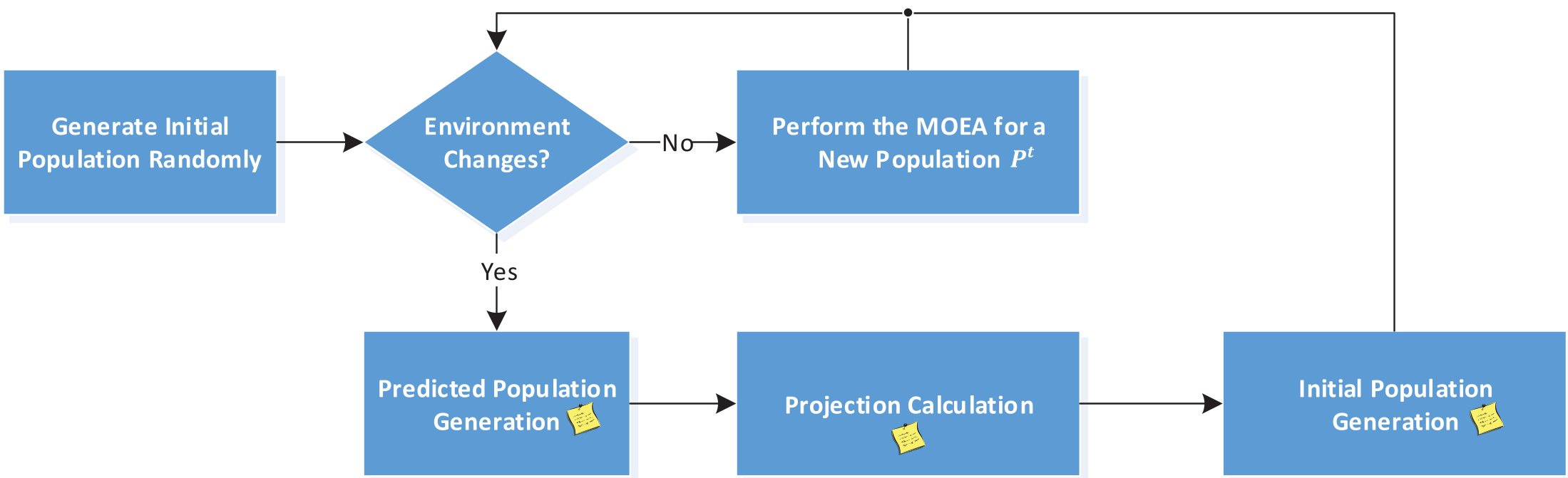 Fig 1: The flow of TPS-DMOEA, showing the interaction between the MOEA core and the prediction/modification modules.
Experimental Validation
The authors tested the algorithm on the F1-F10 benchmark suite. Using RM-MEDA as the base optimizer, TPS-RMMEDA was compared against the original PPS and Tr-DMOEA architectures.
Performance Highlights:
- Dominance: In 8 out of 10 problems, TPS-DMOEA achieved significantly lower Mean IGD (Inverted Generational Distance), indicating a closer and more uniform approximation of the true Pareto Front.
- Robustness: As shown in the IGD-over-time plots, the proposed method recovers from environmental changes much faster than its predecessors.
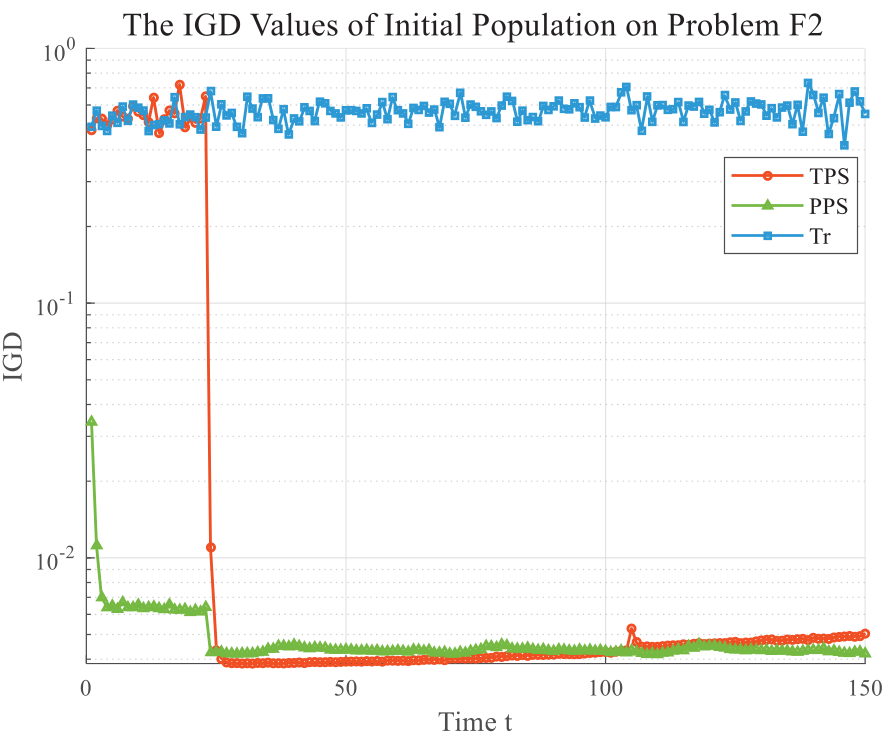 Fig 2: IGD values across different environmental changes. Note the stability of the blue line (TPS-DMOEA) compared to the fluctuations of the others.
Deep Insight: Why Does It Work?
The genius of this approach lies in sampling efficiency. Standard transfer learning for DMOPs often samples the entire objective space to find a mapping, which is like trying to map an entire country just to find a path between two cities. TPS-DMOEA focuses the "transfer" only on the optimal objective domain. By using the predicted population as the starting point for the transfer, it avoids the "negative transfer" that occurs when the mapping is built on irrelevant, non-optimal regions of the search space.
Conclusion & Future Directions
TPS-DMOEA proves that combining time-series prediction with domain adaptation is a powerful paradigm for dynamic optimization. However, the authors note two limitations:
- Complexity: Searching for solutions via TCA is still more expensive than simple AR prediction.
- Static DPOS: In cases where the optimal solutions in decision space don't move (Fixed DPOS, changing DPOF), the transfer step can actually introduce noise (negative transfer).
Future research will likely focus on adaptive selection mechanisms—knowing when to trust the prediction and when to apply the transfer correction.
Takeaway for the Industry
For practitioners in dynamic fields like autonomous warehouse routing or real-time smart grid balancing, this paper suggests that your "prediction" systems shouldn't just look at historical trends; they need a "transfer" layer to adapt to the specific distribution shifts of the new environment.