
Scaling Privacy: Optimizing k-Degree Anonymity for Massive Social Networks
An Improved Privacy Preserving Algorithm for Publishing Social Network Data
The paper proposes an improved privacy-preserving algorithm for social network data publishing based on the k-degree anonymity model. It introduces a novel Max Neighbor Difference partitioning method and a hybrid edge/vertex addition strategy to ensure privacy while maintaining high data utility and computational efficiency.
TL;DR
Releasing social network data is a privacy minefield where even "anonymous" graphs can leak identities through structural signatures like node degrees. This paper presents an improved algorithm for k-degree anonymity that achieves linear-time performance () and significantly reduces the "noise" (modification cost) added to the graph, making it feasible to protect networks with millions of users while keeping the data useful for researchers.
Context: The Vulnerability of Graph Structure
In the realm of social data, removing names is not enough. If an adversary knows you have exactly 47 friends, and only one person in a "de-identified" dataset has a degree of 47, your entire ego-centric network is compromised. The k-degree anonymity model solves this by ensuring that for every node degree in the graph, there are at least other nodes sharing that same degree.
The challenge? Finding the minimal set of changes (edge additions or deletions) to reach this state is computationally expensive and can destroy the network's mathematical properties (like "Small World" characteristics).
The Problem & Motivation
Previous approaches, most notably the work by Liu and Terzi, relied on complex Dynamic Programming (DP) for sequence partitioning and a "Greedy_Swap" method for graph construction. These methods faced three primary hurdles:
- Complexity: High-degree sequences made the DP approach slow for large-scale data.
- Information Loss: The reconstruction process often deleted original edges or added too many unnecessary ones.
- Instability: They often failed to produce a "realizable" graph on the first try, requiring multiple iterations.
Methodology: Precision Partitioning and Hybrid Construction
1. Max Neighbor Difference Partitioning
The authors' core insight is that the optimal "groups" for anonymity usually form around natural gaps in the degree sequence. They propose a Max Neighbor Difference condition:
- Instead of exhaustive DP, they use a greedy approach to find the largest jumps in degrees.
- They constrain group sizes between and , ensuring no group is unnecessarily large (which would increase modification costs).
2. The Two-Stage Construction Strategy
Instead of rebuilding the graph from scratch, the authors modify the existing one through a priority-based system:
- Edge Addition: To increase a node's degree to the target k-anonymous value, they connect it to nodes that are "closest" in terms of path length but not yet connected. This preserves the local community structure (Clustering Coefficient).
- Vertex Addition: If edge additions alone cannot satisfy the degree requirement (due to the graph becoming a complete graph or other constraints), the algorithm adds a minimal number of "noise" vertices.
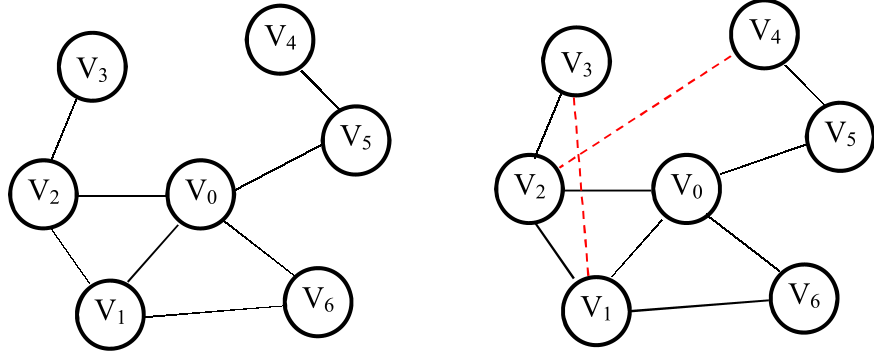 Figure: The transformation from an original graph (a) to a 3-degree-anonymous version (b) using minimal edges.
Experiments & Results
The researchers tested their algorithm across diverse datasets: Facebook (social), Citation (academic), and GRQC (collaboration).
- Data Utility: The Clustering Coefficient (CC) and Average Path Length (APL) remained remarkably stable even as increased to 40. This means the "social" nature of the graph was preserved.
- Scalability: On the YouTube dataset (1.1 Million nodes), the algorithm completed the task in roughly 123 seconds. This is a massive leap over previous methods that struggled with sub-100k node graphs.
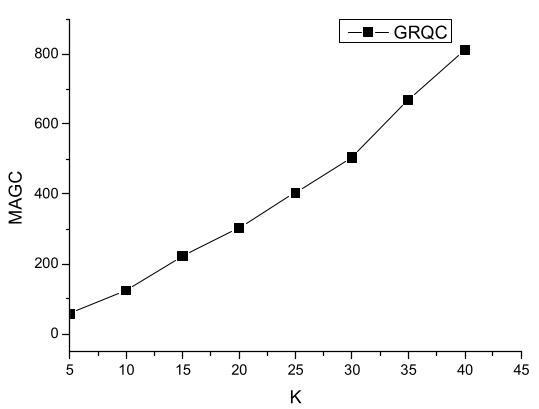 Figure: The Partition Cost (PC) compared against baseline greedy methods, showing consistent improvements in efficiency.
Critical Analysis & Conclusion
Takeaway
The shift from "let's rebuild the graph" to "let's strategically patch the graph" is the winning move here. By utilizing the Max Neighbor Difference, the authors align their algorithm with the inherent distribution of real-world power-law degree sequences.
Limitations
- Knowledge Coverage: The model assumes the adversary only knows the degree of the target. If the adversary knows sub-graph structures (e.g., "my target is part of a 4-node clique"), this method may still be vulnerable to structural re-identification.
- Edge Add-Only: The authors restrict modifications to additions only. While this preserves existing relationships, it could potentially bias certain network analysis metrics that are sensitive to density.
Future Outlook
As social networks grow, the "privacy-utility trade-off" becomes harder to balance. The next frontier involves Multi-Dimension Anonymity, where degree, link, and attribute privacy are protected simultaneously without turning the data into unusable noise.