
ISUED: Elevating Business Intelligence through Multi-Dimensional Tweet Analysis
Improved Sentiment Urgency Emotion Detection for Business Intelligence
This paper introduces the Improved Sentiment Urgency Emotion Detection (ISUED) model, a multi-classifier system built on the Multinomial Naive Bayes algorithm. Designed for Business Intelligence, it simultaneously categorizes social media text into sentiment, urgency, and specific emotion classes, achieving an improved accuracy of 73% and an F1 score of 77% on real-world retail datasets.
TL;DR
In the fast-paced world of social media, knowing a customer is "unhappy" isn't enough—you need to know if they are "angry" and if their issue is "urgent." This paper presents ISUED (Improved Sentiment Urgency Emotion Detection), a Multinomial Naive Bayes-based model that achieves a 77% F1 score by simultaneously classifying sentiment, urgency, and emotion to help businesses prioritize their responses.
Background Positioning
While social media mining has been a staple of Business Intelligence (BI) for a decade, most tools are "sentiment-heavy and context-light." This research moves beyond binary (Positive/Negative) analysis, positioning itself as a practical optimization in the Text Categorization space specifically for the B2B and retail sectors.
Problem & Motivation: The "Silence" in Sentiment Analysis
Traditional sentiment analysis often misses the "call to action." A tweet saying "The milk I bought today is expired" is negative, but more importantly, it is highly urgent.
The authors identify two core challenges:
- Implicit Emotions: Feelings are often triggered by specific circumstances rather than explicit keywords, making simple dictionary-based methods fail.
- Urgency Prioritization: Businesses need a way to rank pending concerns to manage customer service resources effectively.
Methodology: The ISUED Architecture
The core of ISUED is built on the Multinomial Naive Bayes algorithm. While many modern researchers jump straight to Transformers, the authors choose Naive Bayes for its efficiency and effectiveness in text classification using the Frequency Estimate (FE) method.
Key Technical Components:
- N-gram Integration: The model uses both Unigrams (single words) and Bigrams (two-word terms) to capture context better than single keywords.
- Three-Pillar Classification: Unlike standard models, ISUED processes 15 distinct categories across sentiment, urgency, and emotion (e.g., Happiness, Worry, Hate, Complaint, Pricing).
- Training Loop: The model was fine-tuned using 735 manually labeled tweets from diverse business accounts to calibrate its probabilistic parameters.
 Fig 1: The keyword list generated during training shows how the model correlates specific terms with business-relevant categories.
Experiments & Results: Real-World Validation
The model was tested on a dataset of 2,795 tweets mentioning a major UK supermarket chain.
Quantitative Success:
- Accuracy: Lifted to 73%.
- F1 Score: Reached 77%, indicating a strong balance between Precision and Recall.
- Coverage: The "Uncategorized" tweet rate dropped to a mere 0.61%, significantly outperforming the previous version of the model.
Business Categorization Breakdown:
The model successfully identified "Feedback" as the dominant category, followed by "Positive Feedback" and "Complaints." Crucially, it assigned Confidence Values to each, allowing human agents to focus on high-confidence, high-urgency complaints first.
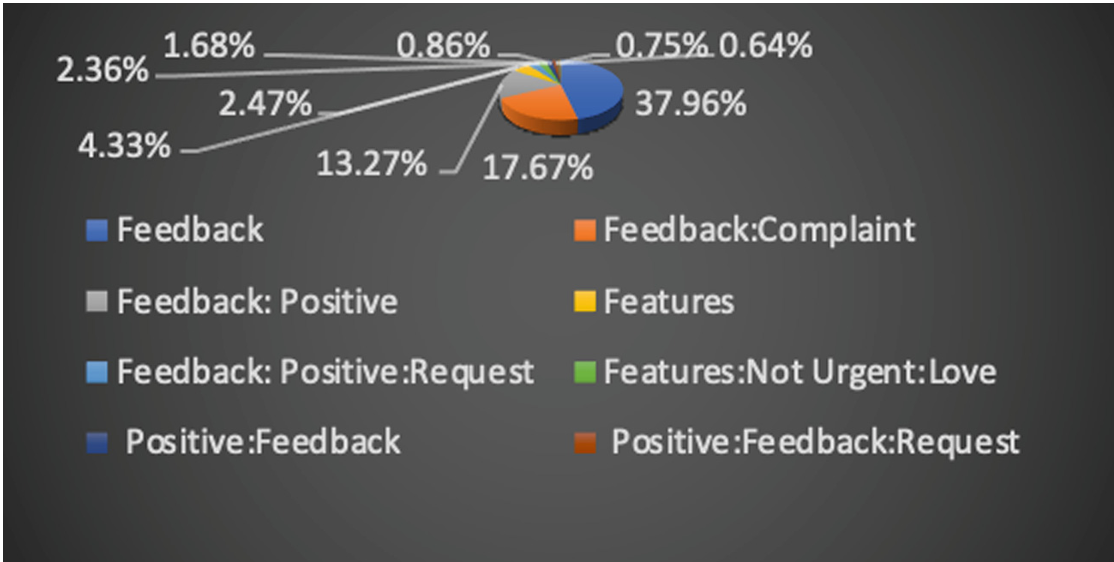 Fig 2: The distribution of tweets across the top 10 categories, providing actionable distribution data for stakeholders.
Deep Insight & Conclusion
The ISUED model proves that you don't always need the most computationally "heavy" model (like a GPT-4 or large-scale Transformer) to achieve high-impact business results. By intelligently combining sentiment with urgency and emotion using a robust Naive Bayes framework, businesses can transform a chaotic stream of tweets into a prioritized task list.
Limitations: The authors acknowledge that about 1% of the dataset still showed "irrelevant confidence numbers," likely due to the inherent noise, sarcasm, or "false positives" often found in Twitter's informal linguistic structure.
Future Outlook: The next step for this technology is Temporal Monitoring—analyzing how these urgency and emotion levels fluctuate over time (e.g., during a product launch or a PR crisis) to provide dynamic, predictive business intelligence.