
Social Networked Curricula: Bridging the Gap Between Engagement and Education
Improvement of Students Curricula in Educational Environments by Means of Online Communities and Social Networks
This paper introduces a cloud-based architectural framework that integrates social networking dynamics into formal educational curricula. It proposes the use of "Educative Patterns" and a system called CSchool to transform traditional learning activities into collaborative online community experiences, facilitating better student engagement and monitoring.
TL;DR
This research tackles the "distraction vs. education" dilemma by proposing a cloud-based architecture that transforms academic curricula into social networking patterns. Instead of banned platforms like Facebook, the authors introduce a system where learning activities function as collaborative "objects," allowing students to interact, share, and process information in a familiar social-media-style environment while providing teachers with robust monitoring and reporting tools.
Background & Motivation: The "Tuenti" Paradox
Younger generations are digital natives, with nearly 94% of those aged 16-35 deeply integrated into mobile social networks. However, most schools treat these platforms as enemies of productivity. The authors argue that the problem isn't social networking itself, but the lack of an educational-first architecture.
The motivation is clear: Educators need to capture student attention by migrating from "static, structured programming" to "dynamic learning networks," where passion and peer support drive the learning process outside the constraints of classroom hours.
Methodology: The Cloud of Educative Patterns
The core of the proposal is not building a new social network from scratch, but creating a Cloud of Patterns. These patterns represent the lifecycle of a learning unit:
- Data Collection: Training students to filter and search for information.
- Processing: Structuring data to meet specific goals.
- Sharing: Collaborative viewing of information within peer groups.
- Treatment: Synthesis and formatting for final presentation.
- Presentation: Executing the final delivery of the content.
System Architecture
The architecture is built on a hybrid cloud model using XML-based data structures. It allows interoperability between school management software (like CSchool) and mobile devices via Web Services.
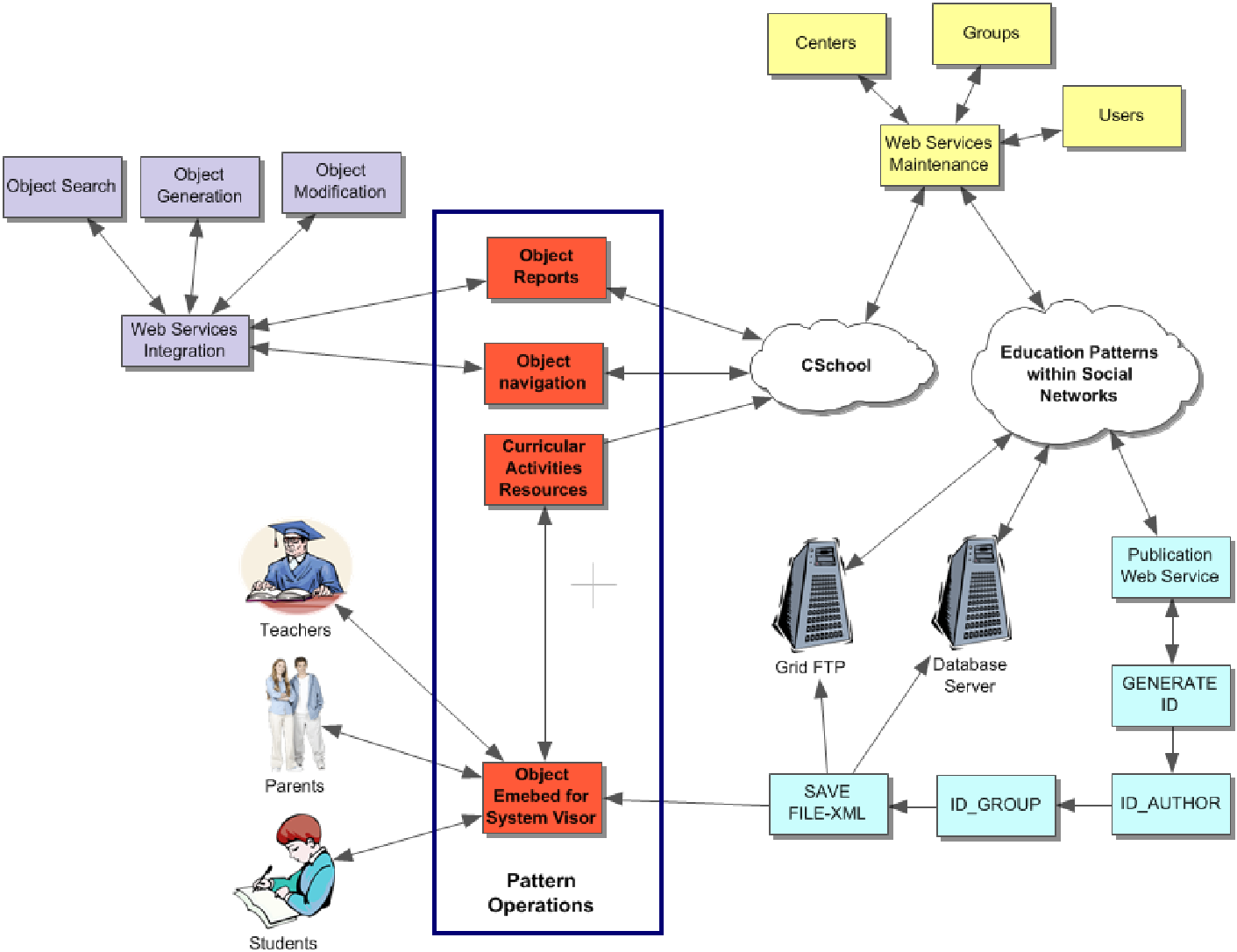
The brilliance of this design lies in its Embedded Objects. The cloud manages the "relationships" and the "activity logic," while the actual user data remains within the school's private domain, addressing privacy concerns.
Implementation: A Case Study in "Knowledge of the Environment"
The authors validated their model through a 5th-grade activity called "Going on a Tour."
- The Workflow: Students took photos of local wildlife (Data Collection), searched Wikipedia for species IDs (Information Processing), and shared these findings in a communal digital pool (Information Sharing).
- The Result: The teacher monitored these "objects" in real-time, assigning grades for specific competencies within each pattern. Once the "timeline" concluded, the system automatically generated a report for parents, linking field-trip fun with measurable academic outcomes.
Critical Insight: It's Not a Social Network, It's a "Network of Patterns"
A significant hurdle identified in the study was the negative bias teachers had toward the term "social network." By reframing the technology as a "Networking of Patterns," the authors successfully introduced social features—such as timelines, object sharing, and digital collaboration—without the baggage of traditional social media.
Conclusion & Future Horizon
The paper effectively demonstrates that the future of the "Student Curriculum" is not a PDF or a physical textbook, but a living, social entity.
Key Takeaways for Future Tech:
- Intelligent Agents: The authors foresee using AI/Agents to analyze these patterns and suggest which learning goals require modification for specific students.
- Personalization: Moving toward an "Adaptive Curriculum" where the social interactions of the student dictate the next logical step in their educational journey.
While the paper focuses on primary education, this framework of Object-Oriented Learning Patterns is highly applicable to corporate training and higher education, where collaborative problem-solving is the primary learning objective.