
Beyond the Global Dictionary: Leveraging Local Lexicons for Better Tag Recommendations
Improving Collaborative Tag Recommendation by Using Local Lexicon in Social Comment Contex
This paper introduces a novel collaborative tag recommendation strategy specifically designed for narrow folksonomies (like Flickr) by leveraging "Social Comment Context." It utilizes K-Nearest Neighbor (KNN) to identify users with similar interests and employs a local lexicon co-occurrence model boosted by user prestige to outperform global recommendation approaches.
TL;DR
In the world of social media, not all tagging systems are created equal. While platforms like Delicious (broad folksonomies) benefit from many eyes on one resource, platforms like Flickr (narrow folksonomies) suffer from sparse metadata. This paper proposes a transition from global tag statistics to local social contexts. By analyzing who comments on whose photos and identifying "high-prestige" users within specific interest clusters, the proposed system significantly boosts the accuracy of tag suggestions.
The Problem: The Sparse Vocabulary of Narrow Folksonomies
In a "Broad Folksonomy," the collective intelligence of thousands of users tagging the same URL creates a rich, stable vocabulary. However, most modern social media (Flickr, YouTube, Instagram) are Narrow Folksonomies. Here, a photo is usually only tagged by its uploader.
The author points out two critical failures in prior work:
- Global Weakness: A globally shared vocabulary is often non-existent or too generic to be useful for specific niches.
- Missing Links: Traditional systems ignore the social fabric—the comments and interactions—that signal shared interests and "local" dialects.
Methodology: The Power of the "Neighbor"
The core insight of this paper is that users who reside "close" to each other in a social comment network are more likely to use the same words.
1. Defining User Prestige
The system doesn't treat all users as equal. It calculates a Prestige Score () based on the number of comments received and the activity levels. High-prestige users act as the "trendsetters" for local vocabularies.
2. Finding the Right Cluster (KNN)
Instead of looking at the whole network, the algorithm uses a Vector Space Model (VSM) to represent users based on the topic groups they join.
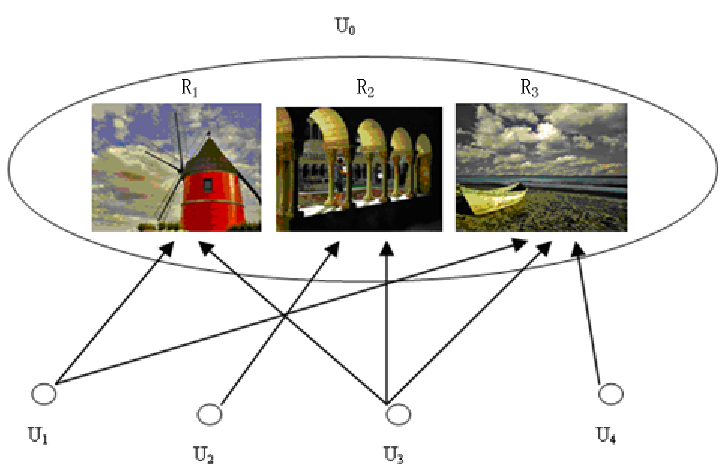 Figure 1: Visualizing the social comment network where U0 is the uploader and U1-U4 are the neighbors.
3. Asymmetric Tag Boosting
Unlike symmetric similarity (Jaccard), the author uses Asymmetric Co-occurrence. Why? Because users don't need synonymous tags; they need tags from different perspectives (e.g., tagging a photo with "Paris" AND "Architecture," not just "Paris" and "City"). These candidates are then boosted by the prestige of the users who previously used them.
Experimental Results
The author crawled a massive dataset from Flickr (over 3.9 million tags) to validate the theory.
Key Findings:
- Local Beats Global: The Precision@5 of the local strategy vastly outperformed the global context precision of 0.056.
- The "K" Factor: The experiment showed that you don't need thousands of neighbors. As shown in the chart below, precision improves rapidly until , then plateaus. This suggests that a user’s "social bubble" is the most effective source for linguistic alignment.
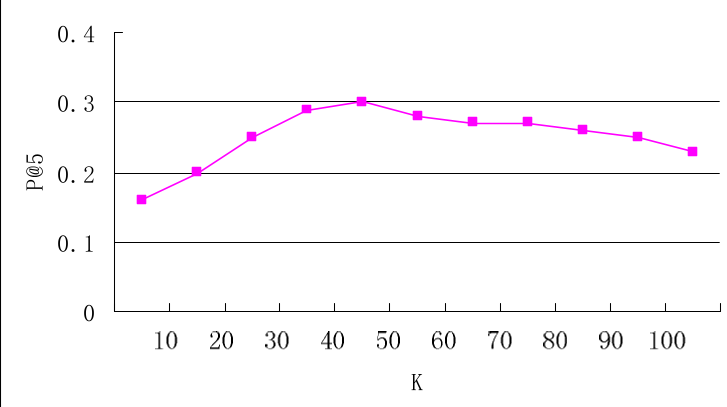 Figure 2: Performance gains as the number of neighbors (k) in the local lexicon increases.
Critical Analysis & Conclusion
Takeaway
This research confirms that Social Context > Global Statistics. By focusing on the "Social Comment Context," the system effectively mirrors how humans naturally communicate within subcultures.
Limitations & Future Work
While the prestige-based boosting is clever, the paper doesn't deeply explore the "Cold Start" problem (new users with no comments). Future iterations could benefit from combining this local lexicon approach with deep learning embeddings (like Word2Vec or Transformers) to handle semantic similarity when exact tag co-occurrence is missing.
In conclusion, the paper provides a robust framework for improving recommendation quality in decentralized social networks by simply looking at who is talking to whom.