
Scaling Autism Intervention: Can AI Automate Behavioral Therapy Training?
Improving communication skills of children with autism through support of applied behavioral analysis treatments using multimedia computing: a survey
This survey explores the integration of multimedia computing and machine learning to support Applied Behavior Analysis (ABA), specifically Pivotal Response Treatment (PRT). It proposes an automated framework to evaluate intervention fidelity in training parents and caregivers of children with Autism Spectrum Disorder (ASD).
Executive Summary
Applied Behavior Analysis (ABA) is the gold standard for treating Autism Spectrum Disorder (ASD), but its reach is stifled by a "human bottleneck." Training parents and teachers to perform these interventions requires dozens of hours of expert clinical oversight.
This survey paper, published in Multimedia Tools and Applications, proposes a paradigm shift: using multimedia computing to automate the feedback loop. By applying computer vision and speech processing to video recordings of therapy sessions, we can provide interventionists with near-instantaneous "fidelity scores," effectively scaling specialized care to rural or underserved populations.
The Problem: The High Cost of Human Fidelity
Naturalistic ABA, such as Pivotal Response Treatment (PRT), creates learning opportunities within a child's natural play. However, for a parent to be "faithful" to the method, they must master a complex three-part sequence: Antecedent (Instruction) → Response (Child Action) → Consequence (Reward).
Currently, a clinician must watch 10-15 minute video probes and manually score behaviors every minute. This leads to:
- High Costs: Intensive clinician hours are expensive.
- Feedback Latency: Parents wait days or weeks for feedback, losing the chance for in-situ correction.
- Accessibility Barriers: Families outside major metropolitan areas lack access to training centers.
The Technical Core: A Multimodal Framework
The paper translates clinical requirements into a technical stack, focusing on two main pillars: Video and Audio.
1. Decoding Multi-Person Interactions (Vision)
Evaluating whether a parent is "following the child’s lead" requires identifying the Natural Reinforcer (the toy) and the child’s Attention State.
- The Challenge: Occlusion (a body blocking the toy) and camera movement from handheld devices.
- The Insight: The paper suggests using spatio-temporal graphs to represent articulation points of both the parent and child. Instead of recognizing specific play activities, the system focuses on "General Poses" that indicate engagement.
2. Parsing the Language of Therapy (Audio)
A critical part of PRT is the "Clear Instruction." This is difficult for standard ASR because:
- Child-Directed Speech: Parents use "baby talk"—higher pitch and elongated syllables.
- Atypical Vocalizations: Children with ASD may respond with phonemes or gestures rather than full words.
- Proposed Solution: Utilizing Voice Activity Detection (VAD) and Speaker Separation to isolate the parent's instructions from the child’s attempts, then using semantic parsing to verify task variation.
Feasibility Analysis
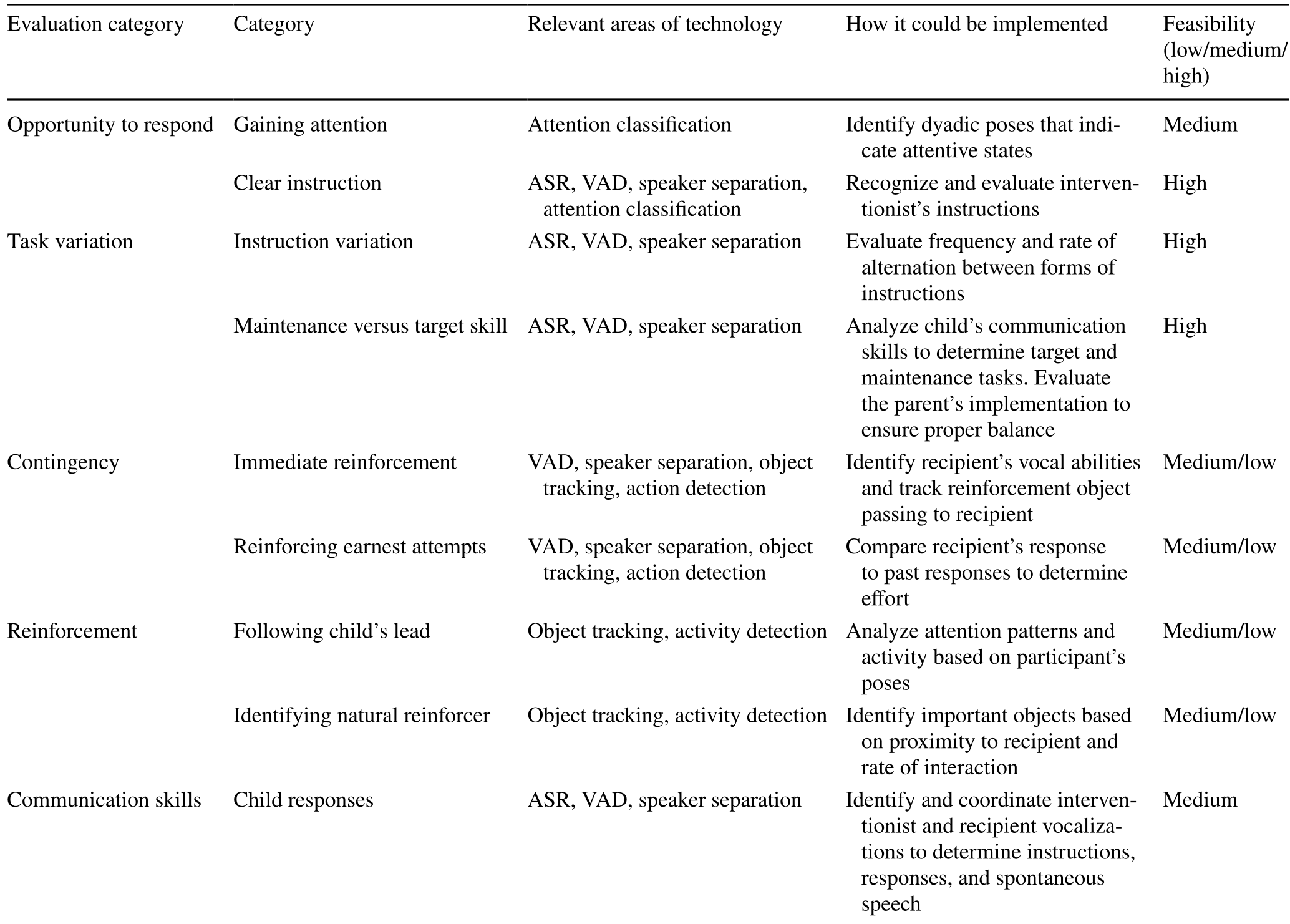
The authors provide a reality check on which parts of therapy can be automated today:
| Feature | Feasibility | Technology Used |
|---|---|---|
| Instruction Variation | High | ASR + NLP |
| Opportunity to Respond | Medium | Pose Estimation + Attention Classification |
| Immediate Reinforcement | Low/Medium | Object Tracking + Action Detection |
The "Instruction" aspect is the lowest-hanging fruit, as modern NLP can easily parse whether a parent is varying prompts. However, detecting if a reward was given "contingently" (exactly when the child made a target attempt) requires highly synchronized multimodal data.
Beyond the Screen: The Future of "Smart" Therapy
The paper concludes by looking at the hardware frontier. To solve the issues of 2D occlusion and audio overlap, the authors suggest:
- 3D/Stereoscopic Cameras: To better estimate visual focus and handle body overlapping.
- Wearable Sensors: Discrete microphones for both parent and child to simplify speaker separation.
- Smart Toys: Embedding inertial sensors in toys to track exactly when and how a "reinforcer" is manipulated.
Final Takeaway
This work highlights that the future of ASD support isn't about replacing clinicians with robots—it's about building a multimedia support structure that empowers caregivers. By reducing the human cost of feedback, we can move from a model of "weekly therapy sessions" to a lifestyle of "continuous, supported intervention."
Reference: Heath, C.D.C., McDaniel, T., Venkateswara, H. et al. Improving communication skills of children with autism through support of applied behavioral analysis treatments using multimedia computing: a survey. Multimed Tools Appl (2020).