
Socially-Aware Negotiation: Enhancing Conflict Resolution through Ambient Intelligence
Improving Conflict Support Environments with Information Regarding Social Relationships
The paper introduces a technological framework for Ambient Intelligence (AmI) designed to support conflict resolution by integrating Social Network Analysis (SNA). By monitoring behavioral biometrics and mapping social ties like friendship and advice networks, the system optimizes negotiation outcomes through context-aware decision support.
TL;DR
This research pioneers a framework that merges Ambient Intelligence (AmI) with Social Network Analysis (SNA) to better manage digital conflicts. By tracking non-invasive behavioral markers and social ties, the system proves that friendship significantly increases collaborative success (from 17% to 42%) and ensures mutually beneficial agreements (100% success rate among friends).
The Missing Link in Digital Mediation
Conflict is often viewed as a localized disagreement between two parties. However, in reality, every conflict is embedded in a complex web of social relationships. Prior work in digital conflict resolution has largely treated users as "islands," ignoring the social context—the friendships, advice loops, and hindrance networks—that dictate whether someone will be competitive or cooperative.
The authors argue that without understanding the social manifold of the participants, conflict management systems remain blind to the underlying motivations that lead to a "win/win" or "lose/lose" outcome.
Methodology: Fusing Behavior with Social Topology
The proposed system architecture operates as a pervasive, transparent observer. It employs two core pillars:
1. Multimodal Behavioral Monitoring
Instead of asking users how they feel, the system monitors:
- Keyboard Dynamics: Time Between Keys (TBK) and Key Down Time (KDT).
- Mouse Interaction: Velocity (MV) and Acceleration (MA).
- Environmental Context: Motion and Brightness via webcam.
2. Social Network Mapping
The system maps the participants using SNA metrics. It measures:
- In-degree Centrality: Popularity or prestige within advice systems.
- Hindrance Networks: Identifying "conflicting" individuals who block progress.
- Friendship Networks: The strongest predictor of cooperative behavior.
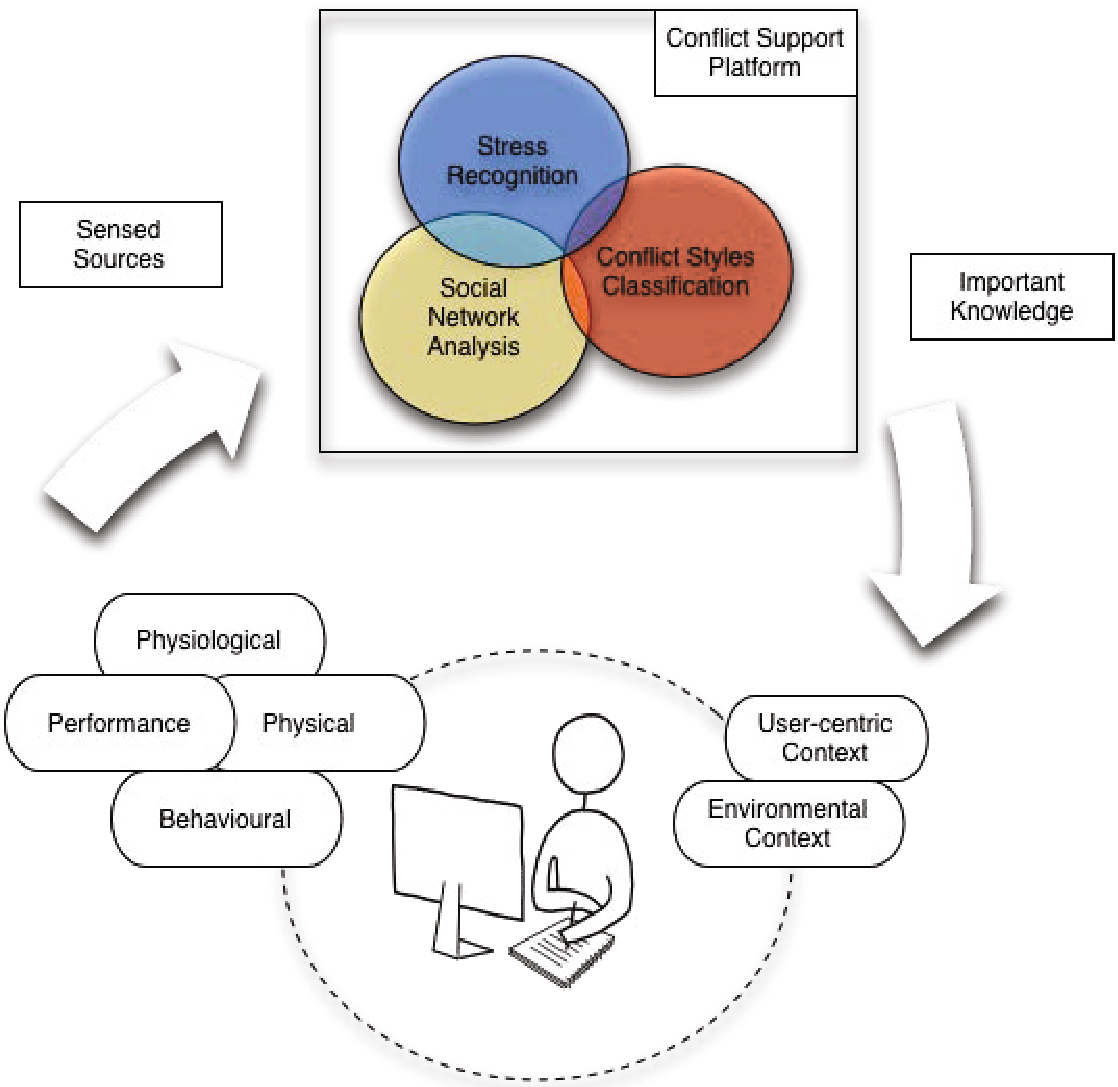 The AmI system loop: Sensing context, reasoning on profiles, and acting through the conflict manager.
The Negotiation Game: A Case Study
To validate the theory, the researchers designed a "Piano Transaction" game involving 20 participants. Players were assigned roles (Seller vs. Buyer) with specific bankruptcy thresholds (BATNA/WATNA), creating a high-pressure Zone of Possible Agreement (ZOPA).
Key Findings:
- The Friendship Effect: When parties were friends, they reached agreements faster and with fewer, more concise messages.
- Quality of Agreement: The distance of the final proposal to the "optimum" was significantly shorter for friends.
- Role Bias: Sellers remained inherently more competitive (63%) than buyers (25%), but friendship mitigated this competitiveness substantially.
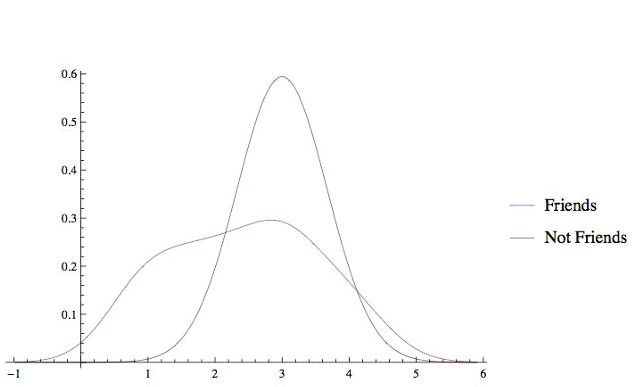 Behavioral shifts: Friends (right) show a clear trend toward higher utility, cooperative handling styles compared to non-friends.
Critical Analysis & Conclusion
The core contribution of this work is the quantifiable proof that relational context changes negotiation physics. By identifying individuals with high "betweenness centrality" or those within hindrance networks, a conflict manager can intervene more accurately—perhaps by pairing specific mediators or adjusting the transparency of proposals.
Limitations: The sample size (20 individuals) is small, and the social networks were elicited via self-reporting (questionnaires) rather than being inferred automatically from digital interaction.
Future Outlook: Integrating these SNA features into AI-driven mediators (like Chatbots or Digital Mediators) could revolutionize how online marketplaces and corporate HR departments handle internal disputes. Leveraging "Social Intelligence" is no longer just a soft skill; it is a data-driven requirement for next-gen Intelligent Environments.
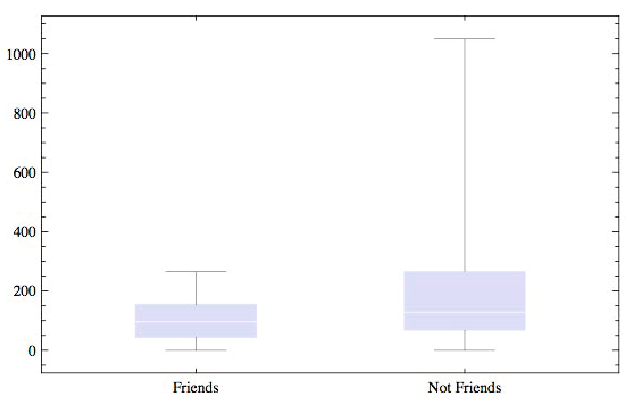 Efficiency visualization: Friends consistently strike deals closer to the mathematical optimum.