
The Efficiency Paradox: Why Limiting Competition Improves Crowdsourcing Contests
Improving the efficiency of crowdsourcing contests
This paper investigates the efficiency of winner-take-all crowdsourcing contests (e.g., TopCoder, Kaggle), proposing a pre-qualification mechanism called the "Top-K Rule." By filtering out low-expertise contestants before they exert effort, the mechanism optimizes social welfare and ensures incentive compatibility. Results show significant improvements in social welfare (e.g., from 16 to 240 in simulations) by reducing wasted effort from non-winners.
Executive Summary
TL;DR: In the world of crowdsourcing (TopCoder, Kaggle, etc.), more contestants usually mean more wasted energy. This paper introduces the Top-K Rule, a mechanism that filters out low-expertise participants before they start working. By charging a calculated entry fee to the "Top K" qualifiers, the mechanism ensures that only those with a real chance of winning exert effort, drastically boosting social welfare without hurting the principal's bottom line.
Context: This work fits into the niche of Mechanism Design for distributed human computation. It moves beyond the classic "All-Pay Auction" model by adding a stochastic layer (Discrete Choice Model) and a strategic filtering stage to solve the "Asymptotically Zero Utility" problem in standard contests.
The "Wasted Effort" Problem
In a standard winner-take-all contest, 100 people might work 10 hours each, but only one person gets paid. Collectively, 990 hours of human effort are "wasted." Previous research showed that as the number of contestants grows, the total utility for participants approaches zero. The challenge is: how do we keep the "best" people competing while telling everyone else to stay home, all while ensuring nobody lies about their skills?
Methodology: The Top-K Rule
The authors suggest that the principal (contest creator) shouldn't just open the gates to everyone. Instead, they propose a pre-qualification stage based on a Discrete Choice Model.
1. The Stochastic Quality Model
The quality of a solution is modeled as: Where is effort, is expertise, and is a random noise variable (representing the uncertainty of the creative process).
2. The Mechanism (Top-K Rule)
The mechanism operates in three distinct steps:
- Bidding: Contestants report their expertise () and the effort they can provide ().
- Filtering: The principal calculates the "Idealized Quality" () and picks the top agents.
- The Entry Fee: Selected competitors pay an entry fee (). This fee is crucial—it's set based on the quality of the -th contestant (the first one who didn't make the cut).
 Figure 1: Conceptual overview of the contest filtering process.
Key Insights: Why It Works
The brilliance of the Top-K Rule lies in its Incentive Compatibility.
- Truthfulness: Under natural assumptions (symmetric noise), contestants have no reason to lie. If they overstate their expertise, they pay a high entry fee but their actual work won't win. If they understate it, they won't get picked.
- Surplus Power: Even though high-quality workers pay higher entry fees, their expected utility remains higher than lower-quality peers, ensuring the contest still attracts the "A-Players."
Experiments & Results
In a simulation involving 10 agents, the researchers compared a "standard" contest (all 10 compete) against a "Top-2" filtered contest.
| Metric | Standard Contest (N=10) | Top-2 Mechanism |
|---|---|---|
| Best Quality Produced | 95.7 | 72.6 |
| Social Welfare | 16 | 240 |
| Principal's Utility | Low | 170 |
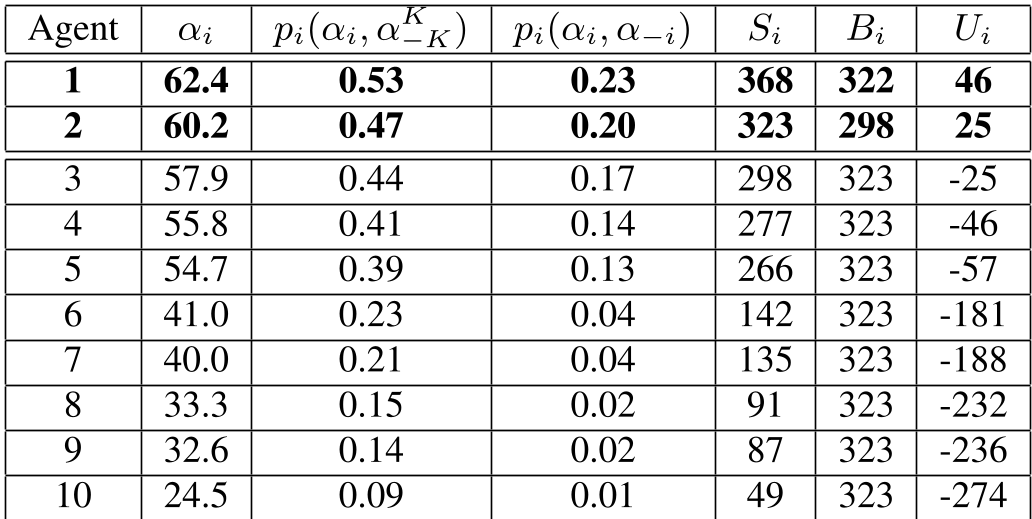 Table 1: Agent-level performance. Note how agents 3-10 would have negative utility (Ui) if they tried to cheat their way into the Top 2.
While the "absolute" best quality dropped slightly (since you explore fewer candidates), the efficiency (Social Welfare) exploded by 1500%. This is because the massive cost of 8 people working for nothing was eliminated.
Critical Analysis & Conclusion
Takeaway
The paper proves that more competition isn't always better. By introducing a modest "barrier to entry" (fees and filtering), we can create a sustainable ecosystem where professional workers aren't exploited by the statistics of all-pay auctions.
Limitations
- Static Prize: The model assumes a fixed prize . In reality, the principal might lower the prize if they know they are filtering.
- Information Asymmetry: It assumes the principal can accurately judge the noise distribution (). If the "noise" in a task is too high, the filtering becomes a lottery.
Future Work
The next frontier is applying this to dynamic contests, where is not fixed but changes based on the quality of the applicant pool in real-time.