
Fusion-Driven Forecasting: Using Web Data to Predict Flu Outbreaks Weeks Ahead
Improving Influenza Forecasting with Web-Based Social Data
The paper introduces a linear autoregressive model with exogenous inputs (ARX) that fuses traditional healthcare data (InfluNet) with real-time web-based signals from Twitter and Google Trends to forecast seasonal influenza in Italy. The model achieves State-of-the-Art (SOTA) performance in nowcasting and forecasting up to four weeks in advance.
Executive Summary
TL;DR: This research tackles the critical "lag time" in public health reporting by combining traditional physician data with real-time social signals. By weighting Twitter and Google Trends data based on their historical correlation with official records, the authors achieved a 47% reduction in forecasting error for seasonal influenza in Italy.
Background: Within the landscape of digital epidemiology, this work represents a refinement of the Autoregressive Exogenous (ARX) paradigm. It moves beyond simple keyword counting toward a more robust, correlation-weighted integration of heterogeneous data sources.
The Problem: The Cost of a One-Week Delay
Epidemiologists face a persistent hurdle: "sentinel" networks of doctors take time to collect, verify, and publish influenza-like illness (ILI) statistics. This reporting lag—usually 7 to 14 days—means that healthcare policy is often made using data that reflects the past, not the present.
While social media and search engines offer a "real-time" window into public health, early attempts (like Google Flu Trends) were criticized for overfitting and "big data hubris." The challenge lies in extracting a clean signal from the noisy nature of web activity.
Methodology: Correlation-Weighted Integration
The core innovation is a linear autoregressive model that treats Google Trends and Twitter as Exogenous Inputs.
The Formula for Real-Time Insight
The model defines the predicted ILI rate () as a weighted sum of:
- Historical Official Data (): Lagged reports from the InfluNet system.
- Weighted Google Trends (): Query volumes for specific keywords.
- Weighted Twitter Activity (): Unique user counts discussing flu-related symptoms.
Unlike naive models, the authors apply the Pearson correlation coefficient () to each keyword. This means if the word "fever" correlates more strongly with actual hospital visits than "sneeze," "fever" is given priority in the mathematical engine.

Figure 1: The ARX framework combining official surveillance () with digital traces ( and ).
Experiments and Results
The model was validated on two Italian flu seasons (2016-2018). The researchers used a rolling forecasting origin—a specialized form of cross-validation for time-series that prevents "looking into the future" during training.
Performance Metrics
Comparing the M4 model (using 4 weeks of history) against various baselines (B1-B5):
- Nowcasting (): The model achieved a Pearson correlation () of 0.9867, effectively mirroring real-time ILI trends with a tiny error margin.
- Forecasting (): Even four weeks in advance, the model outperformed the traditional baseline (B1) which uses only official data, maintaining a correlation of ~0.79.
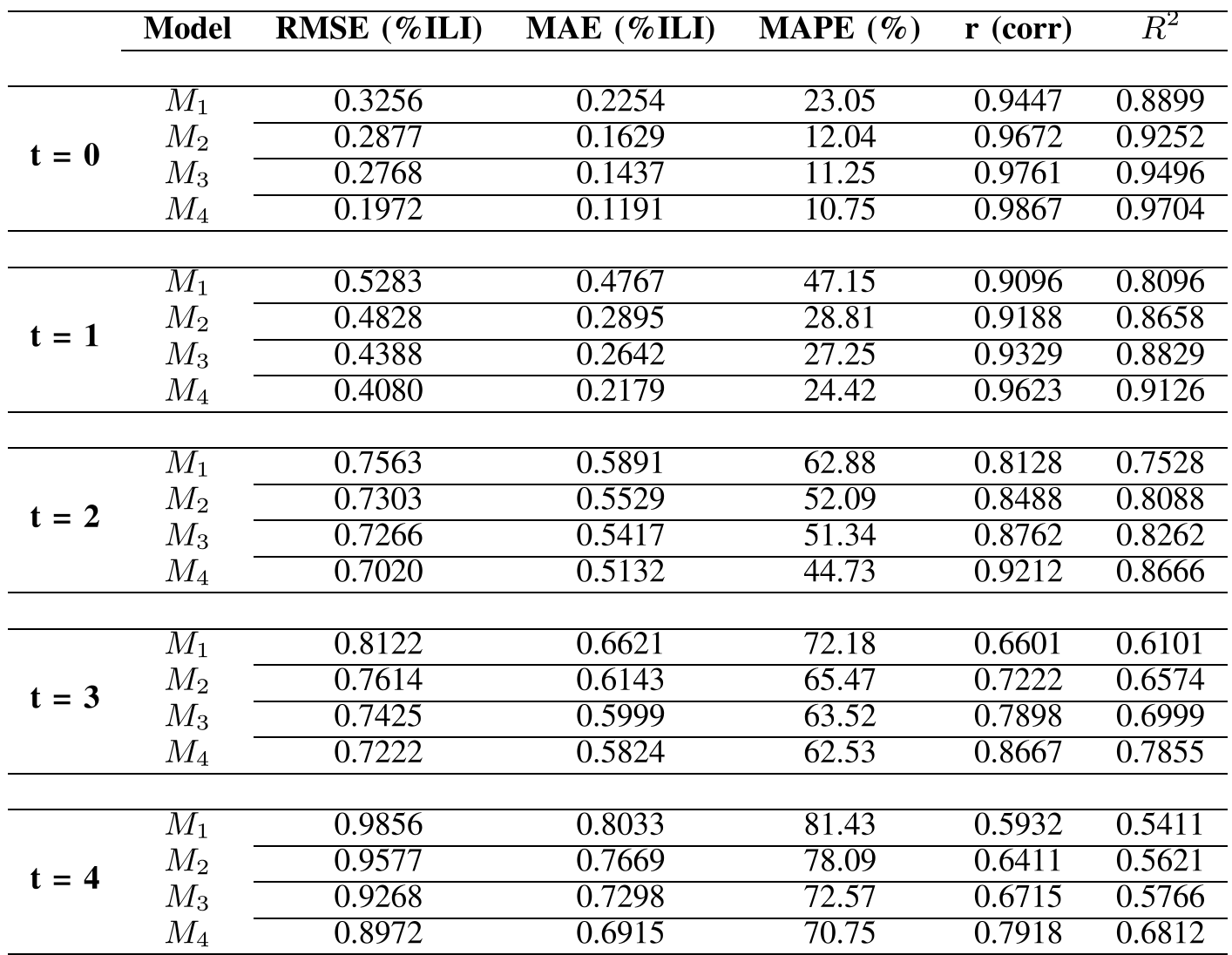
Table 1: Quantitative results showing that M4 consistently outperforms models with fewer weeks of data (-) across all time horizons.
Why it Works
The "Ablation Study" (comparing M4 to B1, B2, etc.) reveals that while web data alone isn't enough to capture complex epidemic dynamics, its integration significantly sharpens the accuracy of traditional models. The web data acts as a "speed-up" signal that alerts the model to sudden spikes before the official paperwork arrives.
Critical Insight & Conclusion
Takeaway
The value of this research lies in its simplicity and effectiveness. By leveraging basic Pearson correlations to weight exogenous inputs, the authors created a system that is transparent, computationally efficient, and significantly more accurate than standard surveillance.
Limitations
- Demographic Bias: As the authors note, web data typically trends younger, while official data captures more children and the elderly.
- Keyword Stability: Pearson correlations may drift over several years as social media language evolves, necessitating periodic re-calibration.
Future Outlook
This ARX approach could be enhanced by incorporating Deep Learning (such as LSTMs or Transformers) to handle the non-linear relationship between social media sentiment and disease spread. However, the current linear approach provides an excellent high-performance baseline for public health institutions worldwide.