
Group Reformation: The "Secret Sauce" for Software Engineering Excellence
Improving Learning Outcomes through Systematic Group Reformation - The Role of Skills and Personality in Software Engineering Education
The paper introduces a systematic group reformation approach in Software Engineering education using the AMEISE simulation framework. By analyzing individual characteristics such as seniority (enrolled semesters) and personality traits (using the FFS model), the authors restructured student teams to optimize learning outcomes, demonstrating significant performance gains.
TL;DR
Is random team selection hurting student performance? This paper argues "Yes." By systematically reorganizing students mid-course based on their personality types and academic seniority, researchers achieved a staggering 27% improvement in group performance and raised the entire class's median grade.
Context: Why Team Synergy is Hard
In Software Engineering (SE) education, project-based learning is the gold standard. However, instructors often face a "black box" problem: some groups flourish while others with similar technical skills fail. The authors posit that the missing link is the Group Outcome Model, which suggests that individual performance is a slave to group composition. Existing methods often ignore the dynamic nature of learning—assuming the first group you join should be your last.
The Problem & Motivation
Most SE courses rely on static, self-selected, or random groups. The pain point is clear:
- Skill Imbalance: One student carries the team.
- Personality Clashes: High dominance without formal structure leads to chaos.
- Static Failure: If a group starts poorly, they usually stay poor.
The researchers' insight was to use the AMEISE simulation environment (a flight simulator for project managers) to first test students in random pairs, collect data on their "Formality" and "Dominance," and then intervene by shuffling the deck.
Methodology: The Core Mechanism
The study utilized the FFS (Five-Factor and Stress) Model to categorize students into four buckets: Renovator, Analyst, Coach, and Manager.
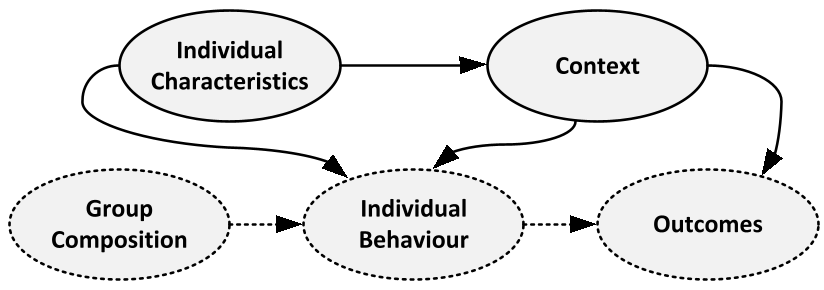
The experiment design followed a rigorous two-stage workflow:
- Stage 1 (Diagnostic): Random formation + Baseline simulation.
- Stage 2 (Optimization): Reconstruction into three cohorts:
- SA (Semester Adjusted): Grouped by high seniority/skill.
- PA (Personality Adjusted): Grouped to ensure a "Manager" or "Coach" (balancing dominance).
- RG (Random/Control): Remaining students left in random groups.
Experiments & Results: Personality Trumps Experience
The results were eye-opening. While everyone expected the "Senior" students (SA cohort) to dominate, it was the Personality-Adjusted (PA) groups that stole the show.
- PA Cohort: Improved average grades from 2.38 to 1.73 (a 27% leap).
- SA Cohort: Improved from 2.02 to 1.83 (a 9.3% gain).
- Individual Growth: The median points per student jumped from 91 to 96 compared to previous years without reformation.
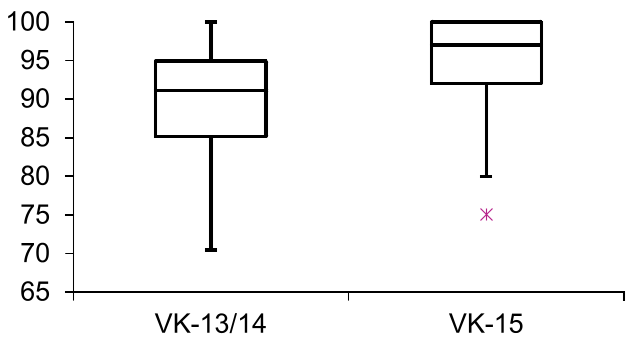 Figure: The significant shift in median scores (left: 2013-14 vs. right: 2015) proves the efficacy of the systematic approach.
Critical Analysis & Conclusion
Takeaway
The study proves that soft skills are hard science. Systematic reformation based on personality leads to better "Group Synergy," which in turn boosts "Individual Performance." Interestingly, groups that performed perfectly in Stage 1 actually saw a slight decline when reformed, suggesting that "if it ain't broke, don't fix it" might apply to top-tier performers.
Limitations
- Sample Size: With only 42 students, the results are promising but require scaling (which the authors are currently doing with 170 students in Kosice).
- Self-Perception: FFS data was gathered via surveys; students might misrepresent themselves.
Future Outlook
This work paves the way for Adaptive Learning Systems that could automatically suggest team reshuffles in real-time based on digital traces (chat logs, commit frequency) to ensure no student is left in a "toxic" or unproductive group environment.