
SMILE: Breaking the Knowledge Bottleneck with Semantic Legal Representation
Improving the representation of legal case texts with information extraction methods
This paper introduces SMILE, a system that utilizes Information Extraction (IE) and Natural Language Processing (NLP) to improve the representation and automatic indexing of legal case texts for Case-Based Reasoning (CBR). By integrating the Sundance parser and AutoSlog IE tool, the method transforms raw legal text into "Propositional Patterns" (ProPs) that reflect legal roles and actions.
TL;DR
SMILE (System for Machine-aided Indexing of Legal Examples) seeks to automate the labor-intensive process of legal case indexing. By moving beyond simple word-matching to a "Propositional Pattern" representation, the system extracts the underlying legal logic—who did what to whom—allowing AI systems like CATO to reason with new cases automatically.
The "Bag-of-Words" Trap in Legal Analysis
In most modern AI tasks, throwing more data at a statistical model (like a bag-of-words classifier) solves the problem. But legal reasoning is different. The authors identify a critical failure in standard machine learning for law: context matters more than frequency.
For example, a bag-of-words model sees the sentences "Plaintiff disclosed the secret" and "Defendant told Plaintiff he would keep the secret" as almost identical. However, in Trade Secret law, these represent fundamentally different legal "Factors." To an AI, "Plaintiff" and "Defendant" are just unique strings (like "Steffi" and "Vincent") unless the system understands their functional roles in the lawsuit.
Methodology: The SMILE Architecture
The core innovation of SMILE lies in its transformation of raw, complex legal prose into a structured representation that a symbolic learner (ID3) can actually use.
1. Identifying the Players (Role Abstraction)
Individual names are noise. SMILE uses a rule-based grammar (implemented in Perl) and the AutoSlog IE tool to find names and map them to generic roles: (Plaintiff), (Defendant), and (Information/Trade Secret).
2. Propositional Patterns (ProPs)
The system doesn't just look for words; it looks for links. Using the Sundance segmenter, SMILE extracts "caseframes"—linguistic contexts that bind an actor to an action.
- Logic: Instead of a "disclosure" keyword, it looks for the pattern
(Plaintiff + discloses + Information).
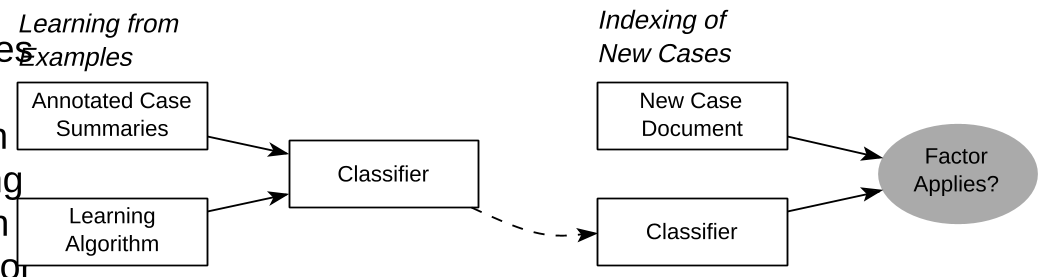 Figure: The SMILE workflow, from annotated squibs to the CATO reasoning engine.
3. Resolving Negation
Negation can flip the legal meaning of a 50-page opinion in a single word. SMILE uses Sundance's clause-splitting ability to determine the scope of a "not" or "no," ensuring the model doesn't credit a "Non-Disclosure Agreement" when the text says one wasn't signed.
Experimental Validation
The authors tested their ability to identify "Products" (the subject of trade secrets) across different cases.
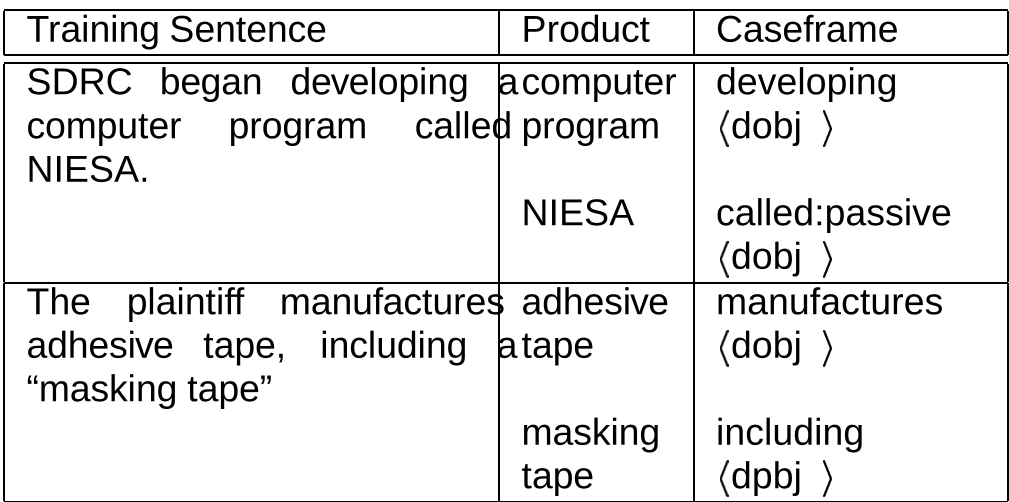 Table: Sample caseframes and extracted product info.
By using 2-fold cross-validation on case "squibs" (summaries), the system reached a 66% precision in product extraction. While not perfect, this represents a massive leap over manual indexing, which is the primary barrier preventing legal AI from moving out of the lab and into the courtroom.
Critical Analysis & The Future
This paper is a classic example of Domain-Driven AI. It recognizes that "Legal Language" is a specific dialect where syntactic structure is the logic.
Limitations:
- The current system relies on "Squibs" (expert summaries). Extending this to 100-page trial opinions remains a major linguistic challenge due to the density of legal jargon and procedural history.
- The dependency on manual semantic hierarchies (see Figure 10) still requires some upfront "expert" labor.
Takeaway: SMILE proves that for specialized fields like Law or Medicine, "Shallow" NLP (which understands roles and clauses) provides a more robust foundation for Machine Learning than raw statistics ever could. As we move into the era of LLMs, the insights here regarding Role Abstraction remain vital for grounding AI outputs in actual legal theory.