
Enhancing Link Prediction: The Power of Collaborative and Context-Aware Social Influence
Improving the Link Prediction by Exploiting the Collaborative and Context-Aware Social Influence
This paper proposes a novel link prediction model that integrates Context-Aware Social Influence, Topological Features, and Collaborative Filtering. By clustering nodes based on network structure and measuring topic-specific user influence, it achieves superior performance on real-world datasets like Digg.
TL;DR
Predicting who will connect next in a social network is more than a game of counting common friends. This paper argues that Social Influence—specifically how it changes depending on the Topic (Context)—is the missing ingredient. By combining topological clustering with context-specific influence signatures, the authors propose a model that significantly improves link prediction accuracy on the Digg social network.
Background & Motivation
In the era of Facebook, Twitter, and Weibo, link prediction is the backbone of recommendation engines. While traditional methods look at Topological Features (like how many mutual friends you have) or Node Attributes (your age or location), they often ignore the "why" behind interactions.
The authors identify a critical gap: Social influence is non-uniform. You might be highly influential when discussing "Artificial Intelligence" but have zero influence in the "Gourmet Cooking" context. Existing models treat influence as a static value, missing the nuanced behavior patterns that lead to new connections.
Methodology: The Core Modules
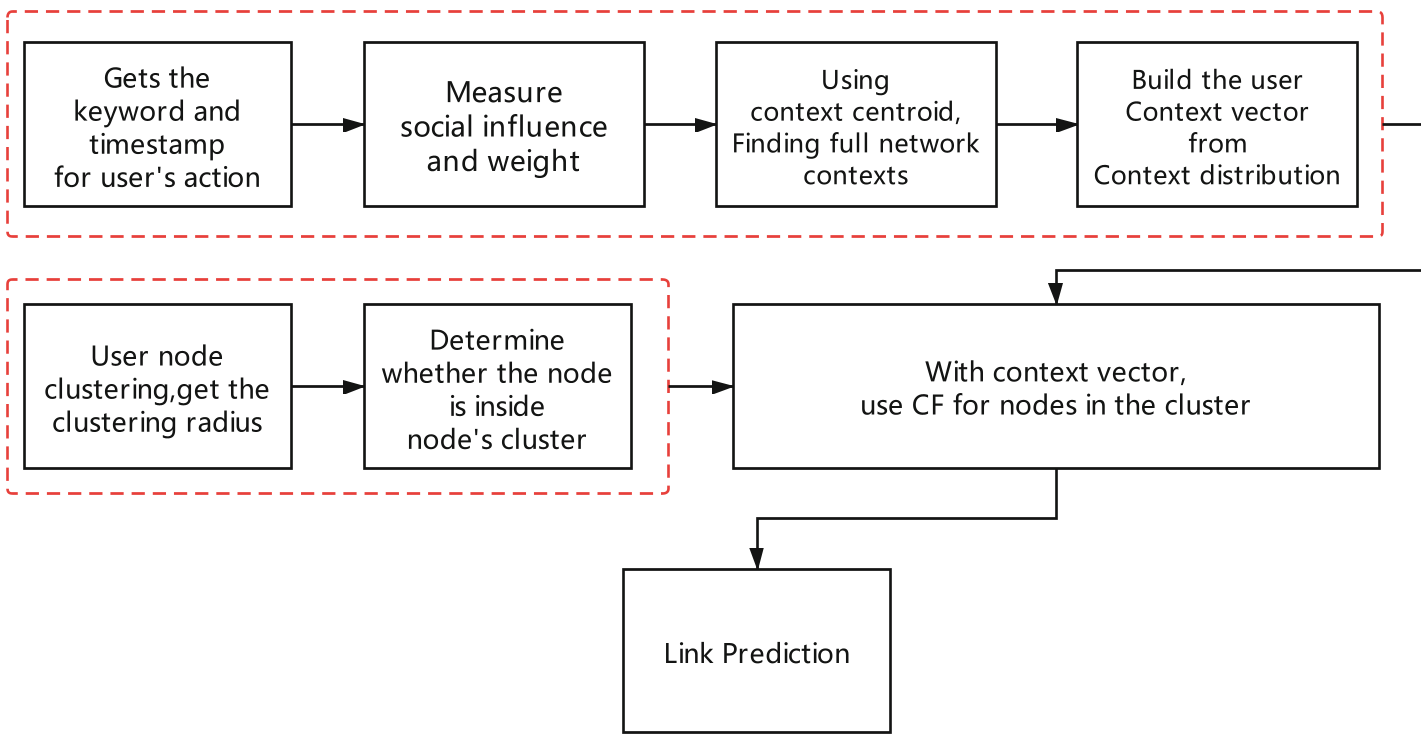
The proposed model operates under a Collaborative Filtering (CF) framework, integrating three distinct layers of data:
1. Context-Aware Social Influence
The model calculates an "Influence Signature" for each topic. By observing the timing of actions (e.g., if User A "diggs" a story before User B), the model quantifies influence.
- The Math: Influence weights are the ratio of successfully influenced actions to total actions per topic.
- Context Grouping: Topics with similar influence patterns are clustered into "Contexts" (using a distance-based signature analysis).
2. Topological Node Clustering
To reduce computational costs and noise, the model performs node clustering.
- Logic: It assumes potential links are most likely found within a certain "topological radius" ().
- Filtering: Only nodes within this radius are considered candidates for the collaborative filtering stage.
3. Collaborative Filtering Integration
Once potential candidates are identified by the topological filter, the model calculates the similarity between the target user and candidates using their Context-Aware Vectors. This final score determines the likelihood of a future link.
Experimental Insights
Testing on the Digg dataset (7,921 users, 47,149 relationships), the research yielded several key findings:
- The "Comment" Advantage: The authors found that "Digg" actions (likes) are "cheap" and low-signal. "Comments," however, require more effort and provide a much higher-quality signal for influence and interest.
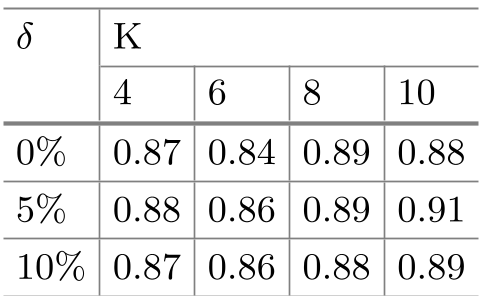
- Granularity Matters: When the number of contexts () is too low, the signal is vague. When it's too high (e.g., ), the model becomes sensitive to noise. The "sweet spot" was found at .
- Superior Performance: The model consistently beat common baselines like Common Neighbors (CN) and Preferential Attachment (PA), particularly in Recall, proving it is better at finding missing links that other models overlook.
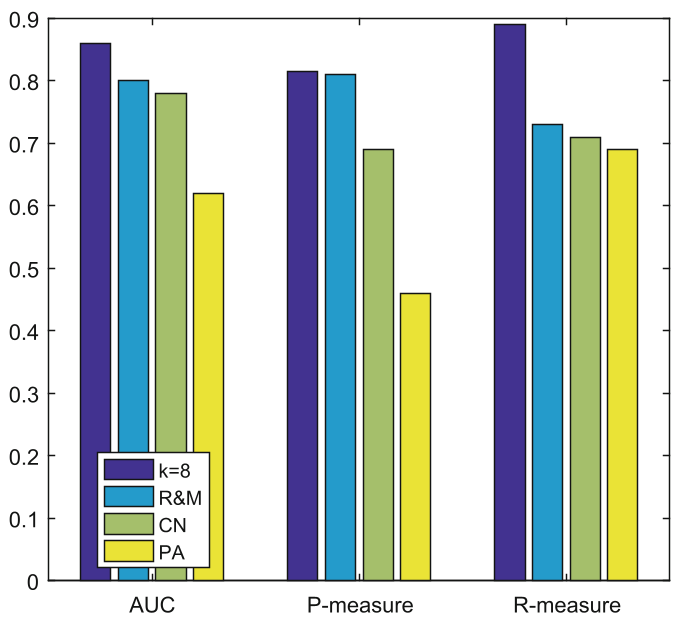
Table 1: Influence of corruption fraction () and context () on model stability.
Critical Analysis & Conclusion
Takeaway: This work successfully demonstrates that who you are influenced by is just as important as where you are in the network. By focusing on user actions (like comments) rather than hard-to-obtain private profile data, the method remains highly practical for real-world applications.
Limitations: The current model assumes a static network. In reality, social networks are evolving graphs where topics and influence patterns shift over time.
Future Work: The next frontier for this research is adapting the context-aware framework to dynamic social networks, where the "context" itself might drift as new trends emerge.