
Kpark: Improving Mobile Crowdsourcing via Trust-Based Portfolio Fusion
17307_Improving the Performance of Mobile Phone Crowdsourcing Applications.
The paper introduces Kpark, a mobile phone crowdsourcing application designed to monitor parking availability. It implements an ensemble-based (AdaBoost) portfolio and real-time data fusion to aggregate sparse, heterogeneous reports from over 1500 users, achieving significant accuracy gains over standard majority voting.
TL;DR
Researchers at the University of Central Florida developed Kpark, a crowdsourcing app that solves the "parking hunt" problem not through expensive sensors, but by treating students' phones as a participatory network. By using a sophisticated algorithm portfolio (AdaBoost) and a decay-based real-time fusion mechanism, the system filters out erroneous reports and maintains data freshness even when updates are sparse.
Background & Motivation: The Hunting License
On a busy university campus, a parking permit is often joked to be a "hunting license." While university infrastructures grow, parking availability remains a black box for most drivers.
The core challenge of crowdsourcing this data is Worker Reliability. Unlike controlled experiments, mobile users provide "opportunistic labels" while they are hurried or distracted. Traditional Majority Voting fails here because:
- The crowd is heterogeneous: One expert reporter is worth ten noisy ones.
- Data is dynamic: A "full" report from 30 minutes ago is significantly less valuable than a "half-empty" report from 2 minutes ago.
- Privacy Concerns: Many users are unwilling to share continuous GPS data, making it impossible to verify proximity-based reporting.
Methodology: The Trust Portfolio & Real-time Fusion
1. The Multi-Model Trust Engine
The researchers didn't rely on a single metric for trust. Instead, they implemented a portfolio of five distinct strategies:
- Beta Reputation: Uses alpha/beta parameters to model the posterior distribution of binary agreement/disagreement.
- Gompertz Function: An asymmetric trust model where trust is gained slowly but lost rapidly.
- Robust Averaging: An iterative method from wireless sensor networks to compute averages amidst noise.
- MLE & Bayesian Estimation: Probabilistic models that treat the gap between user reports and aggregate data as a Gaussian process.
2. AdaBoost Algorithm Selection
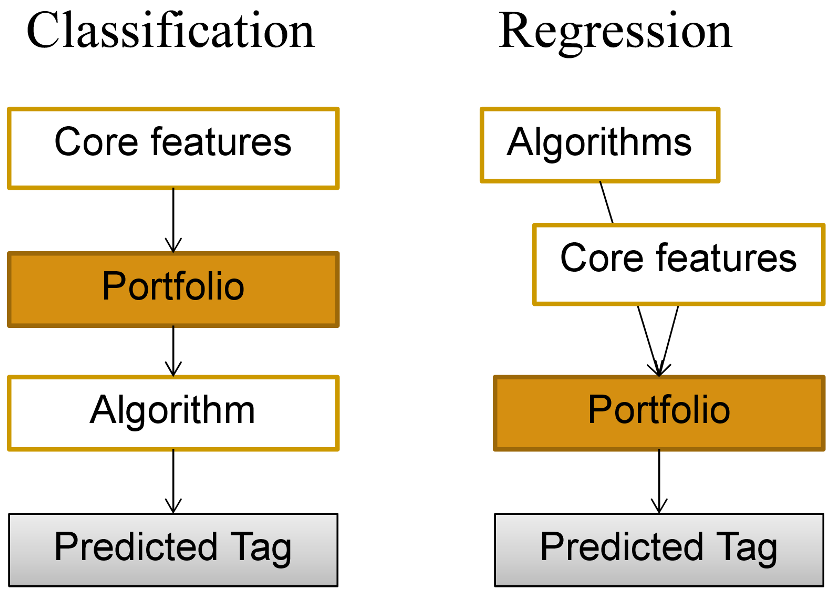
The paper’s key innovation is the Portfolio Selector. Using features like the hour of the day and specific parking sections, an AdaBoost classifier/regressor chooses which model to trust for a specific context.
3. Fighting Data Staleness
To handle transitions (e.g., from rush hour to off-peak), the system uses an asynchronous fusion algorithm:
u_i (u_i - I)}{\Delta t \sigma}$$ Here, $ u_i$ represents the validity of the report based on the user's trustworthiness ($ au_i$), and $\Delta t$ accounts for the time elapsed. This ensures that a highly trusted report eventually "decays," allowing the map to reset without manual input. ## Experimental Validation The system was tested using an agent-based urban simulation before being deployed to 1586 users. ### Simulation Insights In simulated environments with "untrustworthy" populations, the **Gompertz model** excelled at isolating noise, whereas the **Beta Reputation** was the best general performer. However, the Portfolio approach (AdaBoost) successfully leveraged the strengths of each. ### Real-World Performance When pitted against independently collected university parking data, the **Portfolio (Regression)** variant achieved the highest accuracy, significantly outperforming the Majority Vote baseline. 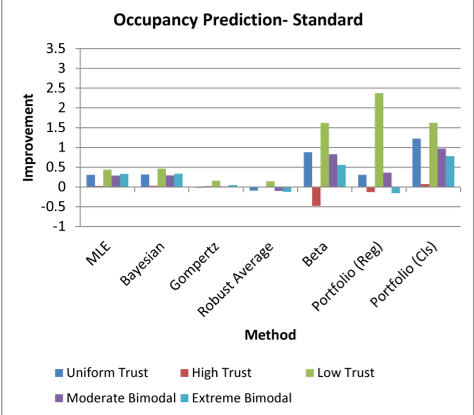 ## Critical Insight & Conclusion Kpark proves that **algorithmic sophistication can compensate for lack of hardware**. By focusing on worker quality (Trust) and temporal relevance (Real-time Fusion), we can build reliable urban sensors from unreliable human inputs. **Limitations**: The system still suffers from low reporting rates during transition periods (0.0186 tags/section/hour). Future work focusing on **gamification** and **incentive design** (like car-finding features) will be crucial to sustain the density of data needed for 100% reliability. **Takeaway for Practitioners**: When building participatory apps, don't look for the "one perfect algorithm." Build a portfolio and let a meta-classifier decide who to trust, when.