
Gatekeeper: Achieving Optimal Sybil-Resilience via Multi-Source Ticket Distribution
Brief Announcement: Improving Social-Network-based Sybil-resilient Node Admission Control
Gatekeeper is a decentralized protocol for Sybil-resilient node admission control in social networks. It leverages a multi-source ticket distribution mechanism to admit honest users while limiting Sybil identities to O(log k) per attack edge, where k is the number of attack edges.
TL;DR
Gatekeeper is a decentralized admission control protocol that uses social network topologies to filter out Sybil (fake) identities. By distributing "tickets" from multiple random sources and requiring a quorum for admission, it achieves near-optimal resilience—limiting attackers to fake nodes per attack edge—while ensuring almost all honest users can join the system.
Background & Motivation: The Sybil Struggle
In the world of decentralized systems (BitTorrent, social voting, or P2P networks), identity is cheap. An attacker can spawn thousands of "Sybils" to manipulate votes or disrupt services. Previous gold standards like SybilLimit established that we could use trust links in social networks to bound these attacks. However, SybilLimit has a fixed "tax": it allows Sybils per attack edge regardless of how few attack edges actually exist.
The authors of Gatekeeper identified two major gaps:
- Efficiency Gap: Prior methods were pessimistic, allowing more Sybils than necessary when the attacker was poorly connected.
- Availability Gap: A significant portion (often ~40%) of honest nodes were accidentally excluded because they weren't "reachable" via specific random routes.
Methodology: The Power of Many Sources
Gatekeeper evolves the concept of Ticket Distribution. In this model, a node acting as a "source" spreads a finite number of tickets through the network.
1. Level-by-Level Distribution
Tickets are propagated based on the shortest-path distance from the source. Each node keeps one ticket and divides the rest among its neighbors at the next level. This "fanning out" naturally slows down as it approaches the sparse "attack edges" that connect the honest cluster to the Sybil cluster.
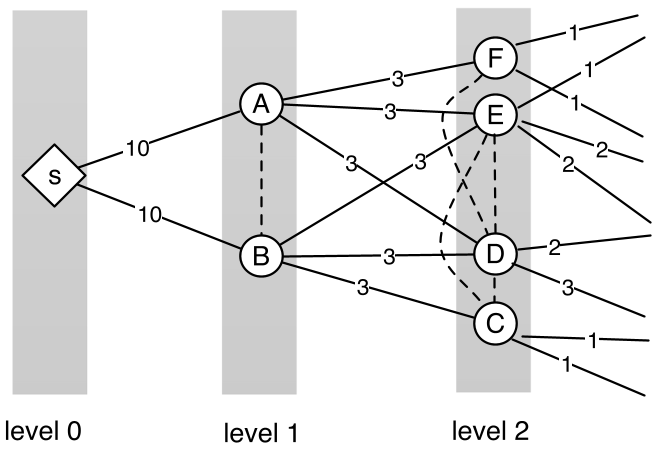 Figure 1: Tickets (numbers on links) flow from source S. Nodes at the same distance (dotted lines) share the remaining tickets.
2. Multi-Source Quorum
The breakthrough in Gatekeeper is the Multi-Source strategy. Instead of relying on a single admission controller's view:
- An admission controller picks random nodes across the network (using random walks).
- These nodes act as independent ticket sources.
- A new node is admitted only if it secures tickets from a minimum fraction () of these sources.
This "ensemble" approach means that even if one ticket source is "unlucky" and located right next to an attacker, the requirement to get tickets from multiple disparate sources makes it statistically impossible for Sybils to flood the admission process.
Experimental Performance
The researchers proved that on random expander graphs, Gatekeeper hits the theoretical lower bound of Sybil admission.
- Resilience: With attack edges, it admits only Sybils, a improvement over SybilLimit.
- Graceful Degradation: Even as the number of attack edges increases to , Gatekeeper maintains parity with the best existing protocols ( Sybils).
- Adaptive Estimation: Since the total number of honest nodes () is often unknown, the protocol includes an adaptive mechanism where sources increase ticket counts until they hit a threshold that signals they've covered the honest network.
Critical Insight & Future Outlook
The "magic" of Gatekeeper lies in its use of the expander property of social networks. Because honest social networks tend to be fast-mixing, tickets spread quickly among the "core," while the narrow "bridge" of an attack edge acts as a bottleneck.
Limitations: The protocol's strongest guarantees rely on the graph being a "random expander." In real-world social networks with strong community structures (clustering), the "level-by-level" distribution might be less uniform, potentially requiring more local tuning of the ticket counts.
Conclusion: Gatekeeper represents a shift from "path-verification" (SybilLimit) to "flow-based admission." By decentralizing the source of trust, it provides a robust, scalable wall against identity fraud in open systems.