
Beyond the Friend Request: Decoupling Trust and Privacy in Social Networks
Improving Trust and Privacy Models in Social Networks
This paper introduces multidimensional privacy and trust models for Social Networking Sites (SNS), leveraging a field study on Facebook user behavior. The models move beyond simple access control by incorporating spatial, temporal, and event-based contexts to mitigate unauthorized personal data disclosure.
TL;DR
Social Networking Sites (SNS) face a fundamental paradox: we share to connect, but sharing erodes privacy. This paper proposes a sophisticated framework to resolve this by introducing context-aware models. By analyzing 600 real-world interaction samples on Facebook, the authors demonstrate that more information does not always equal more trust—especially across different genders—and propose "N-level" controls to stop data leaks.
The "Friend of a Friend" Vulnerability
The "Privacy Paradox" in SNS is driven by a lack of granularity. Most users assume that limiting content to "Friends" or "Friends of Friends" is sufficient. However, the authors argue that these static policies are the primary source of information leakage. If User A shares with User B, and User B shares with User C, User A's data has entered a sphere they never intended to authorize.
The core motivation here is to transform privacy from a static barrier into a dynamic process that asks: Specifically for whom, when, and under what circumstances is this data accessible?
Methodology: The Multidimensional Framework
The paper bifurcates its solution into two interlocking models:
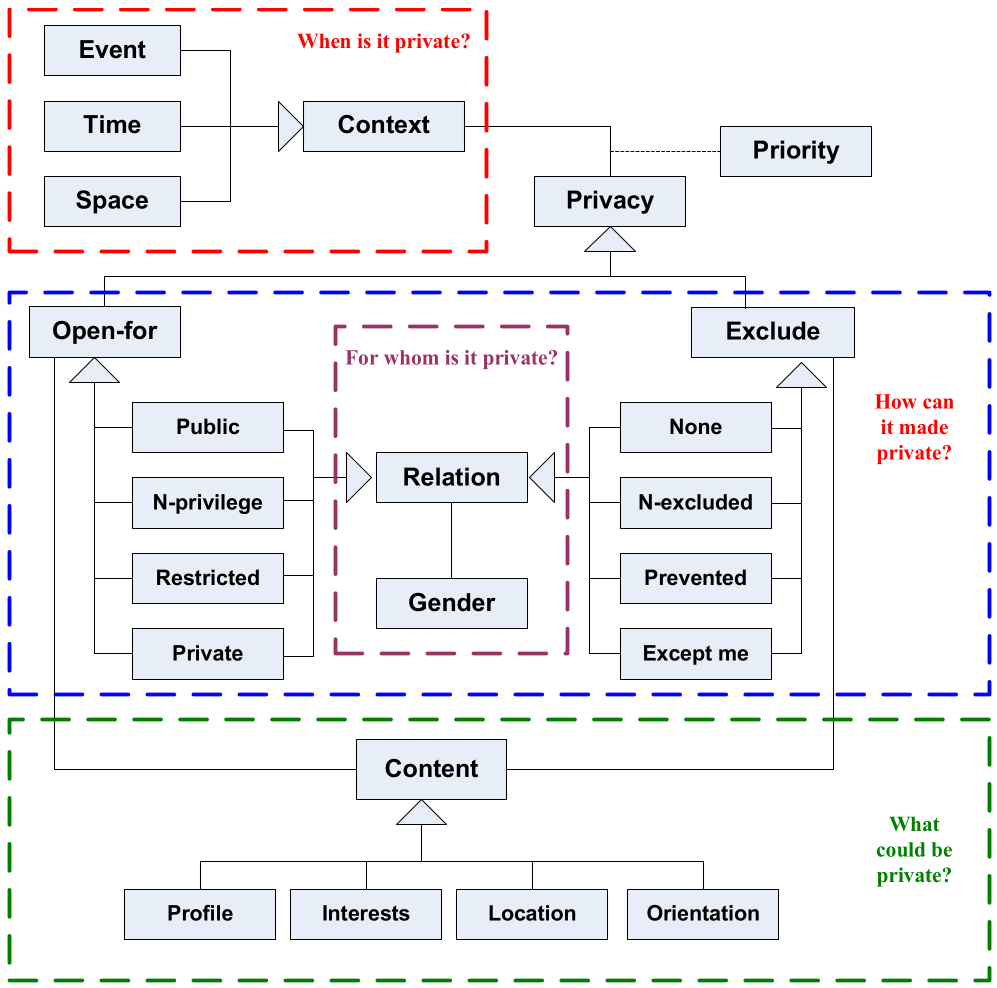
1. The Context-Aware Privacy Model
Instead of a simple "Public/Private" toggle, the authors introduce two attitudes:
- Open-for (Positive Attitude): Default access is granted, refined by
N-privilege(restricting access to nodes within N degrees of separation). - Exclude (Negative Attitude): Default access is denied, using
N-excludedto ensure people beyond a certain social distance can never see the content.
2. The Five-Aspect Trust Model
Trust is viewed not as a score, but as a relationship between the trustor, the trustee, and the environment. The model accounts for:
- Spatial Context: Restricting data in regions with limited freedom of speech.
- Temporal Context: Vulnerabilities that change based on the time of day or activity.
- Intermediaries: Trusting not just the other user, but also the SNS administrator and third-party marketers.
Experimental Insights: The Gender Trust Gap
The most striking part of the research is the gender-based analysis of 600 friendship requests. The researchers used three levels of account disclosure: Minimum, Medium, and Maximum (adding photos and personal interests).
Key Findings:
- The "Visual" Multiplier: For male accounts, adding a picture caused an acceptance spike from 6% to 46%.
- The "Suspicion" Threshold: For female accounts, the "Maximum Information" profile actually saw lower acceptance rates than the "Minimum Information" profile. Users often suspected that overly detailed female profiles were "bots" or fake identities.
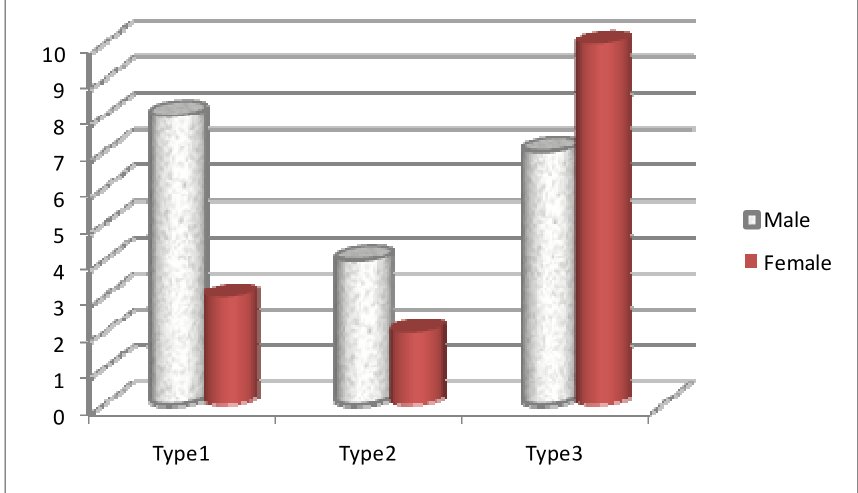 Figure: The acceptance rate of requests sent from male accounts shows a clear preference for profiles with photos.
Critical Analysis: Is "Context" Enough?
The paper identifies a critical flaw in modern SNS architectures: the Inductive Bias that more data leads to better social experiences. By proposing the N-level separation, authors tackle the mathematical reality of small-world networks where everyone is connected by six degrees or less.
Limitations:
- User Burden: While the model is robust, it requires users to define complex parameters (When/Where/Why). Without an AI-driven automation layer, most users might default to the path of least resistance.
- Verifiability: The trust model suggests trusting SNS administrators, but in the era of data commoditization, this "trust" is often legally mandated rather than socially earned.
Conclusion
This work provides a necessary bridge between sociology and computer science. It proves that privacy is not just a technical constraint but a cultural and contextual one. Future SNS platforms should look toward these "N-level" controls and context-sensitive filters to rebuild the crumbling foundation of online trust.