
PBP: Revolutionizing Building Thermal Modeling with Particle-Bernstein Polynomials
An acquisition system of in-house parameters from wireless sensors for the identification of an environmental model
The paper introduces a comprehensive system for acquiring indoor environmental parameters using the ToLHnet protocol and identifies thermal models via machine learning. The core contribution is the application of Particle-Bernstein Polynomials (PBP) for room temperature regression, achieving superior computational efficiency and accuracy compared to standard baselines.
TL;DR
Building energy management hinges on accurate temperature forecasting. This paper presents a full-stack solution: a robust sensor network using the ToLHnet protocol and a novel machine learning approach called Particle-Bernstein Polynomials (PBP). PBP demonstrates a remarkable ability to model complex thermal dynamics with significantly lower computational overhead than traditional Support Vector Machines (SVM) or Decision Trees.
The Challenge: Thermal Inertia and Energy Efficiency
HVAC systems account for over 50% of a building's energy use. To optimize this, controllers need a "Control-Oriented Model" that predicts how internal temperature () reacts to external changes (). However, buildings have thermal inertia—the temperature now depends on what happened 20 or even 100 minutes ago. Modeling this non-linear, time-lagged relationship usually requires heavy computation, which is difficult to implement on low-power local master controllers.
Methodology: ToLHnet and the PBP Insight
The researchers deployed 19 BLE sensors in a controlled grid to collect 164,160 readings. The communication is handled by ToLHnet, a protocol designed to move complexity from end-nodes to a central master, making the network "asymmetrically efficient."
The Core Innovation: Particle-Bernstein Polynomials
Standard regression techniques like Linear Regression are often too simple, while SVMs are too slow for large datasets. The authors introduce Particle-Bernstein Polynomials (PBP).
Traditional Bernstein polynomials are defined by:
PBP improves this by relaxing the integer to a real value . This "particle" approach allows the model to adapt to data distributions more fluidly without the rigid constraints of standard polynomial degrees.
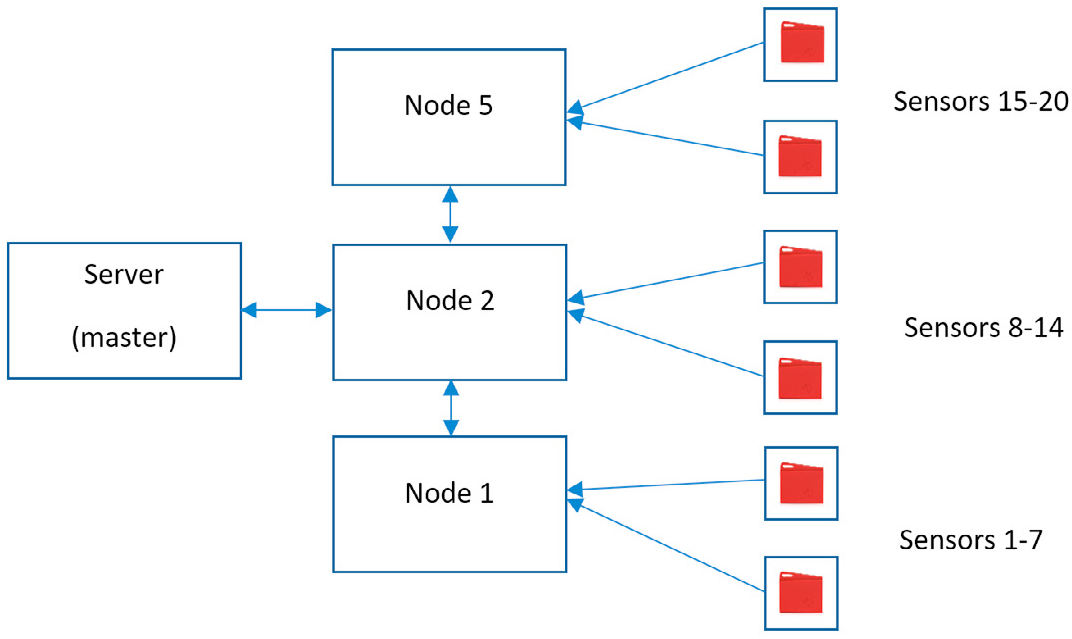 Figure 1: The hierarchical sensor network architecture using the ToLHnet master-slave protocol.
Experimental Showdown: Speed vs. Accuracy
The authors compared PBP against Linear Regression (LR), Classification and Regression Trees (CART), and SVM across two scenarios: (short memory) and (long memory).
1. Accuracy (MSE and R² Score)
For , PBP was the clear winner, achieving a Variance Score of 0.997. In the scenario, CART showed slightly better resilience to long-term lags, but PBP remained highly competitive.
2. The Speed Advantage
The real breakthrough was in Computation Time. While SVM took nearly 95 seconds to train and test for the dataset, PBP finished in mere 0.036 seconds. This makes PBP nearly 2600x faster than SVM in high-dimensional lag spaces.
 Table 4: Training and Testing time comparison showing PBP's massive lead in efficiency.
Critical Insight: Why This Matters
The thermal behavior of a room is essentially a low-pass filter with non-linear characteristics. The PBP method effectively "identifies" this system by placing "particles" (polynomial functions) where the data exists.
Limitations: The paper notes that as the lag increases significantly, CART might offer better accuracy. This suggests a hybrid approach could be optimal: using PBP for fast, real-time updates and CART for deeper periodic historical analysis.
Conclusion
This work proves that we don't always need "deeper" neural networks for effective IoT modeling. By revisiting mathematical foundations like Bernstein Polynomials and adapting them into a "Particle" framework, we can achieve SOTA performance with a fraction of the carbon footprint.
Future Outlook: Integrating PBP models directly into Edge-AI chips could allow every room to have its own autonomous, self-learning HVAC controller that reacts in milliseconds.