
The Deepfake Dilemma: Why the Most Politically Active Are Often the Most Vulnerable
Who inadvertently shares deepfakes? Analyzing the role of political interest, cognitive ability, and social network size
This study investigates the predictors of inadvertent deepfake sharing among social media users in the United States and Singapore. Using survey data from over 1,400 participants, it identifies political interest as a positive driver and cognitive ability as a significant mitigating factor for spreading manipulated AI media.
TL;DR
A cross-national study involving the US and Singapore reveals a counterintuitive reality: individuals most interested in politics are actually more likely to inadvertently share deepfakes. While high cognitive ability serves as a vital defense, the sheer size of one's social network can amplify the "disinformation trap" for the politically engaged.
Background: The New Frontier of Fake News
For years, "disinformation" meant fabricated articles or misleading headlines. Enter Deepfakes—AI-manipulated media so convincing they bypass our logical filters by exploiting the "realism heuristic." We are evolved to trust what we see and hear. This paper, published by Saifuddin Ahmed, explores the socio-cognitive mechanics of why we accidentally click "share" on these digital ghosts.
The "Interest" Paradox
In a healthy democracy, high political interest is seen as a virtue. However, this study suggests it acts as a risk factor for deepfakes.
- The Exposure Trap: Politically interested users are "voracious news consumers." Simply put, they encounter more content, increasing the statistical probability of hitting a deepfake.
- Cognitive Misers: Even the most engaged users often browse in a state of "automaticity," failing to apply critical thinking to every video in their feed.
Methodology: A Tale of Two Nations
The researcher compared the US and Singapore—two vastly different political landscapes—to find universal truths.

The study utilized:
- Wordsum Test: A 10-item vocabulary assessment to gauge cognitive ability.
- Network Estimation: Measuring the "critical network resource" (number of friends).
- Self-Reported Sharing: Tracking instances of "inadvertent" sharing (sharing content later discovered to be a hoax).
Key Findings: The Defensive Shield of Intelligence
The results provided a clear hierarchy of risk and protection:
- Cognitive Ability as a Bulwark: Higher cognitive ability was the strongest predictor of not sharing deepfakes. Interestingly, this effect held even after controlling for education, proving that "raw" processing power matters more than degrees in the fight against AI deception.
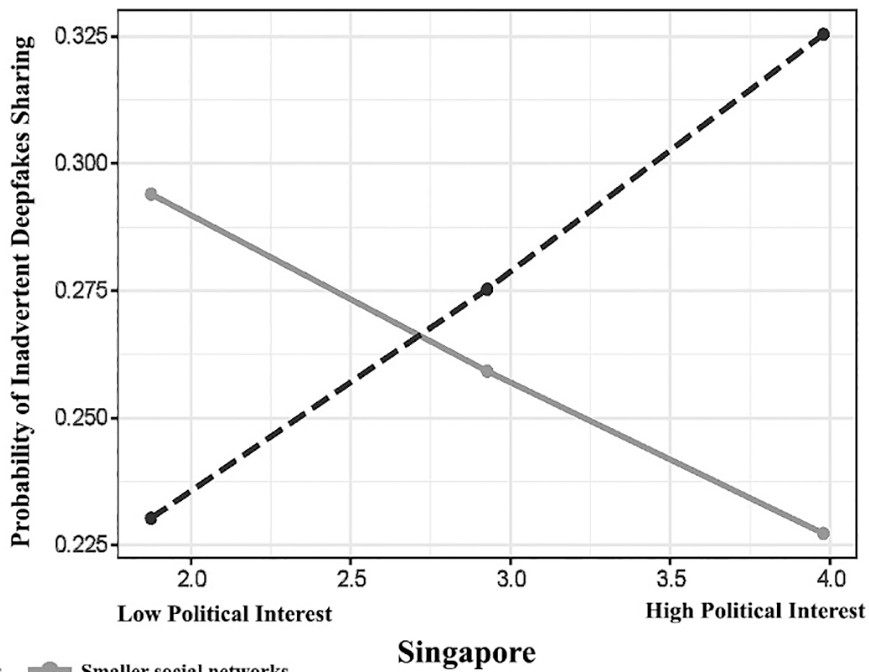
- The Network Amplifier: Social network size doesn't directly cause sharing, but it moderates the effect of political interest. As networks grow, the pressure to act as an "opinion leader" increases, leading highly interested users to share content faster to maintain social influence.
Deep Insights: The "Opinion Leader" Trap
Why does a large network make it worse? The author speculates on Opinion Leadership. Users with huge followings often feel a social obligation to curate and disseminate news. This motivation to stay "relevant" in a large network often overrides the cautious verification process, leading to the "inadvertent" spread of deepfakes.
Critical Analysis & Conclusion
This research highlights a terrifying future: as deepfake technology evolves to eliminate visual artifacts, even those with high cognitive scores may eventually fail.
Takeaways for the Industry:
- Beyond Labeling: While Facebook and Twitter's labeling of manipulated media is a start, it doesn't address the "realism heuristic" at the neural level.
- Targeted Literacy: Media literacy programs should specifically target highly active "opinion leaders" who serve as the nodes in disinformation networks.
- Cross-Cultural Consistency: The fact that these patterns held in both the US and Singapore suggests that deepfake susceptibility is a fundamental human cognitive issue, not just a localized political one.
Limitations: The study relies on self-reporting. Many people share deepfakes and never realize they were hoaxes, meaning the actual rate of sharing is likely much higher than reported.