
Frugal Crowdsourcing: How to Minimize Your Budget While Maximizing Participation
Incentive Mechanism Design to Meet Task Criteria in Crowdsourcing: How to Determine Your Budget
This paper investigates frugal incentive mechanism design for crowdsourcing procurement tasks. It proposes a Truthful Auction-based Mechanism (TM) and a Stackelberg-game-based Mechanism (CS-Mech) to minimize the requester's total payment while meeting a predefined task contribution target.
TL;DR
In crowdsourcing, paying participants enough to guarantee honest behavior (truthfulness) often leads to "overpaying." This paper introduces two new incentive models—one based on auctions and another on game theory—that minimize the requester's total payment while ensuring a task's contribution goals are met. The results show we can achieve high-quality results with a budget very close to the theoretical minimum cost.
Context: The Hidden Cost of Honesty
Crowdsourcing platforms like Amazon Mechanical Turk or specialized sensing networks rely on selfish participants. To get them to contribute, you must reward them. Traditionally, mechanisms like VCG (Vickrey-Clarke-Groves) are used to ensure users don't lie about their costs (Truthfulness).
However, there's a catch: VCG can be incredibly expensive. In some cases, the requester might end up paying times more than the actual cost of the work. This paper asks a fundamental question: Is it possible to design "frugal" mechanisms where the total payment is bounded and close to the optimal cost without incentives?
1. The Auction-Based Approach: Guaranteeing Truthfulness
The authors first propose a Truthful Mechanism (TM). This is "user-centric": users submit bids (cost and maximum contribution), and the system decides how much of their service to buy and what to pay.
The "secret sauce" here is a logarithmic allocation function:
By using this specific curve and a "stretching parameter" , the authors prove that:
- Truthfulness is a dominant strategy (no one benefits from lying).
- Frugality: The total payment is at most the optimal cost plus a bounded additive value related to the task's target.
2. The Stackelberg Game: Optimizing the Budget
To push frugality even further, the authors propose CS-Mech, a requester-centric game. Here, the requester announces a fixed budget first. Users then compete for a share of this budget based on their relative contribution (Proportional Share Rule).
The Challenge of Heterogeneity
In the real world, participants have different skills (Value) and different expenses (Cost). Previous models assumed everyone was the same, which simplified calculations. In this paper's general setting, the Nash Equilibrium (NE)—the state where no one wants to change their strategy—is much harder to find.
The O(n³) Algorithm
The authors developed a sophisticated algorithm to find the unique NE. It uses a "fixing" procedure:
- Start by assuming everyone can contribute any amount.
- Check which users would "overshoot" (try to contribute more than 100% of their capacity).
- Iteratively fix those users at 100% and recalculate until the system settles.
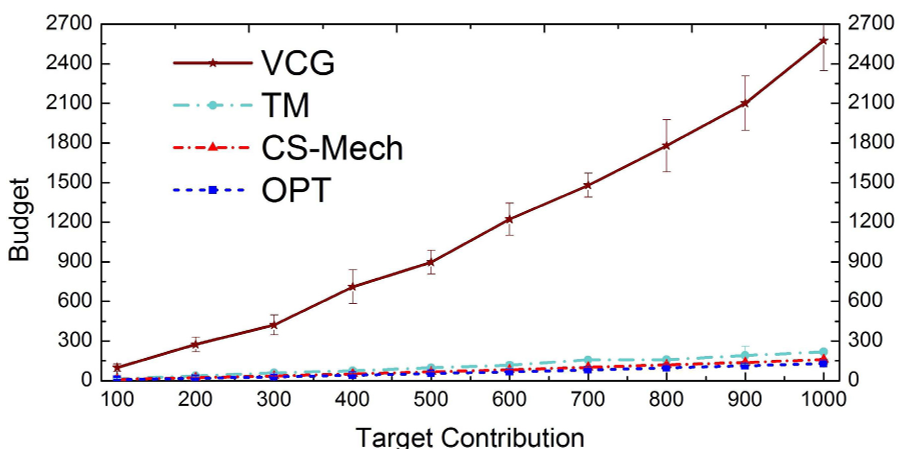 Fig 1: The payment efficiency of TM and CS-Mech compared to the theoretical optimum (OPT) and the expensive VCG.
3. Key Findings & Experimental Results
The researchers tested their models with 1,000 users and varying cost-to-value ratios.
- VCG is indeed expensive: It consistently required much higher budgets than any other method.
- Stackelberg (CS-Mech) Wins on Frugality: It used less payment on average than the auction-based TM.
- The Price of Truthfulness: The experiments showed that requiring "Dominant Strategy Truthfulness" (in the auction) costs about twice as much extra payment as simply reaching a "Nash Equilibrium" (in the game).
 Table 1: As costs grow (Case I to Case V), the mechanisms become even more efficient relative to the optimal solution.
Takeaways for Academic and Industry Leaders
If you are building a crowdsourcing platform or a decentralized network (like a DePIN project), this research suggests you don't always need to pay the "VCG tax" to ensure participation.
- Use Stackelberg Games if you have historical data on participant costs—it's the most budget-efficient path.
- Use Frugal Auctions if you have zero information about your participants—it still protects your budget better than traditional methods.
The bottleneck remains the assumption of linear utility; future work exploring concave utility functions (where the 10th hour of work is "harder" than the 1st) will be the next frontier in crowdsourcing economics.