
Beyond Absolute Metrics: Why Rank-Order Tournaments Rule Mobile Crowdsourcing
12692_Incentive Mechanism for Mobile Crowdsourcing Using an Optimized Tournament Model.
This paper proposes a rank-order tournament incentive mechanism for mobile crowdsourcing to maximize a service provider's utility while ensuring continuous user participation. By rewarding users based on their relative performance rank rather than absolute metrics, the method effectively filters out "common shocks" (measurement errors) that typically plague contract-based systems.
TL;DR
Mobile crowdsourcing often fails because service providers and users don't trust the data metrics used for payments. This paper introduces an Optimized Tournament Model that rewards users based on their rank rather than absolute numbers. This simple shift filters out environmental noise ("common shocks") and prevents the service provider from cheating, ultimately maximizing utility for everyone involved.
Background: The Trust Gap in Crowdsourcing
In mobile crowdsourcing, a principal (the service provider) needs data from users (participants with smartphones). However, two problems usually break the system:
- Moral Hazard: Users might provide low-quality data to save battery (free-riding).
- Common Shock: Factors like bad GPS signals or sensor errors can make a hard-working user look like a slacker.
- False Reporting: If rewards are based on absolute performance, the principal is tempted to lie and say the data was poor to save money.
The Solution: The Power of Ranking
The core insight of this paper is that while absolute performance is noisy and easy to manipulate, ordinal ranking is robust. In a tournament, the principal commits to a set of prizes () before the task starts. No matter what the "absolute" quality of data is, someone will be #1 and get the top prize. This removes the principal's incentive to lie because the total payout is fixed.
Methodology: From Contracts to Tournaments
The authors solve the tournament design problem in three steps:
- Ideal Contract Analysis: They first determine what the "perfect" reward would be if the principal had full information (no noise).
- Step-Function Approximation: They approximate this continuous reward curve using discrete steps corresponding to ranks.
- Effort Optimization: They derive how much effort () a user will actually exert given the probability of hitting a specific rank.
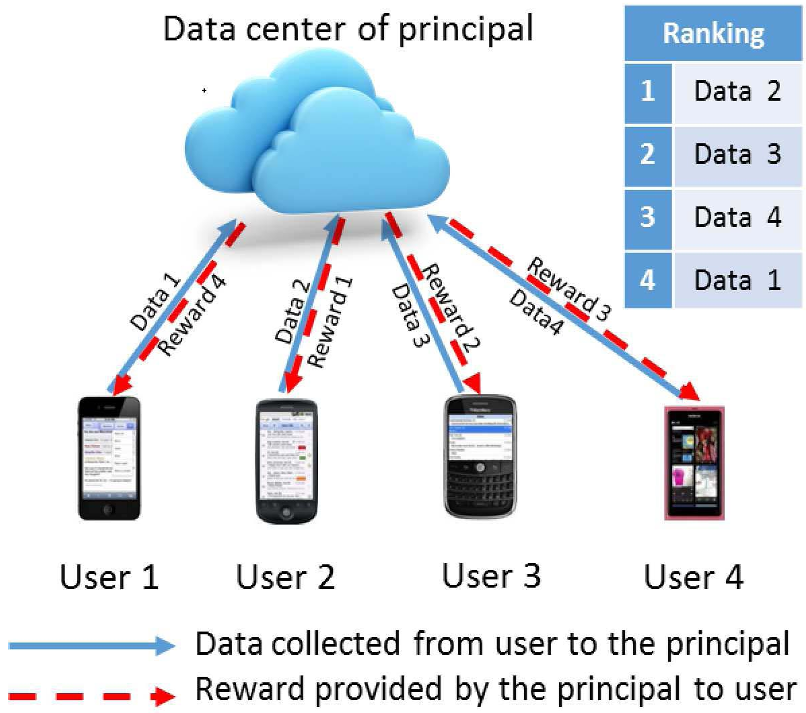 Figure 1: Illustration of the Rank-Order Tournament mechanism.
Key Design Features
The paper uncovers several "physics" laws of crowdsourcing tournaments:
- The 50% Rule: Mathematically, to maximize effort, the principal should not reward everyone. In fact, receiving a prize is usually only optimal for ranks . Slacker-level performance gets zero reward.
- The Spread: The gap between prizes should grow as the rank increases. The difference between #1 and #2 is larger than the difference between #4 and #5. This creates a "long tail" of high-value rewards that drives peak performance.
- Risk Tolerance: If users are less afraid of risk (high risk tolerance), they exert more effort, and the principal can offer a wider spread between top ranks.
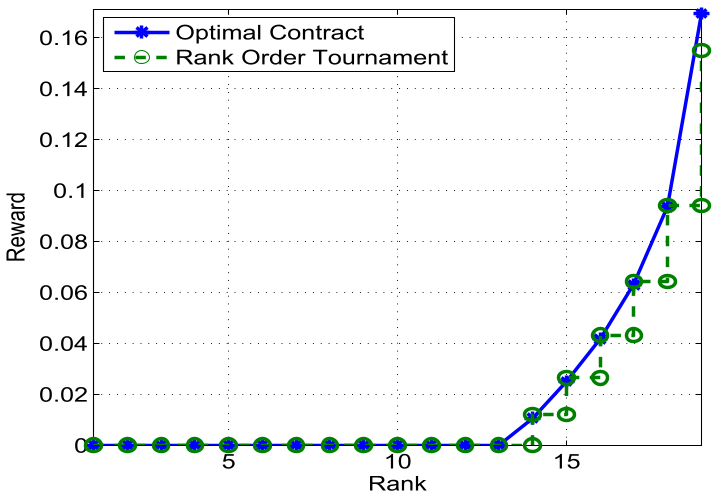 Figure 2: Comparison of the discrete Tournament prizes vs. the continuous Optimal Contract.
Experimental Insights
Through simulations (Figures 3-7 in the paper), the authors validated the impact of three variables:
- User Count (): As more users join, the probability of any single user winning drops, which can lower effort. The principal counters this by increasing the number of winners but narrowing the prize spread.
- Noise/Variance (): When the link between effort and result is noisy, users tend to work less. However, the tournament remains more stable than absolute contracts because it "filters" the noise shared by all users.
- Principal Utility: Interestingly, while an absolute contract provides a theoretical upper bound for the principal, the tournament is the practical winner in real-world "noisy" environments.
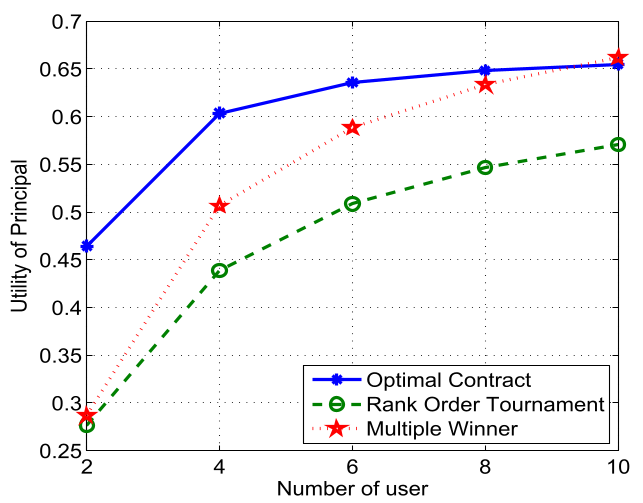 Figure 3: User utility trends across different system parameters.
Critical Analysis & Conclusion
Takeaway
The rank-order tournament is a powerful tool for mobile crowdsourcing. It solves the Moral Hazard and False Reporting problems simultaneously. For developers building LBS (Location Based Services) or data-collection apps, switching from "pay-per-datum" to "rank-based-prizes" could significantly increase the quality and reliability of incoming data.
Limitations
The current model assumes identical users. In reality, a user with an iPhone 15 Pro has a hardware advantage over someone with a $100 budget phone. Future research needs to account for asymmetric contestants to ensure the tournament remains fair and competitive for everyone.