
Fair Gains in the Gig Economy: A Shapley Value Approach to SC Platform Cooperation
Incentive Mechanism for Spatial Crowdsourcing Cooperation: A Fair Revenue Allocation Method
This paper introduces a game-theoretic framework for revenue allocation in Spatial Crowdsourcing (SC) platform cooperation. It proposes the Shapley value-based Revenue Allocation (SRA) method and a more efficient approximation variant, Coalition-based SRA (CSRA), to distribute the economic surplus generated by multi-platform worker-task sharing fairly.
TL;DR
Spatial Crowdsourcing (SC) platforms like Uber or Meituan often face supply-demand imbalances. While "sharing" workers and tasks between platforms can maximize social welfare, it raises a critical question: Who gets the extra profit? This paper proposes SRA and CSRA, mechanisms based on Cooperative Game Theory that ensure every platform is compensated fairly according to its marginal contribution, solving the "incentive to cooperate" problem.
Problem & Motivation: The Cooperation Paradox
In the world of Spatial Crowdsourcing, the distribution of workers (supply) and tasks (demand) is rarely uniform. Platform A might have 100 idle riders in a quiet district, while Platform B has 100 unfulfilled orders in a busy one. Cooperation seems like a "win-win," yet it rarely happens at scale.
The rub? Current research focuses heavily on the logistics—how to match the worker to the task—but ignores the economics. If Platform B completes its orders using Platform A's workers, how much should Platform B pay Platform A? A simple 50/50 split ignores the reality that one platform might have provided more value by bringing more specialized resources to the table.
Methodology: Game Theory to the Rescue
The authors argue that platform cooperation is a Cooperative Game. To ensure fairness, they adopt the Shapley Value, a solution concept that satisfies four critical axioms:
- Group Rationality: All generated revenue is distributed.
- Individual Rationality: Platforms earn more by cooperating than by going solo.
- Symmetry: Equal contributors get equal pay.
- Dummy Player: Those who contribute nothing gain nothing.
The SRA Method
The Shapley value-based Revenue Allocation (SRA) calculates the average marginal contribution of a platform over all possible subsets of participants:

Scaling Up: The CSRA Innovation
The problem with the standard Shapley value is its Exponential Complexity (). If you have 20 platforms, you need to calculate over a million combinations.
The authors propose CSRA (Coalition-based SRA). Instead of treating every platform as an individual agent, they:
- Randomly group platforms into coalitions.
- Calculate revenue distribution between these coalitions.
- Distribute the coalition's share among its internal members.
This reduces the search space from to , making it computationally feasible for real-time applications.
Experiments: Performance vs. Precision
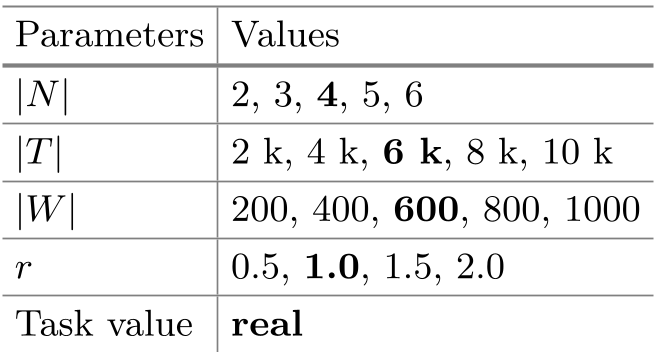
Using real-world data from Didi Chuxing (Chengdu taxi orders), the authors compared SRA, CSRA, and a simple Weighted Average (WA) baseline.
- Effectiveness: CSRA remained consistently close to the "True" Shapley value (low MAPE), while the Weighted Average (WA) method had high errors because it failed to account for the synergistic effects of worker-task density.
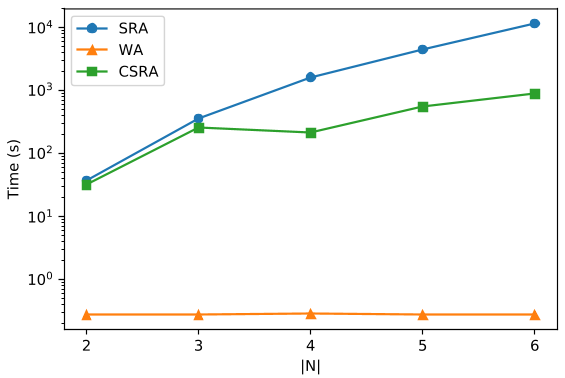
- Efficiency: As shown in the experimental graphs, while SRA’s time consumption skyrockets as the number of platforms increases, CSRA’s growth is much more manageable, especially when is optimized to .
Critical Insight & Future Outlook
The beauty of this work lies in moving SC research from purely algorithmic matching to economic sustainability. By proving that we can approximate fair revenue allocation efficiently, the authors remove a major hurdle for B2B collaboration in urban logistics.
Limitations: The current CSRA uses random grouping for coalitions. In a competitive market, platforms might be picky about who they are grouped with. Future work could explore strategic coalition formation, where platforms choose partners to maximize their collective Shapley value.
Final Takeaway
For SC platforms to truly "cooperate," they don't just need better APIs; they need a "fairness guarantee." SRA and CSRA provide the mathematical backbone for that promise.