
Beyond the Bottom Line: Why Social Context is the Next Frontier for SLAs
Incentives in Service Level Agreement establishment the case of economic and social aspects
This paper explores the integration of social preferences into Service Level Agreement (SLA) negotiations. It transitions from a purely economic model of price and penalty to a socio-economic framework that accounts for trust, reciprocity, and non-monetary incentives in Social Computing environments.
TL;DR
Service Level Agreements (SLAs) are the backbone of digital services, but they are currently built on a flawed foundation of "rational greed." This paper argues that in the age of Social Computing (Facebook, LinkedIn, etc.), we must move beyond monetary penalties. By incorporating Social Preferences like trust and reciprocity, we can create more resilient and effective service ecosystems.
The "Rationality" Trap: Why Traditional SLAs Fail
In a standard economic setting, a service provider and consumer follow a predictable dance: the provider sets a price, the consumer sets a penalty for failure, and both parties seek to maximize their own profit. This is mathematically expressed as:
Where:
- : Price
- : Costs
- : Expected penalty cost.
The Problem? Humans aren't machines. Prior work shows that purely monetary incentives can "crowd out" intrinsic motivation. If you pay someone to be a good partner, they stop being a partner and start being a profit-optimizer. In social networks, the relationship is the value, and traditional SLAs ignore this entirely.
Methodology: From Economic Games to Social Contracts
The authors contrast the Ultimatum Game (where fairness dictates behavior) with the Dictator Game. In theory, a rational agent would offer the smallest possible fraction of a reward to their partner. In reality, people offer significantly more to avoid being "punished" for unfairness.
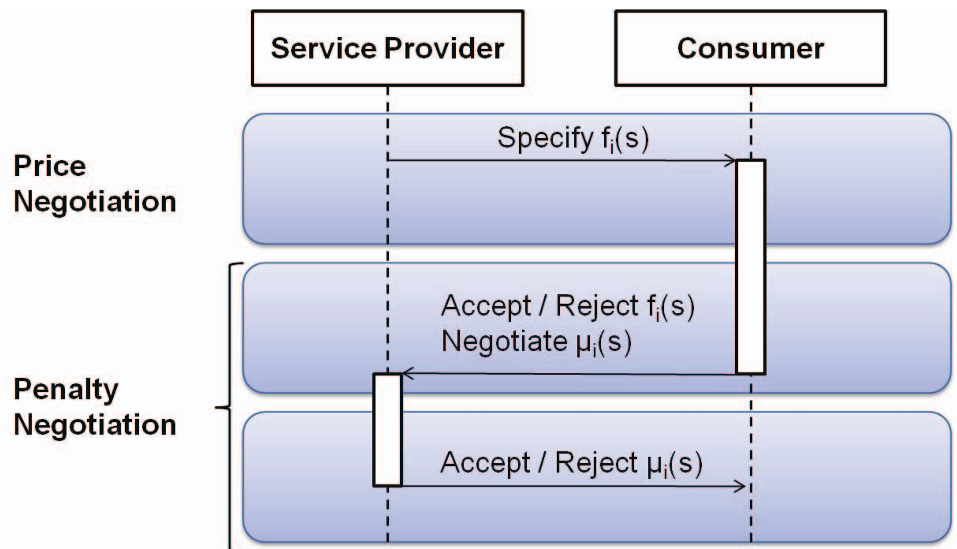
The paper argues that Social Computing scenarios are characterized by:
- Incomplete Information: Users rarely know the provider's exact failure distribution.
- Implicit Penalties: Instead of a fine, the penalty for a service failure in a social network might be a loss of reputation or the denial of future reciprocity.
Requirements for the "Social SLA"
To bridge the gap between sociology and computer science, the authors propose five core requirements for future contract modeling:
- Description of Relationships: Modeling the diverse types of connections (e.g., friend vs. professional).
- Formalized Trust: Moving trust from a "feeling" to a mathematical parameter in the negotiation.
- Flexibility: Individualized contracts that don't rely on a one-size-fits-all legal template.
- Reciprocity: Capturing "I help you, you help me" cycles through commitment-based patterns.
- Non-Monetary Penalties: Integrating "Social Threats" (like lower search ranking or social exclusion) as a deterrent.
Critical Insight: The Shift to Socio-Technical Design
The most striking takeaway is the realization that Information Symmetry is a myth in modern service interactions. Most SLA negotiations today resemble a Principal-Agent problem where the "Principal" (consumer) is flying blind.
By introducing Social Welfare Maximization—where the goal is the total payoff of all players rather than individual rent-seeking—systems become more stable.
Conclusion & Future Outlook
This paper serves as a conceptual manifesto. The next step for the industry is to develop a "Criteria Catalogue" that allows platform designers to choose the right incentive (monetary vs. social) for a specific setting. As we move toward decentralized autonomous organizations (DAOs) and AI-driven service agents, understanding the Socio-Economic impact of our code is no longer optional—it is a requirement for survival.
Future research will focus on formalizing trust-driven mechanisms that determine efficient price levels in social settings.