
Incentivize to Build: Balancing the Economics of Federated Learning
Incentivize to Build: A Crowdsourcing Framework for Federated Learning
The paper proposes a novel crowdsourcing framework for Federated Learning (FL) that optimizes the trade-off between local computation and global communication. It leverages a two-stage Stackelberg game to model the interaction between an MEC server (leader) and mobile clients (followers), ensuring high-quality global model updates through an incentive-based reward mechanism.
TL;DR
Federated Learning (FL) is often discussed as a technical challenge of communication and convergence. This paper shifts the focus to Economics: How do we motivate mobile users to participate? By framing FL as a two-stage Stackelberg game, the authors propose a crowdsourcing framework that optimizes rewards to ensure clients provide high-quality updates while minimizing the total cost of the global model.
The "Motivation Gap" in Federated Learning
Most FL research assumes clients are "willing participants." In reality, training a local model is expensive—it drains battery, consumes CPU cycles, and takes time. Without a clear incentive, rational users won't participate, leading to sparse data and poor model performance.
The core tension lies in Local Accuracy () vs. Global Rounds:
- If a client does very little local work (large ), the server needs more global communication rounds to converge.
- If a client does heavy local work (small ), the server converges faster, but the client’s local cost skyrockets.
Methodology: The Stackelberg Game Approach
The authors model this interaction as a game between a Leader (MEC Server) and Followers (Mobile Clients).
1. The Client's Dilemma (Stage II)
Each client maximizes its utility , which is the reward received minus the cost of computation and communication. The cost model is defined as:
u_k T_k + (1 - u_k) \gamma_k \log(1/ heta_k))$$ where $ u_k$ acts as a "preference weight" between talking to the server and crunching numbers locally. ### 2. The Server's Strategy (Stage I) The MEC server wants the best global model for the least reward payout. It determines the optimal reward rate $r^*$ after predicting how clients will react. 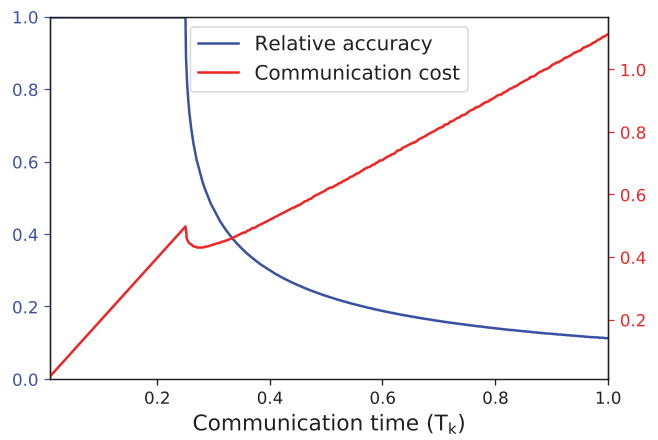 *Fig 1: Analysis of local accuracy $ heta$ against communication adversity $T_k$. As communication becomes more "expensive," clients are incentivized to work harder locally.* ## Key Insight: Client Heterogeneity One of the paper's strongest contributions is the classification of clients: - **Reluctant Clients**: Low $ u_k$. They hate computing and require high rewards to improve accuracy. - **Sensitive Clients**: High $ u_k$. They are highly affected by channel quality and prefer to compute more locally to avoid the cost of poor communication. - **Rational Clients**: Balance both costs effectively. ## Experimental Performance The proposed **Algorithm 1** (a linear complexity approach) was compared against an exhaustive Search (OPT) and a heuristic Baseline. 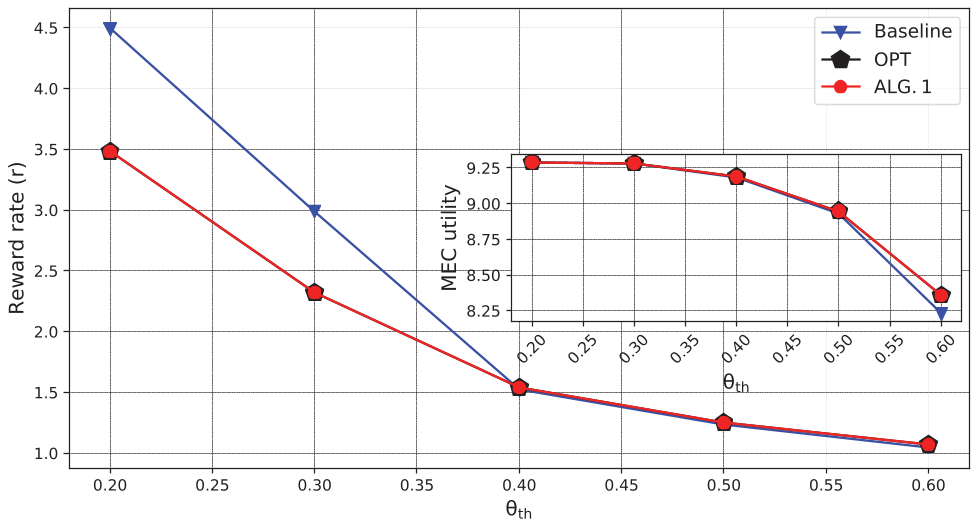 *Fig 2: Reward Rate (a) and MEC Utility (b) vs. Threshold Accuracy.* The results show that the proposed mechanism perfectly matches the Optimal (OPT) solution while providing a **22% gain** in reward efficiency over the baseline. As the server demands higher threshold accuracy (smaller $ heta$), the reward rate naturally increases to compensate clients for their increased local effort. ## Critical Perspective & Summary This work provides a robust mathematical foundation for the "pay-to-play" model of Federated Learning. **Takeaways:** 1. **Dynamic Incentives**: Fixed rewards are inefficient. Rewards must scale with the desired local accuracy and the client's specific channel conditions. 2. **Linear Complexity matters**: The paper provides Algorithm 1, ensuring that the server can solve the incentive problem in real-time even with many clients. **Limitations**: The model currently relies on a centralized MEC server. The next frontier, as the authors suggest, is **Self-Organizing FL**, where incentives are managed in a completely peer-to-peer (P2P) fashion, likely requiring blockchain or smart contracts to manage the "bounty" distribution.