
Incentivizing Truth: A Game-Theoretic Approach to Defeating Fake News
Incentivizing the dissemination of truth versus fake news in social networks
The paper introduces an integrated game-theoretic framework to model the spread of truth versus fake news in social networks using the Volunteer’s Dilemma (VOD). It proposes a subscription-based shared reward mechanism to incentivize "truth dissemination" as a public good, successfully identifying stable equilibria where truthful news can dominate fake news.
TL;DR
Is "truth" a public good? This paper argues that it is, and like all public goods, it suffers from the "free-rider" problem. By modeling social interactions as a Volunteer’s Dilemma (VOD), the authors demonstrate that without specific incentives, users choose not to verify news. However, by implementing a shared reward mechanism (e.g., subscription-driven journalism), the system can reach a stable equilibrium where truth outmuscles fake news.
The Core Conflict: Why We Don't Fact-Check
In the digital age, a piece of news gains credibility simply by going viral. This "network effect" creates a dangerous loophole: investigative journalism is expensive, while creating fake news is cheap.
The authors frame this as a Volunteer’s Dilemma. If at least people volunteer to verify news, the society benefits (the "truth" is established). But if I expect you to do the hard work of fact-checking, I can "free-ride" on your effort. If everyone thinks this way, the public good fails, and fake news fills the vacuum.
Methodology: Engineering the Incentive
The authors propose a symmetric mixed-strategy model for regular agents and fake news agents. The breakthrough here is the Shared Reward Pool ().
Unlike traditional VOD models where the cost is purely a burden, this model introduces an aggregated reward (representing the value of credible journalism subscriptions) that is distributed among those who volunteer to validate news.
The Payoff Mathematical Intuition
The payoff for volunteering () and defecting () is calculated based on:
- : Cost of volunteering (fact-checking).
- : Cost of failure (the social cost of fake news winning).
- : Number of actual volunteers.
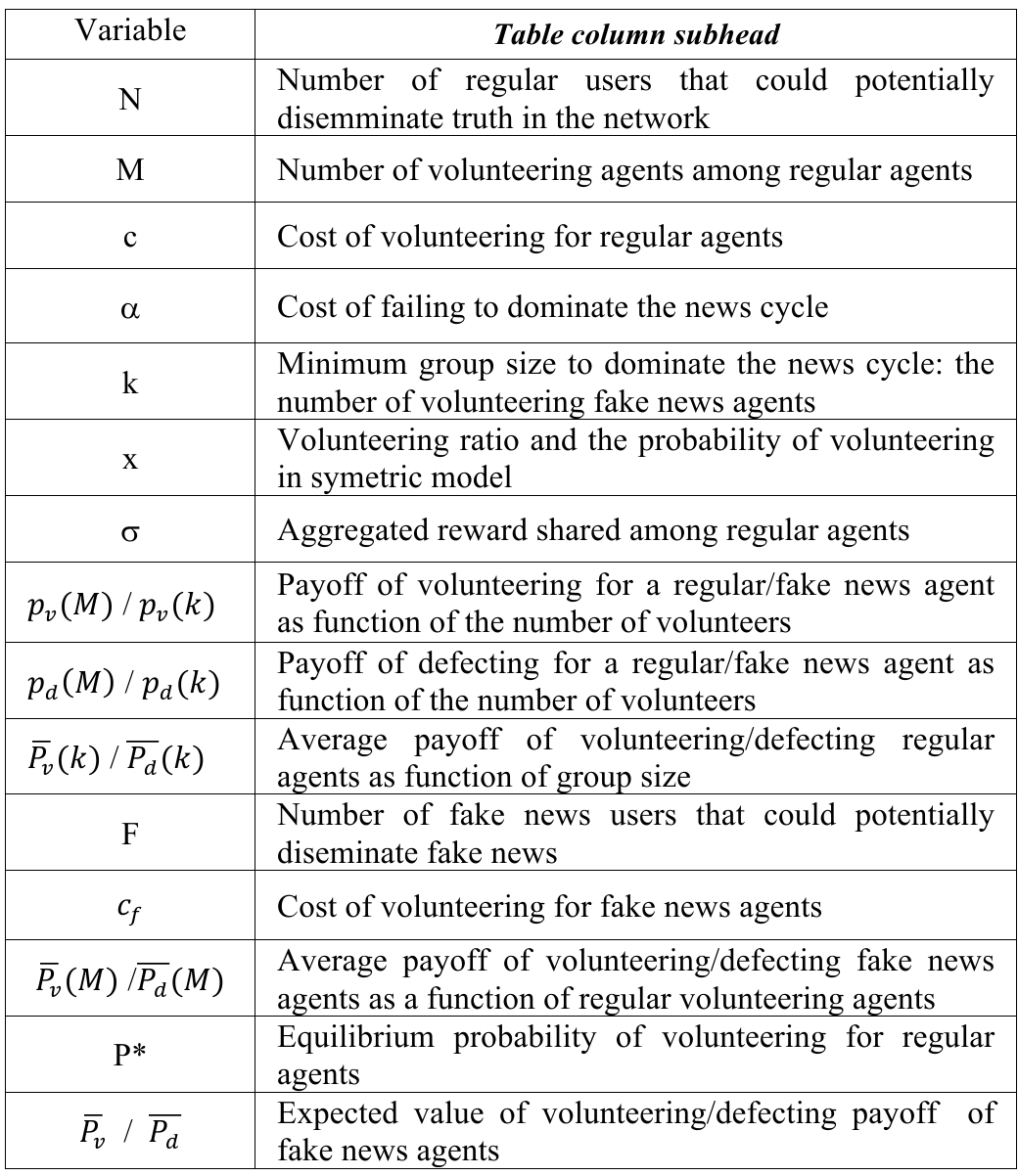 Table 1: Key variables defining the interaction between regular users and fake news agents.
The model assumes that the "Fake News" group is smaller but more motivated. Their success depends on the threshold—if regular users don't provide enough volunteers to reach , fake news dominates the news cycle.
Experimental Insights: The Power of Reward
The research highlights two critical findings regarding the stability of the network:
1. The Stability of Truth
As shown in the charts, there are two equilibrium points where the net payoff difference is zero. However, only the one with a negative derivative is stable.
- The Insight: Increasing the shared reward doesn't just make people feel better; it shifts the stable equilibrium point to the right, meaning a higher percentage of the population will consistently volunteer to verify information.
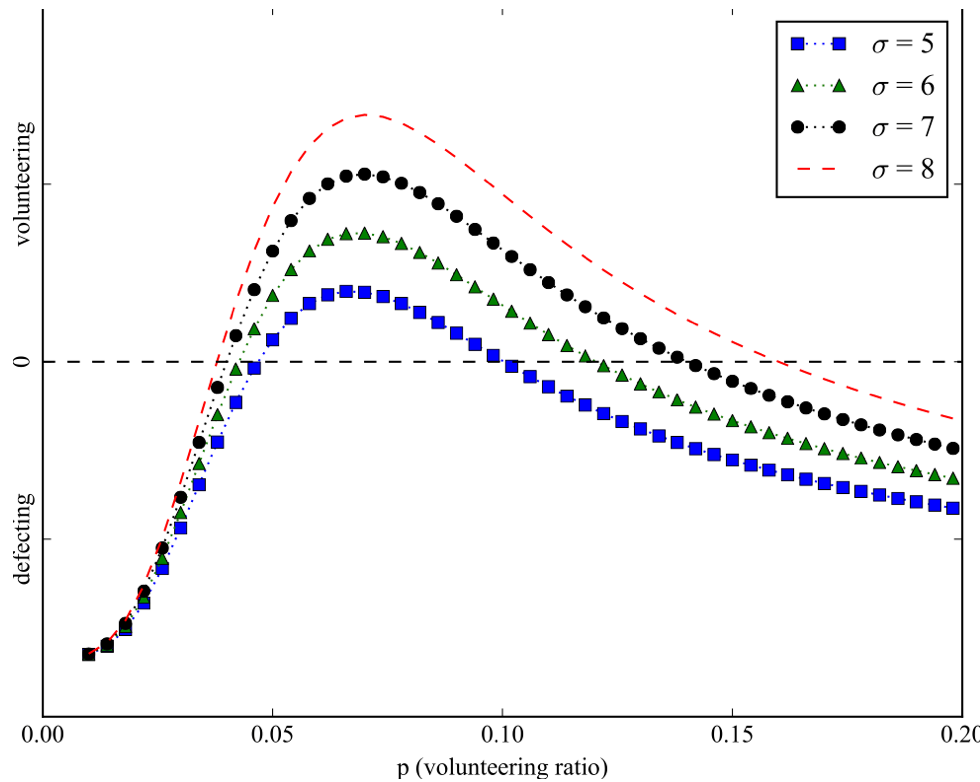 Figure 1: Net payoff difference. As the total reward () increases, the stable equilibrium (where the line crosses zero with a downward slope) moves toward a higher volunteering ratio.
2. Disincentivizing the Fakes
One of the most profound conclusions is the "leakage" of the regular agents' equilibrium into the fake news agents' payoff. When regular agents have high volunteering probabilities, the "expected payoff" for fake news agents plummets.
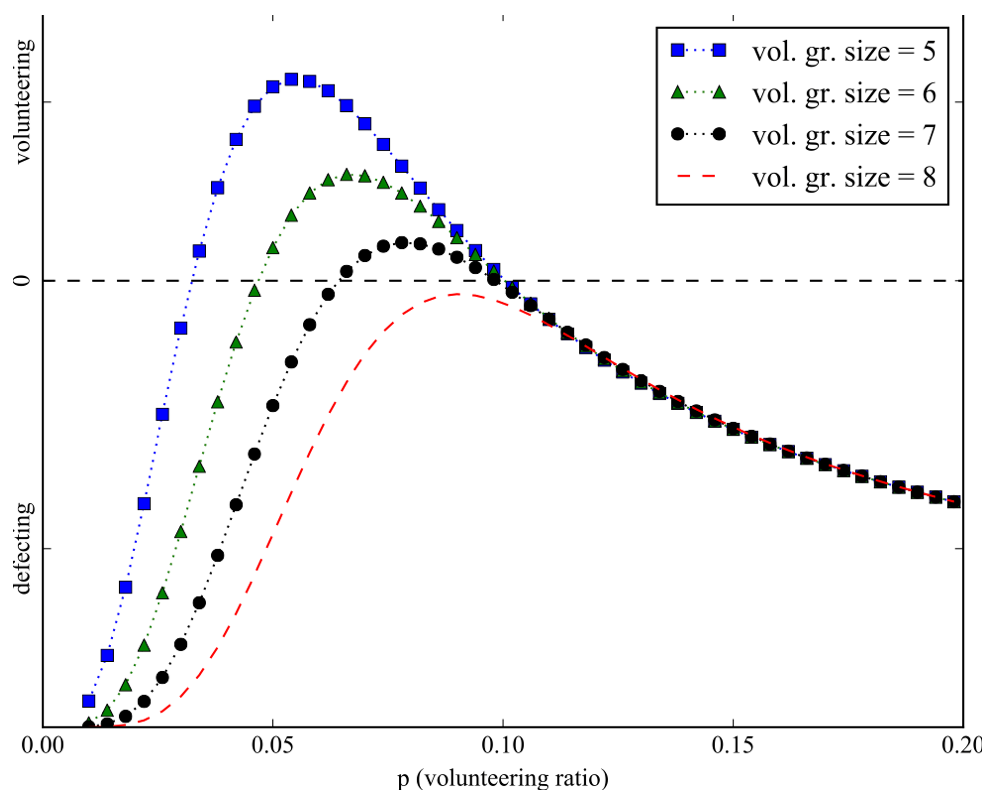 Figure 3: Net payoff for fake news agents. When truth-volunteering probability (vol.prob) is high (e.g., 0.10), the incentive for fake news spreaders is drastically suppressed.
Critical Analysis & Conclusion
The paper effectively treats a social problem as a System of Systems (SoS) governance issue. By focusing on Shared Rewards, it moves the conversation from "censorship" to "incentive alignment."
Takeaways:
- Financial Models Matter: Subscription-based journalism isn't just a business model; it’s a defense mechanism for social truth.
- Asymmetry: The model shows that while regular user behavior strongly affects fake news agents, the reverse is less true. This means proactive truth-incentivizing is more effective than reactive fake-news-punishing.
Limitations: The model assumes agents are homogeneous and the network is balanced. In reality, Echo Chambers and the "Strong vs. Weak" agent dynamics (asymmetric VOD) might create pockets where fake news remains dominant despite global incentives. Future work and dynamic algorithms will be needed to address these heterogeneous clusters.