
Incentivizing Distributive Fairness: A New Game-Theoretic Blueprint for Crowdsourcing
Incentivizing Distributive Fairness for Crowdsourcing Workers
This paper introduces a game-theoretical framework to incentivize "Distributive Fairness" in crowdsourcing markets like Amazon Mechanical Turk. It proposes a novel pricing policy for requesters and a reputation-based rating policy for platforms to minimize payment variance among workers while maintaining high-quality outputs.
TL;DR
Crowdsourcing markets often feel like a "race to the bottom" regarding worker wages. This paper moves beyond simple ethics to provide a mathematical framework for Distributive Fairness. By modeling the interaction between platforms, requesters, and workers as a 3-level Stackelberg Game, the authors demonstrate that we can minimize pay disparity and improve work quality without blowing the requester's budget.
The "Fairness" Gap in Digital Labor
In platforms like Amazon Mechanical Turk (AMT), the requester holds all the power. They set the price, often with zero cues on what is "fair," and can reject work unilaterally. This creates a toxic environment of high variance: some workers are underpaid for high effort, while others are penalized for minor errors.
The authors identify Distributive Fairness—the consistency of input/output (labor/compensation) ratios—as the missing piece. Existing SOTA methods focus on utility maximization (getting the most work for the least money), but this paper argues that fairness maximization is the key to long-term market health and worker retention.
Methodology: The Three-Layer Game
The researchers break the system down into three distinct layers, each with its own objective function:
- The Platform (Layer 1): Acts as the ultimate leader. Its goal is to maximize fairness (minimize payment variance) by setting a "Rating Policy" that dictates how requester reputations are calculated.
- The Requesters (Layer 2): They want to maximize the total work completed while maintaining a high enough reputation (rating) to attract skilled workers.
- The Workers (Layer 3): They optimize their effort level to maximize personal utility (Payment minus Effort/Laziness).
The Pricing Mechanism
The authors propose a quadratic pricing function that maps a worker’s approval ratio to their compensation. Unlike binary pay, this rewards quality on a gradient.
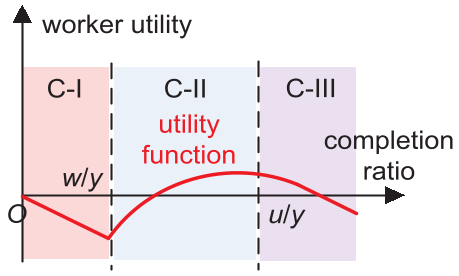
Figure 1: The quadratic pricing function ensures that workers are rewarded proportionally to their performance, avoiding the "all-or-nothing" trap.
Scalable Optimization via Primal Decomposition
Solving a 3-level optimization problem is typically NP-hard. To make this practical for a platform with millions of users, the authors utilized Primal Decomposition. They decoupled the requesters' competition by fixing the average market rating, allowing each requester's best-response problem to be solved in parallel.
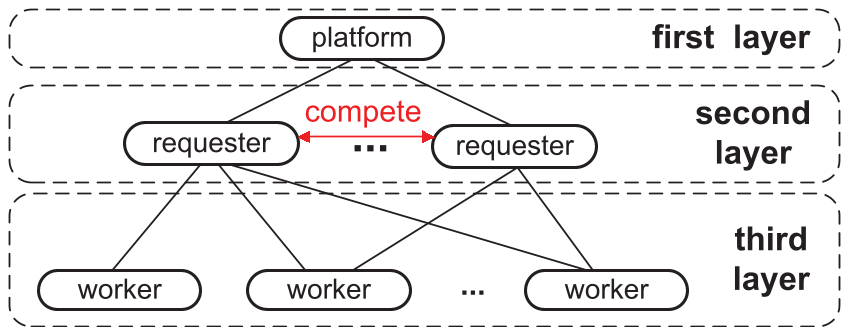
Figure 2: The 3-layer hierarchical structure of the proposed Payment Fairness Maximization (PFM) model.
Experimental Results: Fairness at Scale
Using a massive dataset of 3 million task records, the authors compared their model against real-world AMT traces.
- Fairness vs. Cost: The model achieved significantly lower payment variance (higher fairness) than the actual market trace, even when the total budget remained identical.
- Computational Efficiency: The distributed approach maintained a runtime under 15 seconds for 150 requesters, whereas a centralized subgradient method spiked to over 120 seconds.
- The "Laziness" Insight: By estimating the "laziness coefficient" () of workers from historical data, the model can predict exactly how much incentive is needed to guarantee high-quality submissions.
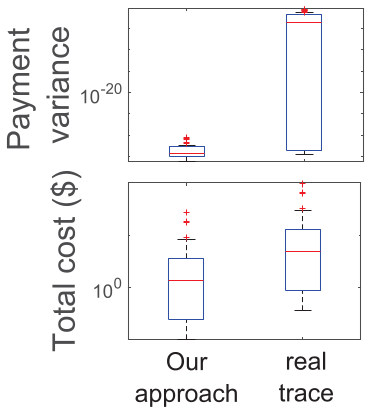
Figure 3: Our pricing policy (darker bars) reduces payment variance compared to real AMT traces across various task groups.
Critical Insight: Why This Matters
The brilliance of this work lies in treating fairness as a competitive advantage. In a fair market, high-quality workers stay, and requesters get better data. The study objectively proves that "being fair" doesn't have to be more expensive—it just requires a more intelligent redistribution of the existing budget based on quality-driven quadratic functions rather than arbitrary rejections.
Limitations & Future Work
The current model assumes all tasks from a requester have equal urgency. In the real world, "rush jobs" might require higher variance in pay to incentivize speed. Integrating temporal urgency and multi-dimensional effort (creativity vs. rote labeling) represents the next frontier for this research.
Conclusion
This paper provides a robust mathematical foundation for a "Fairer Gig Economy." By implementing reputation-based rating policies and quality-sensitive pricing, crowdsourcing platforms can transition from digital sweatshops into efficient, equitable marketplaces.