
Achieving Truthfulness in the Wild: The QEDE Mechanism for Quality-Aware Crowdsourcing
Incentivizing Truthful Data Quality for Quality-Aware Mobile Data Crowdsourcing
The paper proposes the Quality, Effort, and Data Elicitation (QEDE) mechanism, a novel incentive framework for mobile data crowdsourced tasks centered on coarse-grained detection. It achieves dominant incentive compatibility (DIC) and individual rationality (IR), ensuring that strategic workers truthfully report private quality and data while exerting the effort desired by the requester.
TL;DR
In mobile data crowdsourcing, the "wisdom of the crowd" is often undermined by "lazy" or "dishonest" agents. This paper introduces QEDE, the first mechanism to simultaneously incentivize three critical behaviors: truthful reporting of Quality, exertion of actual Effort, and reporting of honest Data. By using a sophisticated reward system that includes "information rent," the authors prove that being honest is the most profitable strategy for any participant.
The Problem: The Triple Threat of Strategic Manipulation
Most crowdsourcing research assumes that if you pay enough to cover a worker's cost, they will do a good job. In reality, modern mobile sensing (like spectrum sensing or environment monitoring) faces a triple threat:
- Private Quality: A worker knows their sensor is low-grade but claims it is high-grade to get assigned more tasks.
- Hidden Effort: A worker gets assigned a task but simply "guesses" the result (e.g., reporting 0 or 1 randomly) to save battery and effort while collecting the reward.
- Private Data: Even if they have the data, they might manipulate the report if they think a specific answer is more likely to be rewarded.
The fundamental challenge is coupling. If the requester doesn't know the ground truth, how can they distinguish between a "high-quality worker who had a rare error" and a "low-quality worker who is just lucky"?
Methodology: Decoupling Incentives via QEDE
The authors propose the Quality, Effort, and Data Elicitation (QEDE) mechanism. The core insight is to exploit the statistical dependency of a worker's data on their quality.
1. The Design Logic
The mechanism uses a reference data point (either from the requester or another worker). It then applies a reward function that includes:
- A Peer-Prediction Score: Rewarding the worker when their data matches the reference.
- Information Rent: An integral-based payment that compensates workers for the "risk" of reporting high quality.
2. Theoretical Framework
The paper establishes a monotonicity condition for task assignment: to remain truthful, a worker who is assigned a task at a certain quality level must also be assigned that task if their quality increases.
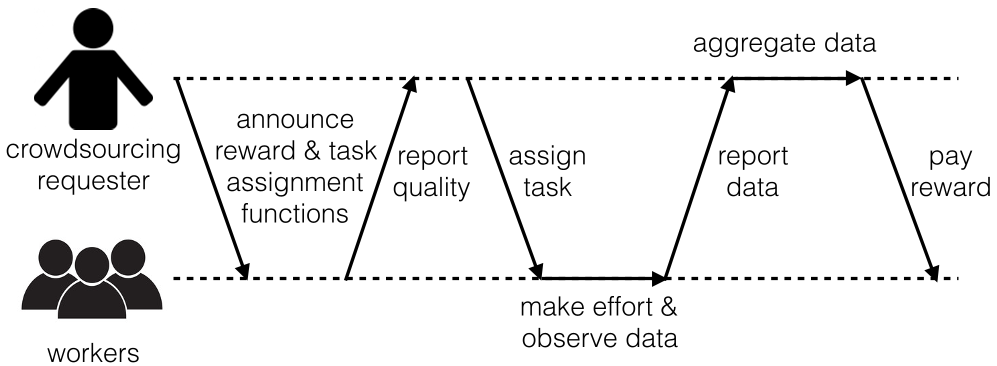 Figure 1: The Quality-Aware Crowdsourcing Framework architecture, illustrating the flow from quality reporting to data aggregation.
Optimal Task Assignment: Quality vs. Virtual Valuation
A fascinating finding in the paper is how the requester should choose workers. While the Socially Optimal (SO) path is to just pick the highest quality workers, the Requester's Optimal (RO) path is different.
The requester must consider the "Virtual Valuation" of a worker: This formula accounts for the "cost of truthfulness." Because eliciting the truth from a very high-quality worker is expensive (high information rent), the requester might sometimes choose a slightly lower-quality worker if they are "cheaper" to keep honest.
Experimental Results
The authors validated QEDE through extensive simulations. Two key insights emerged:
- Truthfulness is the Best Policy: As shown in Fig. 2, any deviation from the true quality leads to a sharp drop in the worker's expected payoff.
- Asymptotic Efficiency: As the number of workers increases, the performance gap between the Requester's Optimal and Socially Optimal assignments vanishes.
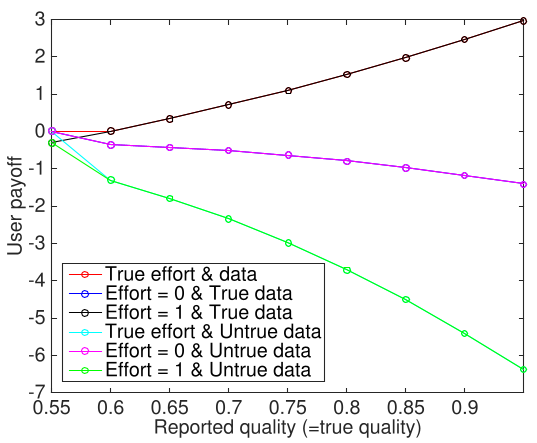 Figure 2: Impact of reported quality on worker payoff. The peak at the true quality value proves the Dominant Incentive Compatibility (DIC).
Critical Insight & Conclusion
The QEDE mechanism moves the field beyond simple cost-elicitation. Its greatest value lies in the mathematical decoupling of effort and quality. By treating quality as a private variable that follows a distribution, the authors provide a template for "Trustless Crowdsourcing."
Limitations: The model currently assumes the requester knows the cost of the effort. In future iterations, if were also private information, the mechanism would require even more complex multi-dimensional screening techniques.
Takeaway: If you are building a crowdsensing app, don't just pay for participation—pay for verifiable accuracy using peer-prediction rewards.