
Decoupling Bias from Recruitment: A Multi-Agent Approach to Ethical AI Auditing
Inclusive AI in Recruiting. Multi-agent Systems Architecture for Ethical and Legal Auditing
This paper proposes a decentralized Multi-Agent System (MAS) architecture designed to perform ethical and legal auditing of AI-driven video recruitment interviews. By integrating ontologies and a legal rules engine, the framework aims to mitigate algorithmic bias (e.g., race, gender, or sexual orientation) and ensure compliance with regional labor laws.
TL;DR
As AI-driven video interviews become the norm, the risk of "black-box" discrimination grows. This paper proposes a Multi-Agent System (MAS) architecture that introduces independent "Audit Agents" into the recruitment pipeline. By formalizing labor laws into a digital rules engine, the system can automatically flag or halt interviews that unfairly profile candidates based on sensitive traits like race, gender, or even facial morphology.
Background: The HR Tech Paradox
While AI was initially touted as a way to remove human subjectivity from resume scanning, the shift toward video-interview analysis has reintroduced deep-seated biases. Vendors now use computer vision to analyze eye contact, tone of voice, and micro-expressions—data points that are often proxies for protected characteristics. This work positions itself as a technical solution to the regulatory vacuum, moving from "Ethics by Design" to "Auditing by Architecture."
The Core Problem: Beyond Human Bias
The authors identify two primary failure modes in current HR AI:
- Technical Imprecision: Algorithms trained on non-representative datasets (e.g., those primarily featuring white individuals) fail under different lighting or for mixed-race candidates.
- Invasive Feature Extraction: High-dimensional analysis can inadvertently—or intentionally—detect a candidate's sexual orientation or age, even when such inquiries are legally forbidden in many jurisdictions.
The fundamental challenge is that companies are given "more and more freedom to customize their systems," often without neutral oversight.
Methodology: The MAS Architecture
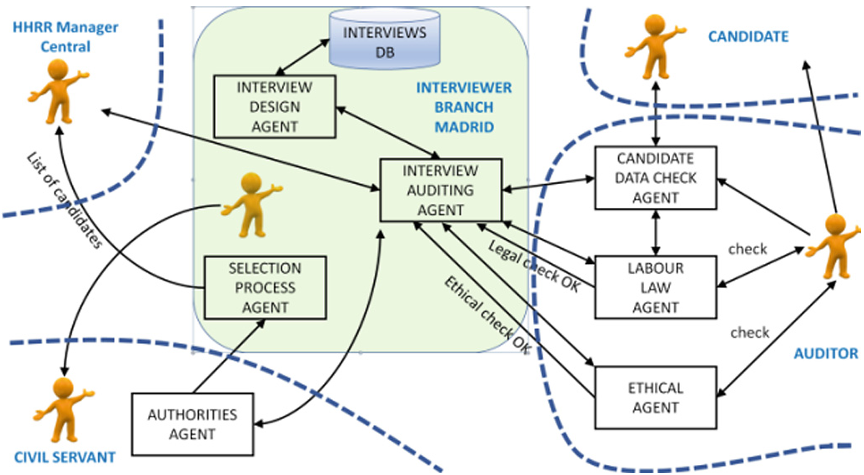
The proposed solution is a distributed Multi-Agent System. Instead of a monolithic recruitment tool, the authors break the process into specialized agents with distinct "Inductive Biases" towards law and ethics.
Architecture Breakdown
The architecture (as visualized below) establishes a checks-and-balances system between three domains:
- The Recruiter/Company: Operates the Interview Design Agent.
- The Auditor: Operates the Ethical Agent.
- The State: Operates the Labour Law Agent.
Why MAS?
The choice of a Multi-Agent System allows for interoperability and domain specification. By using ontologies, the system can translate "Legal Text" into "Computational Logic." For example, if a company’s selection process triggers a feature analysis that correlates with age, the Selection Process Agent communicates with the Labour Law Agent to verify the legality of that specific regional scenario before the data is processed.
Experiments and Prototyping
The researchers developed a Legal Rules Engine as a proof of concept.
- Scope: Focused on Spanish and US Laws (e.g., The Civil Rights Act of 1964).
- Functionality: The engine evaluates recruitment parameters against a knowledge base of forbidden "descriptors."
- Evaluation: Since real corporate data is often proprietary and sensitive, the authors utilized a simulated corporate scenario to test how agents navigate "controversial characteristics" like facial symmetry or intonation.

Note: The prototyping focused on the "legal formalization" of laws—turning qualitative rights into quantitative constraints.
Critical Insight: The Human-to-Descriptor Reduction
The paper offers a profound warning: AI reduces a "human recruit to a set of descriptors." The MAS architecture is not just a tool for compliance; it is a defensive layer for human dignity. By introducing a Selection Process Agent that can "cancel the process due to controversies," the framework effectively gives the "AI Auditor" a kill-switch over biased algorithms.
Conclusion & Limitations
This work represents a vital step toward Automated Legal Auditing. However, the authors acknowledge a significant hurdle: the formalization of "hundreds of rules" across different global jurisdictions. As the project advances, the focus will likely shift from broad architecture to the granular scaling of these legal ontologies.
Future Outlook: For developers, the takeaway is clear—integrated auditing must be a first-class citizen in AI pipelines. For candidates, it offers a glimpse into a future where "Inclusive AI" is verified by neutral digital observers, rather than just corporate promises.