
Strategic Adoption of Social Collaboration Software: Beyond the Hype
Increasing the Adoption of Social Collaboration Software
2014-07-01
Summary
Problem
Method
Results
Takeaways
Abstract
This research identifies key adoption factors and promotional channels for Social Collaboration Software (SCS) within the Smart Commerce framework. By surveying 65 respondents across 10 industries, the study highlights "Ease of use" and "Security" as the most critical features while placing the 2013 SCS market in the "Late Majority" phase of diffusion.
## TL;DR
Social Collaboration Software (SCS) is no longer a luxury but a core component of e-business efficiency. This research analyzes the "Late Majority" stage of SCS adoption, identifying **Ease of Use**, **Security**, and **Price** as the primary levers for customer decisions. It provides a blueprint for developers to tailor both product features and marketing channels (Search, Social, Email) based on user demographics and business size.
## The Motivation: Bridging the Collaboration Gap
As the digital economy matures, the distinction between *e-commerce* (automation) and *e-collaboration* (alignment) becomes vital. While e-commerce speeds up transactions, e-collaboration changes how work is fundamentally performed. The authors argue that despite a projected market growth of 45% annually, software providers often fail because they do not understand the nuanced requirements of different customer segments.
The central insight is that **diffusion of innovation** is not uniform; a "Very Innovative" user at a startup has radically different priorities compared to a "Traditional" user at a large enterprise.
## Methodology: Segments and Correlations
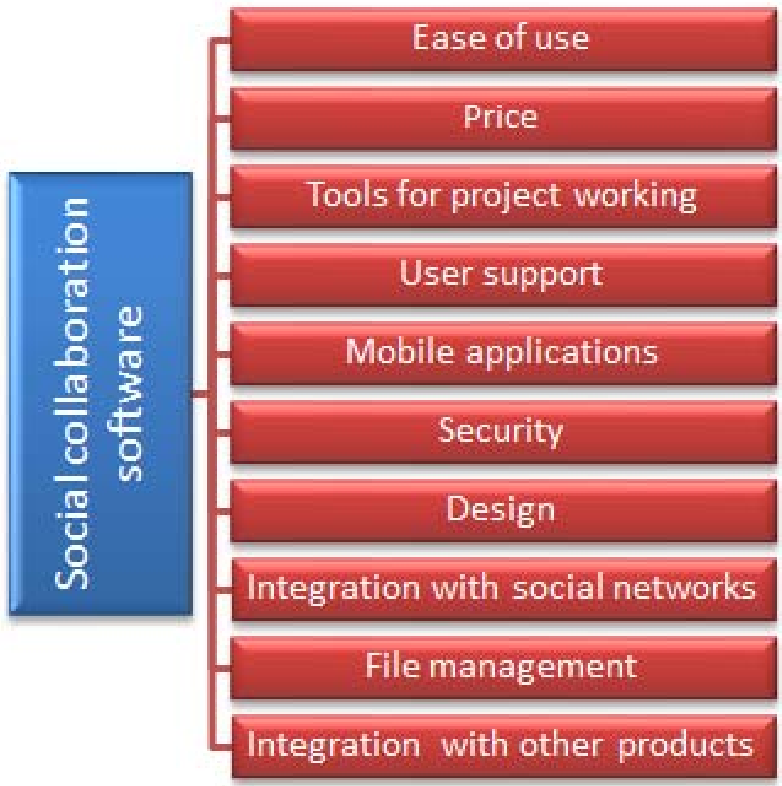
The study breaks down the "Social Phenomenon" of software into 10 measurable factors and correlates them with user profiles (Gender, Age, Innovativeness, and Company Size).
### Core Model Architecture
The researchers visualised the relationship between these factors to help developers prioritize their R&D roadmaps.
One of the most striking technical findings is the **correlation matrix**. High positive correlations were found between:
* **Mobile availability & Social network integration (0.69)**: Users who want to work on the go also want social connectivity.
* **Project management tools & Software integration (0.59)**: Professional power users demand a seamless ecosystem.
## Key Results: What Actually Drives the Purchase?
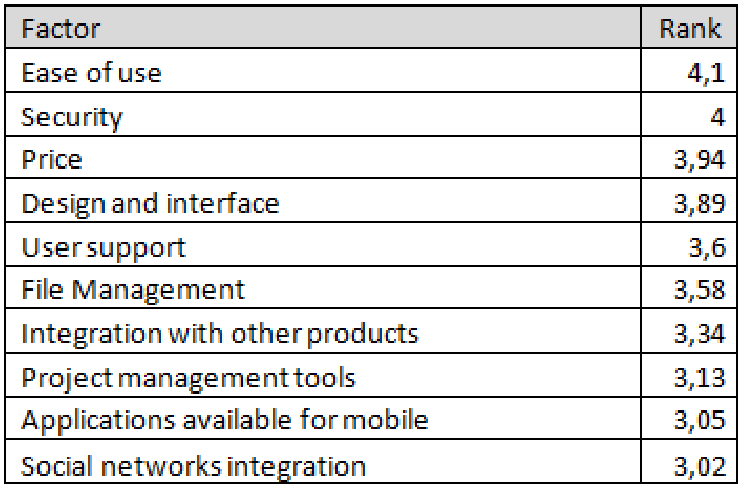
The survey data from 65 respondents across 17 companies provides a clear hierarchy of needs. While "social features" are the marketing buzzword, "Ease of Use" and "Security" remain the non-negotiable foundations for adoption.
### Segmented Insights:
1. **Age Matters**: Younger users (18-24) view **User Support** as a critical factor, whereas users over 55 prioritize **Price** and **Interface Simplicity**.
2. **The Innovation Paradox**: "Very Innovative" individuals value security just as much as traditional users, debunking the myth that innovators are reckless with data.
3. **Promotion Channels**: **Search Engines** are the undisputed king across all demographics. However, if targeting large enterprises, **Social Networks** and **Email Ads** show significantly higher engagement.
## Critical Analysis & Conclusion
The value of this paper lies in its **Segmented Recommendation Engine**. It moves beyond the "build it and they will come" mentality, offering a tactical guide:
* **To reach Males**: Focus on Design/Interface via Search Ads.
* **To reach Medium Businesses**: Prioritize File Management and Official Blogs.
* **To reach Project Teams**: Emphasize Ease of Use over Price.
### Limitations and Future Outlook
The study's sample (65 respondents) is relatively small for a broad quantitative claim, and being based in 2013, it does not account for the modern "Slack/Teams" era of total market saturation. However, its fundamental methodology—correlating psychological "innovativeness" with technical requirements—remains a gold standard for SaaS marketing strategy.
As we move toward AI-integrated collaboration, the next frontier will likely be "Automated Ease of Use," where the software anticipates user needs before they are even expressed.