
USEMP: Decoding the Hidden Value and Risks of Your Social Media Footprint
Increasing Transparency and Privacy for Online Social Network Users – USEMP Value Model, Scoring Framework and Legal
The paper introduces USEMP, a multi-disciplinary framework designed to enhance transparency and privacy in Online Social Networks (OSNs). It presents the Databait toolset, which utilizes a novel "Disclosure Scoring" mechanism and a legal "Data Licensing Agreement" (DLA) to help users visualize and control the value and sensitivity of their inferred personal data.
TL;DR
The USEMP project introduces a multi-disciplinary framework and a tool called Databait to break the "black box" of social media profiling. By moving past simple "I Agree" buttons toward a Data Licensing Agreement (DLA) and using a hierarchical scoring system, the project empowers users to see exactly what OSNs infer about their health, politics, and "market value."
The "Institutional Privacy" Gap
Most social media users are worried about "Social Privacy"—who can see their photos. However, the authors argue that the true threat is "Institutional Privacy": the invisible process where algorithms infer your sexual orientation, religious beliefs, or health conditions from seemingly harmless "likes" and posts.
Current business models rely on an opaque exchange. The authors identify a massive power imbalance:
- Information Asymmetry: Large OSNs know exactly how to monetize you; you have no clue how much you are worth.
- Consent Fatigue: Standard Privacy Policies are legally dense and offer an "all or nothing" choice.
Methodology: The Hierarchical Scoring Model
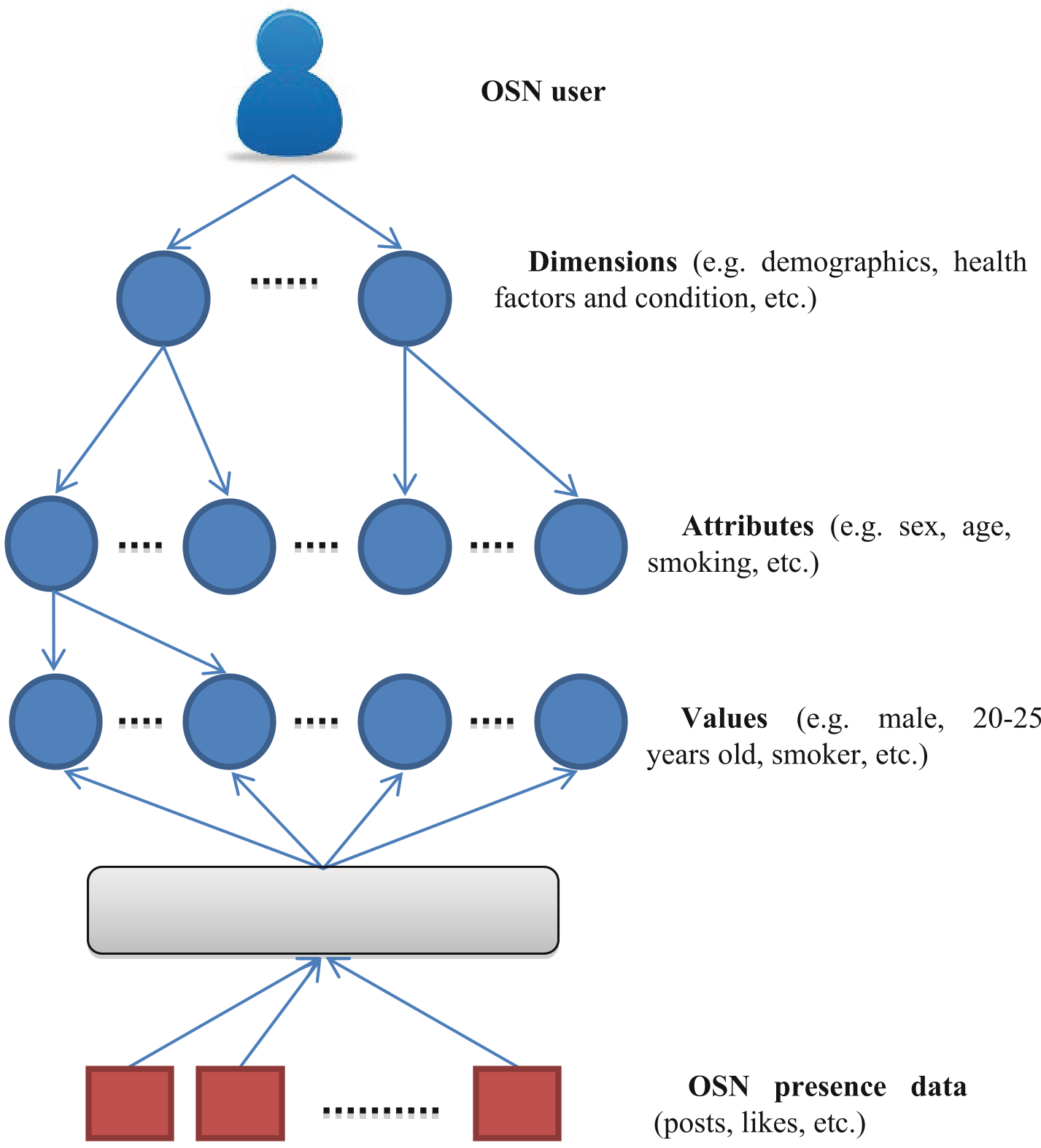
The core innovation of USEMP is the transition from raw data tracking to Disclosure Dimensions. Instead of just looking at "data points," the system organizes your digital life into 8 sensitive categories:
- Demographics (Age, Gender)
- Psychological Traits (Openness, Extraversion)
- Sexual Profile
- Political Attitudes
- Religious Beliefs
- Health Factors
- Location
- Consumer Profile
The Scoring Logic
The framework calculates a Disclosure Score () based on three pillars:
- Confidence: How sure is the algorithm that this inferred trait is true?
- Sensitivity: How much does the user care about this specific topic?
- Visibility: How many people or entities actually see this data?
Quantifying Your Worth: The Value Formula
One of the boldest moves in this paper is trying to define the "Value" of personal data. They propose a simple yet effective formula: Where:
- (Influence): Calculated based on your social graph and history.
- (Momentum/Importance): Measures the reactions (shares, likes) your specific post generates.
By showing users that their individual data is worth very little monetarily, but the inferences drawn from it are worth a fortune to advertisers, USEMP shifts the user's perception from "monetary greed" to "privacy protection."
Experiments & User Reactions
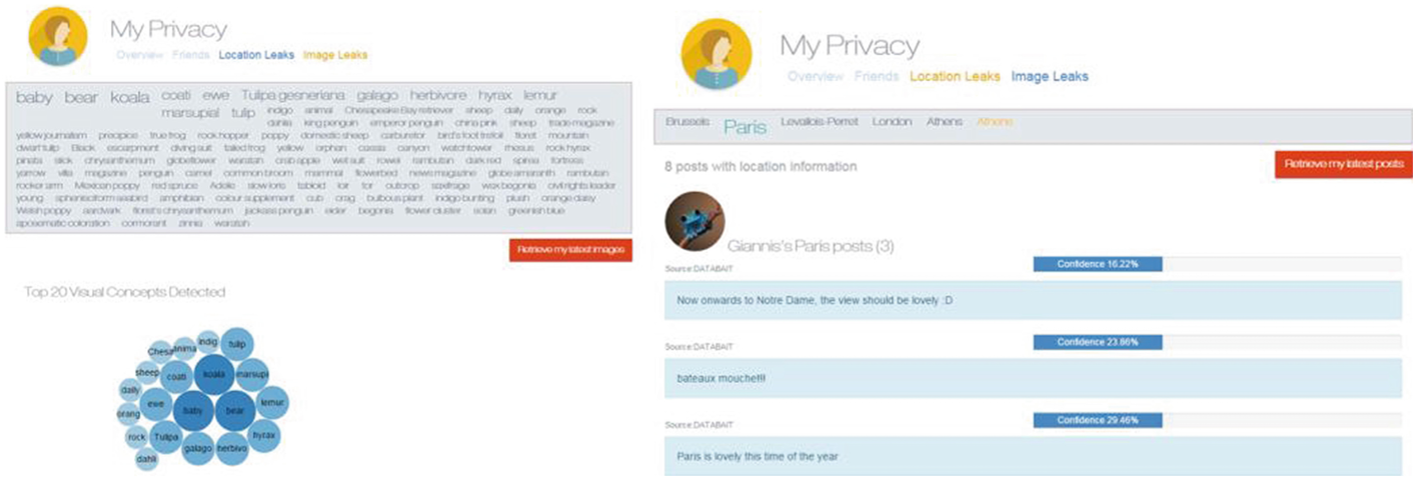
The authors tested the Databait tool (a browser plugin and webapp) with focus groups. The results were telling:
- Users were "shocked" by the level of sophistication in the inferences.
- Visibility of "Location Leaks" was the most effective trigger for users to change their privacy settings.
- Ablation Insight: Simple visualizations (like heatmaps of locations) were far more effective than providing raw data logs.
Critical Insight: Why This Matters
The most profound takeaway from this research is the concept of Data Protection by Design (DPbD). The legal argument for a "Modular License" (similar to Creative Commons) for personal data is a potential game-changer. Imagine a world where you could license your "Location Data" to a map app for 24 hours, but explicitly forbid its "re-use" by insurance companies.
Limitations
While the scoring framework is robust, the authors acknowledge that algorithmic accuracy is a double-edged sword. If the tool incorrectly predicts a sensitive trait (like a health condition), it might cause unnecessary user "dread."
Conclusion
USEMP proves that transparency isn't just about reading a policy; it's about active awareness. By quantifying the "invisible" inferences of social networks, we can finally begin to balance the scales between the digital citizens and the data giants.