
Modeling Social Contagion: Beyond the Myth of Node Independence
Modeling the Spread of Influence for Independent Cascade Diffusion Process in Social Networks
2017-06-01
Summary
Problem
Method
Results
Takeaways
Abstract
This paper presents a spatial Markov dependence model to characterize the Independent Cascade (IC) diffusion process in online social networks. By mapping IC diffusion to the Susceptible-Infected-Recovered (SIR) epidemic model, the authors improve upon traditional "independent" assumptions to achieve significantly higher prediction accuracy for social influence.
## TL;DR
Predicting how a product or idea "goes viral" in a social network is notoriously difficult. This paper identifies a fundamental flaw in existing models—the assumption of node independence—and proposes a **Markov Model** that accounts for spatial correlations. The result? A mathematical framework that matches complex simulations with 60x faster performance.
## The Illusion of Independence
In the study of "Independent Cascade" (IC) diffusion, researchers often treat nodes like isolated islands. If Alice and Bob are friends, traditional models assume Alice's status (influenced or not) has no probabilistic relationship with Bob's status beyond the direct infection attempt.
The authors argue this is a fallacy. In real-world social networks, nodal statuses are **spatially positively correlated**. If Bob is Alice's friend, they are likely to share similar interests or behaviors. Ignoring this correlation leads to a massive overestimation of influence spread—essentially a "false positive" in predicting viral success.
## Methodology: The Markovian Shift
The authors utilize the **SIR (Susceptible-Infected-Recovered)** epidemic model to map out the stages of influence. Their key innovation lies in the transition probability $\beta_i(t)$.
Instead of assuming:
$P(Neighbors | Node) = P(Neighbor 1) imes P(Neighbor 2) \dots$
They introduce a **Spatial Markov Dependence**:
It assumes that given a node is susceptible, its neighbors' statuses are conditionally independent. This captures the "one-step" spatial dependency that models how friends influence friends without falling into the "independence trap."

*Fig 1: The SIR state transition used to characterize the Independent Cascade process.*
## Experimental Validation
The model was tested against several topologies:
1. **Power-law (BA) Graphs**: Mirroring real social network structures.
2. **ER Random Graphs**: Testing against classical random connectivity.
3. **Real Coauthorship Network**: A dataset of scientists collaborating on network theory.
### Key Result: Accuracy vs. Efficiency
In every test case, the "Independent Model" (the status quo) overestimated the spread significantly as the influence probability $\beta$ increased. The Proposed **Markov Model**, however, overlapped almost perfectly with the ground-truth simulations.
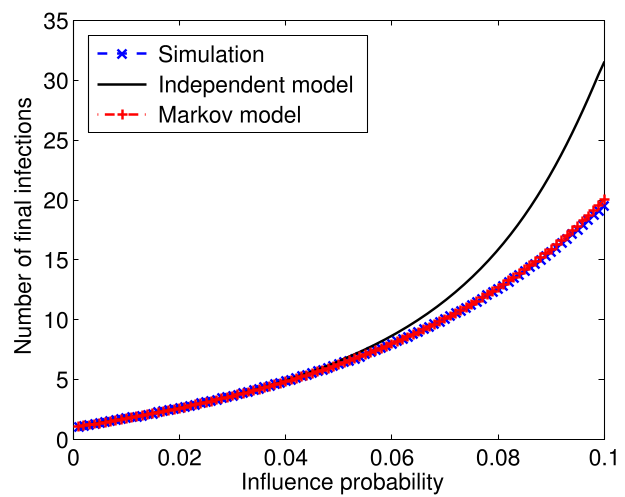
*Fig 2: Performance comparison on a Power-Law topology. The Markov model (triangles) aligns with simulations, while the Independent model (rectangles) diverges.*
## Why This Matters: Efficiency in Influence Maximization
The "Influence Maximization Problem" (IMP) asks: *Which 10 people should I give free samples to in order to reach the whole city?*
Previously, solving this required running 10,000+ Monte Carlo simulations, which is computationally expensive.
This paper shows that the Markov model can provide the same insights in **6 seconds** compared to the **374 seconds** required by simulations. This is a game-changer for real-time viral marketing analytics.
## Critical Analysis & Conclusion
While the Markov model is a significant step forward, it focuses on **one-step dependence**. In highly clustered groups, multi-hop dependencies might still exist. However, the trade-off here is brilliant: by capturing just the first layer of spatial correlation, the authors eliminated the majority of the error found in independent models without the computational explosion of global dependency modeling.
**Future Outlook**: Integrating this Markovian framework into "Linear Threshold" models—the other pillar of social influence—will be the next frontier in perfecting our understanding of human digital behavior.