
Bridging the Chasm: A New Blueprint for Industry-University Synergy in India's AI Ecosystem
17139_India Industry-University Collaboration - A Novel Approach Combining Technology, Innovation, and Entrepreneurship.
This paper presents a novel Industry-University Collaboration (IUC) model between Intel India and PES University, specifically targeting undergraduate students in a developing economy. The approach integrates technology, innovation, and entrepreneurship through long-term research contests and industry-aligned curricula in AI, ML, and Deep Learning.
TL;DR
In the fast-evolving landscape of AI/ML, the gap between academic theory and industrial application is a significant bottleneck, particularly in developing economies. This paper explores a two-year strategic partnership between Intel India and PES University. By moving beyond guest lectures to semester-long innovation contests and industry-shaped curricula, the collaboration successfully turned undergraduate projects into tier-1 conference publications and high-value industry hires.
The Motivation: Why Traditional IUC Fails at the Undergraduate Level
In developed economies, Industry-University Collaboration (IUC) is a mature engine of growth. However, in India, the authors identify a "silo" problem: high-quality research is concentrated in a few premier institutes like the IITs, while the vast majority of undergraduate students are stuck in a cycle of rote learning.
Key Pain Points:
- Talent Scarcity: Despite the hype, there is a massive shortage of "industry-ready" AI engineers.
- Curriculum Lag: Academic syllabi often trail 2-3 years behind the State-of-the-Art (SOTA) tools used in production.
- The IP Barrier: Intellectual Property negotiations often kill collaborations before they start.
The authors propose a "low-friction" model: remove proprietary IP hurdles, focus on open-source SOTA, and prioritize long-term talent cultivation over immediate commercial metrics.
Methodology: Re-engineering the Collaboration Pillars
The collaboration is anchored by two distinct yet complementary programs designed to foster an "Applied Research" mindset.
1. The Research and Innovation Contest (RIC)
Unlike a 48-hour hackathon, the RIC is a 14-week marathon.
- Real-World Complexity: Problem statements included Advanced Driver Assistance Systems (ADAS) and Natural Language Processing (NLP) for Indian languages.
- Continuous Mentorship: Each team was dual-mentored by a faculty member and an Intel engineer using digital platforms for weekly feedback.
- Evaluation Shift: Teams were judged on two tracks: Complete Solution (engineering excellence) and Innovative Solution (research novelty).
2. The PADL Course: Deep Learning for Everyone
The "Practical Approach to Deep Learning" (PADL) course broke the mold by targeting Electronics and Communication (ECE) students rather than just Computer Science majors.
- Lab-in-Class Pedagogy: 50% of class time was dedicated to coding on hardware accelerators.
- Alternative Assessment: Traditional exams were replaced by a 6-week tumor detection project using real brain scans, judged by industry panels.
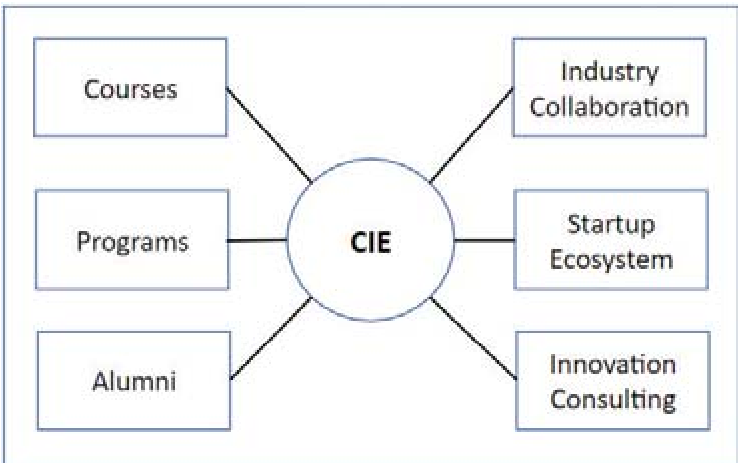 Figure 1: The six pillars of PES University's Center for Innovation and Entrepreneurship (CIE), showing how Industry Collaboration is integrated with Incubation and Research.
Evidence of Success: Beyond the Classroom
The quantifiable impact of this collaboration serves as a benchmark for other institutions.
- Academic Quality: Undergraduates published papers in prestigious venues like ICMLA 2020 and ICPR 2020. This proves that given industry context, undergraduates can contribute to the global research community.
- Diversity & Inclusion: Interestingly, the programs maintained a strong gender balance, with 50% female participation in the PADL course and a 1:3 ratio in the RIC, helping address the diversity gap in AI.
- Pipeline Efficiency: Intel India was able to identify and onboard high-performing interns with a significantly lower risk of "bad hires," as their technical and soft skills were verified over months of collaborative work.
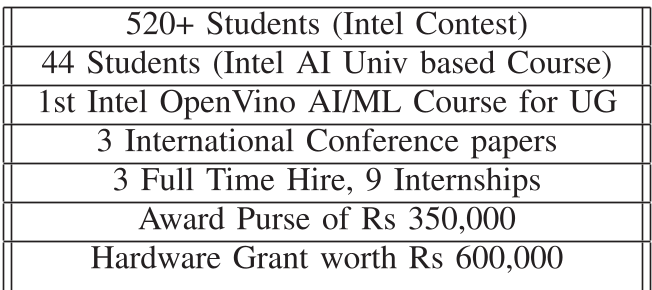 Table 1: High-level summary of the two-year collaboration outcomes, highlighting the research output and employment metrics.
Critical Analysis & Future Outlook
The "Intel-PES Model" succeeds because it addresses the incentive structure of both parties. The university gains updated curriculum and funding, while the industry partner gains a de-risked recruitment pipeline and a "force multiplier" effect by training faculty.
Limitations: The authors acknowledge that this high-touch model requires significant time commitment from industry engineers—something that may be hard to scale across hundreds of universities without dedicated "Education Evangelism" roles within tech companies.
The Road Ahead (2020-2022): The next phase of this collaboration aims to merge Entrepreneurship with research. By linking the output of the RIC to startup incubators, the goal is to transform student projects not just into papers, but into viable tech products.
In conclusion, this paper demonstrates that the "skill gap" in AI is not an inherent intellectual deficit but a structural one. By realigning the "Pillars of Collaboration," even undergraduate programs can become significant contributors to the SOTA landscape.