
ISED: Unmasking Genuine Emotions in the Indian Context
The Indian Spontaneous Expression Database for Emotion Recognition
The paper introduces the Indian Spontaneous Expression Database (ISED), a first-of-its-kind dataset capturing genuine emotional responses from participants of Indian origin. It employs a non-intrusive elicitation protocol to record 428 segmented video clips, achieving a baseline recognition accuracy of 86.46% using Local Gabor Binary Patterns (LGBP).
TL;DR
The Indian Spontaneous Expression Database (ISED) is a significant academic contribution that addresses the "authenticity gap" in affective computing. While most AI models are trained on actors "pretending" to be sad or happy, ISED captures 428 genuine, high-resolution video clips from 50 Indian participants using a concealed recording setup. By combining Expert Annotation, Stimulus Validation, and Self-Reports, it provides a benchmark for recognizing 4 core emotions with a baseline accuracy of 86.46%.
Background: Posed vs. Spontaneous
In the world of computer vision, there is a massive difference between a "posed" smile and a "spontaneous" one. Posed expressions are often exaggerated and involve different muscle groups (Action Units) compared to spontaneous ones, which are subtle, short-lived, and often mixed. Furthermore, facial morphology varies across ethnicities, yet Indian faces have been chronically underrepresented in global datasets.
Methodology: The "Stealth" Approach to Data Collection
To capture "pure" emotions, researchers must avoid Social Masking—the tendency for humans to hide feelings when watched.
1. The Experimental Setup
The authors built a custom 3m x 3m isolated room. A Nikon D-5200 was hidden inside a wooden box with a one-way glass, camouflaged so participants believed they were simply participating in a video rating survey.
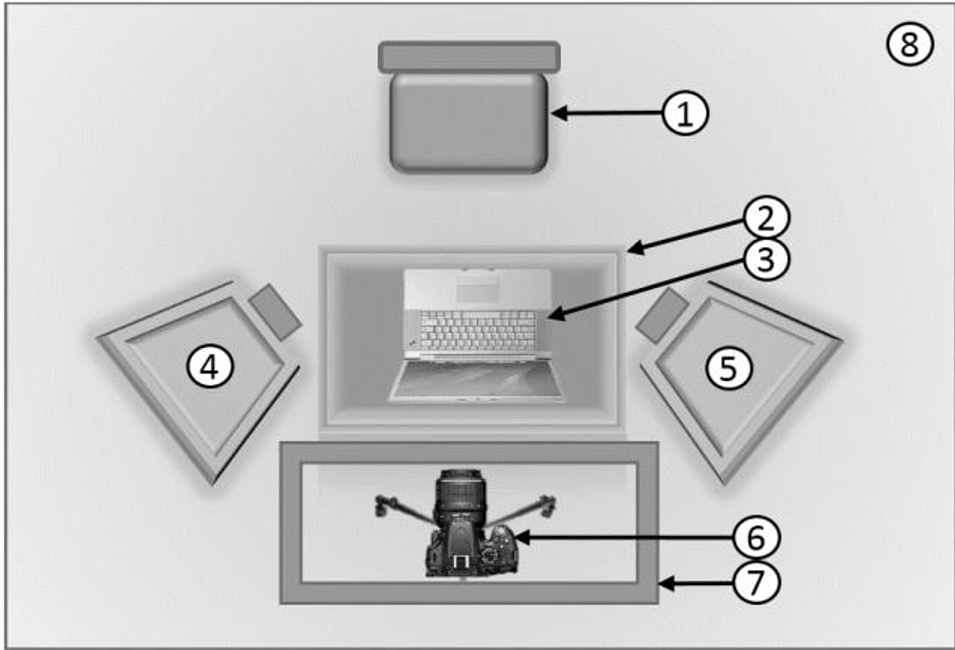 Figure 1: The concealed camera box and ambient lighting setup used to ensure natural reactions.
2. Elicitation and Validation
Participants watched 10 video clips (ranging from Bollywood scenes to "gross-out" clips from YouTube). To ensure the ground truth was accurate, the authors didn't just trust the computer; they used:
- Self-Reports: Subjects rated their own feelings on a scale of 0-5.
- Expert Decoders: Four specialists trained in the Facial Action Coding System (FACS) annotated every clip.
- Stimulus Logic: The emotion label had to match the intent of the video clip the subject was watching.
Technical Deep Dive: Feature Extraction
The paper doesn't just present data; it evaluates how machines "see" these emotions. They compared several classical techniques:
- LBP (Local Binary Patterns): Captures local texture.
- Gabor Wavelets: Mimics human visual system responses to orientation.
- LGBP (Local Gabor Binary Patterns): The winner. It applies LBP on Gabor-filtered images, capturing both spatial and frequency orientations.
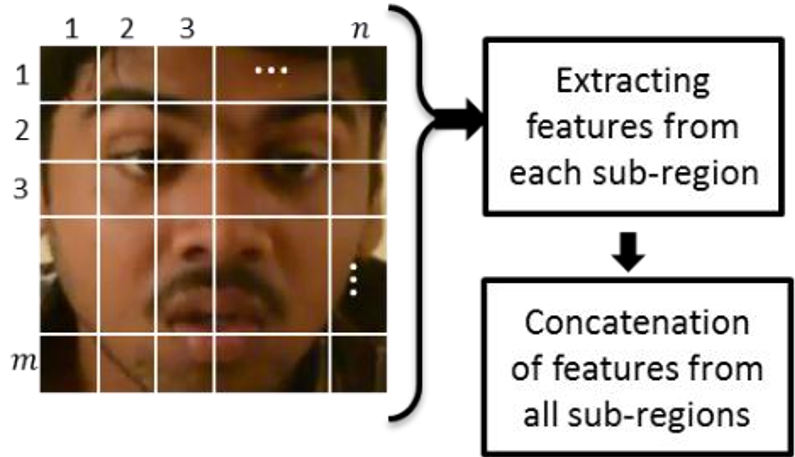 Figure 2: Multi-block feature extraction strategy for dividing the face into sub-regions.
Experiments & Results
Using PCA + LDA (Linear Discriminant Analysis), the team achieved impressive results. Interestingly, Happiness was the easiest to detect (96.9% recall), while Sadness was the most difficult (70.8%), likely because sadness is a "low-intensity" emotion that is harder to induce in a lab setting than a sudden "Surprise."
Performance Comparison
| Feature Type | Classifier | Accuracy (%) |
|---|---|---|
| Grayscale Pixels | PCA + LDA | 75.70 |
| LBP (7x6 Regions) | PCA + LDA | 82.47 |
| LGBP (5x5 Regions) | PCA + LDA | 86.46 |
Critical Analysis & Conclusion
The ISED database is a landmark for Indian ethnic representation in AI. However, there are limitations:
- Class Imbalance: The dataset is heavy on Happiness (227 clips) and light on Sadness (48 clips).
- Occultations: Real-world factors like beards, glasses, and hand-to-face contact (common in disgust) still pose a challenge for standard "Viola-Jones" face detectors, which only managed ~89% accuracy on this dataset.
The Takeaway: For researchers building "Emotion AI," the lesson is clear: context and ethnicity matter. The ISED database provides the necessary "messy" real-world data needed to bridge the gap between laboratory success and pragmatic, real-world application.