
Don’t Judge Me by My Face: Scrubbing Hidden Bias from Automated Job Interviews
Don’t Judge Me by My Face: An Indirect Adversarial Approach to Remove Sensitive Information From Multimodal Neural Representation in Asynchronous Job Video Interviews
The paper introduces an indirect adversarial learning framework designed to remove sensitive information (gender and ethnicity) from multimodal neural representations in Asynchronous Video Interviews (AVIs). It leverages candidate face representations as a proxy for sensitive variables, achieving fairness without requiring explicit labels of protected attributes.
Executive Summary
TL;DR: Researchers have developed an "indirect" adversarial training method that removes sensitive traits like gender and ethnicity from AI hiring models without ever needing to know the candidate's actual race or gender. By forcing the model to "forget" the candidate's face while processing their interview data, the system becomes significantly fairer.
Positioning: This work is a crucial "legal-technical bridge." It addresses a massive hurdle in AI ethics: how to be fair when the law (such as in France) forbids you from collecting the very data (race, gender) needed to measure or fix bias.
The Hidden Leakage Problem
Asynchronous Video Interviews (AVIs) are surging, but so is the skepticism. Even if a model isn't told a candidate's gender, that information "leaks" into the neural network's hidden layers through vocal pitch, facial structure, or word choice.
Standard "fair" AI uses a technique called Adversarial Training: a second "adversary" network tries to guess the secret (protected) variable from the main model's internal data. If the adversary succeeds, the main model is penalized until it "humbles" its internal representation to be neutral. However, this requires a labeled dataset of gender and ethnicity—which is often illegal to collect in recruitment contexts.
Methodology: The Face as a Proxy
The core insight of Hemamou et al. is that the face is a goldmine of correlated information. If you can stop a model from recognizing a specific face, you effectively stop it from utilizing the sensitive traits associated with that face.
They proposed two architectures using a Gradient Reversal Layer (GRL):
- Static Face Representation (Method A): They extract a neutral face frame and compress it using ArcFace (face recognition) and UMAP (dimensionality reduction). The adversary tries to predict this compressed vector.
- Negative Sampling (Method B): The model is presented with the interview representation and a "line-up" of faces. The goal is to make the interview data so anonymous that the adversary cannot tell which face in the line-up belongs to the speaker.
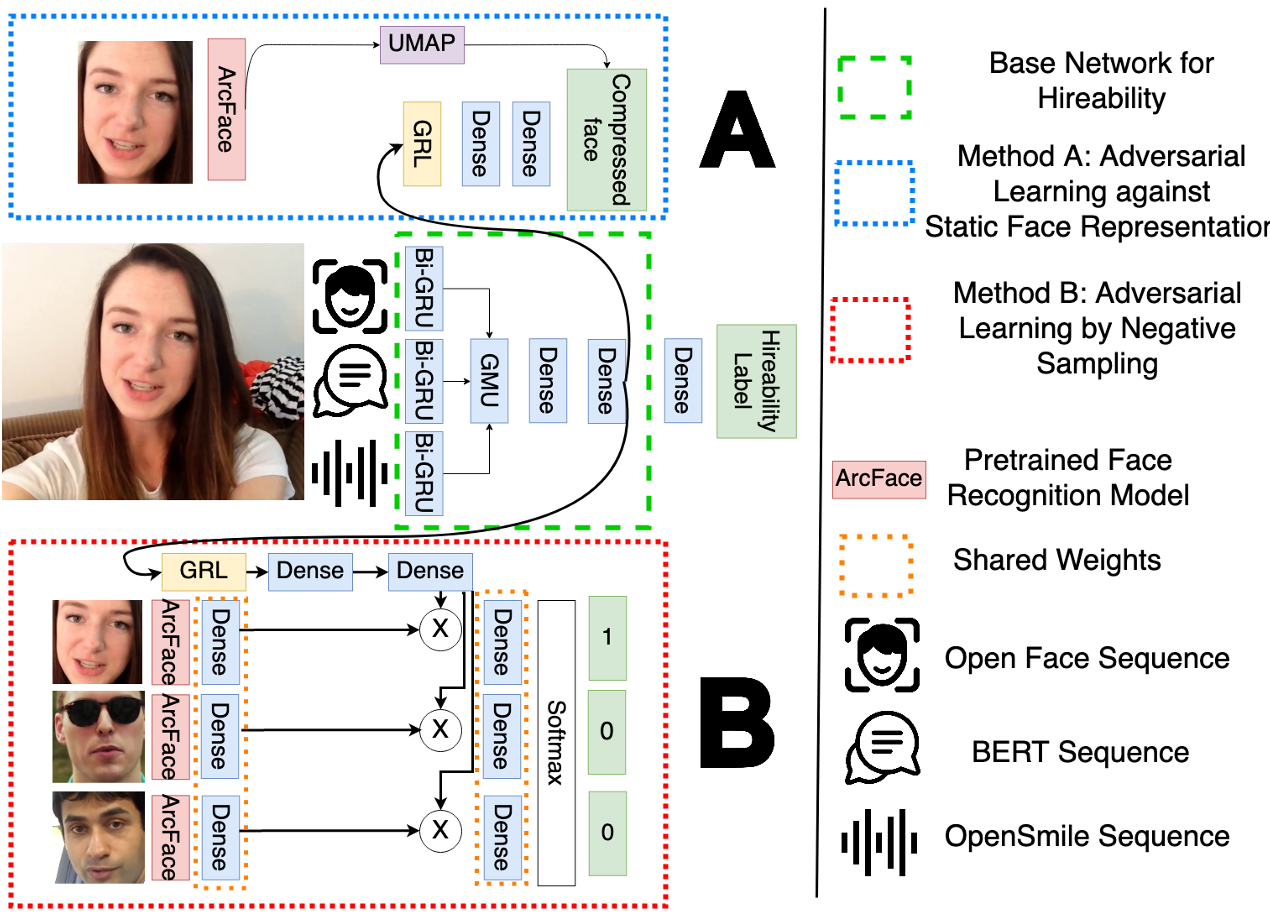 Fig 1: The proposed framework integrating HireNet with adversarial branches (Method A in blue, Method B in red).
Experimental Insights
The researchers tested their methods on the ChaLearn First Impressions dataset. The results were striking:
- Bias Recovery: In "unprotected" models, a diagnostic classifier could guess gender with an AUC of 0.85 from audio alone.
- Success of Indirect Methods: Their "Negative Sampling" (NS) approach slashed this recovery rate significantly, approaching the performance of "Supervised" models that actually had access to gender labels.
- Modality Shifting: Interestingly, the Gated Multimodal Unit (GMU) learned to stop trusting the visual modality (which contains high bias) and shifted its weight toward linguistic content when the adversarial pressure was applied.
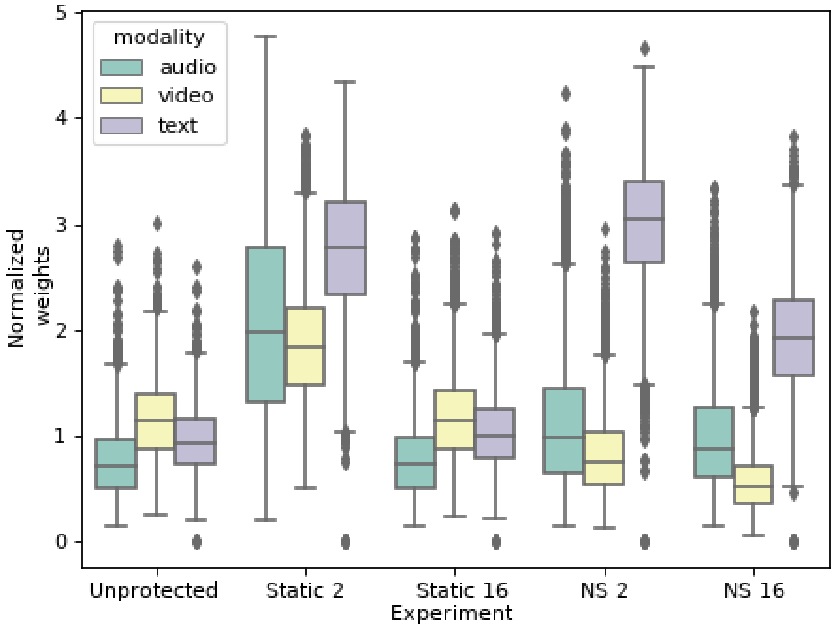 Fig 2: Boxplots showing how the model shifts reliance from Video to Language when "Negative Sampling" (NS) is used.
Critical Analysis & Conclusion
This paper proves that Privacy and Fairness are two sides of the same coin. By treating a candidate's sensitive attributes as private information to be protected, we naturally arrive at a fairer decision-making process.
Takeaways:
- The 2D Advantage: Compressing facial information into a very low-dimensional space (2D) worked better than 16D, likely because it forced the model to focus only on the most prominent (and thus most biasing) clusters of features.
- Trade-offs: There is a slight "Fairness-Accuracy" trade-off. As gender/ethnicity information was removed, the hireability prediction accuracy dipped slightly, suggesting that the original "accuracy" might have been partially inflated by relying on biased shortcuts.
Ultimately, this is a major step toward Equality in Job Selection, providing a blueprint for ethics-compliant AI where sensitive data collection is restricted.