
Mazadoo: Bridging the Generational Digital Divide via TV-Centric Social Networking
From Individual Communication to Social Networks: Evolution of a Technical Platform for the Elderly
The paper introduces Mazadoo, a technical platform designed to integrate elderly residents of retirement homes into modern social networks. By bridging the gap between standard SNS (Social Networking Services) like Facebook and simplified TV/Phone interfaces, it enables seniors to engage in micro-conversations and multimedia sharing to combat social isolation.
TL;DR
The Mazadoo project addresses the epidemic of loneliness among the elderly by integrating them into Facebook ecosystems through familiar hardware: the TV and the landline phone. By converting complex social media interactions into vocalized newsfeeds and voice-recorded comments, it enables seniors to reconnect with both "strong ties" (close family) and "weak ties" (old friends and hobby groups).
Background: Beyond Passive Consumption
While life expectancy is rising, so is social isolation. In France, 74% of elderly people suffer from loneliness, a condition that often accelerates physical and psychological decline once they enter nursing homes. Previous iterations of this research (the AIPA project) realized that seniors were tired of being mere "receivers" of photos; they wanted to converse.
The core challenge identified by the authors was the "Consumer Trap"—where technology treats the elderly as passive recipients of data rather than active participants in a social fabric.
Methodology: The "Social Network Bridge"
The authors made a strategic choice: Why build a new social network when everyone is already on Facebook?
1. The Architecture
The system uses a cloud-based SIP (Session Initiation Protocol) infrastructure. This allows the platform to handle real-time voice and data without installing heavy servers in retirement homes.
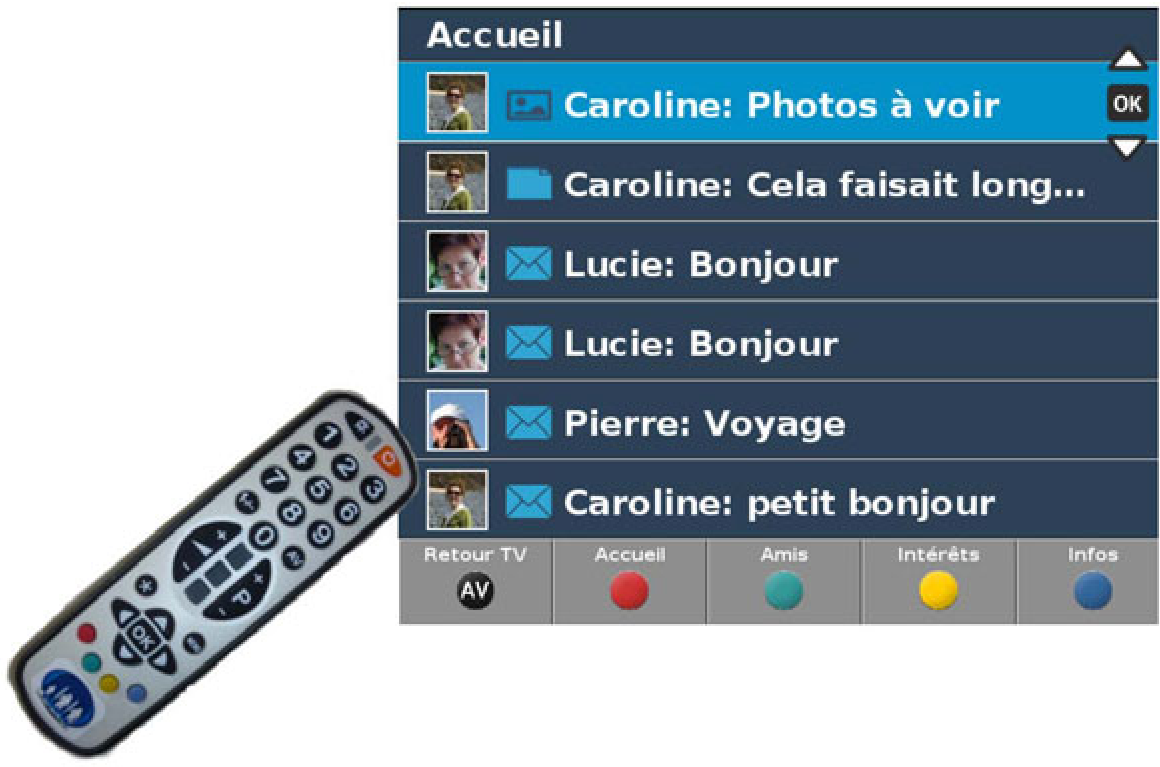 Figure 1: The Mazadoo interface provides a simplified "channel" on the resident's TV, aggregating Facebook updates into a readable, vocalized list.
2. Interaction Design (The "Magic" of Voice)
Because typing on a TV remote is a nightmare for anyone—especially the elderly—Mazadoo employs two clever workarounds:
- Text-to-Speech (TTS): All Facebook statuses and comments are read aloud, bypassing vision impairment issues.
- Voice-as-Comment: When a senior wants to reply, the system triggers a phone call. The senior speaks into their landline, and that recording is posted back to Facebook as an audio link comment.
Experiments and Deployment
The project moved beyond lab settings into two real-world retirement homes.
Key Findings:
- High Sociable Users: Those who were already socially active used the platform to deepen existing ties.
- Hobby-Oriented Ties: For those without large families, the ability to follow "Facebook Pages" related to their native villages or hobbies (like soap operas) provided a new sense of belonging.
- Institutional Integration: Retirement homes began using Facebook pages to publish meal menus and activity photos, allowing distant family members (who are often the payers) to see the quality of care.
Critical Insight: Pragmatism over Novelty
The brilliance of Mazadoo is not in a new "algorithm," but in its pragmatic UX. By acknowledging that teenagers and grandchildren will not leave Facebook to use a "special senior app," the authors brought the seniors to Facebook through a proxy.
Limitations & Future Work
The paper honestly notes the "Privacy Paranoia" surrounding Facebook. They mitigated this by managing accounts on behalf of the seniors with strict "Friends Only" settings. Future work aims to incorporate Social Games and multi-profile management to separate private family life from public retirement home activities.
Conclusion
Mazadoo proves that the "Digital Divide" is not a lack of interest from the elderly, but a lack of modal adaptation. By turning the TV into a portal and the phone into a keyboard, we can keep our elders immersed in the micro-conversations of the 21st century.