
The Social Mechanics of SNS: Do the Socially Rich Get Richer Online?
Individual differences in social networking site users: The interplay between antecedents and consequential effect on level of activity
This study develops and tests a structural equation model to examine how individual differences—personality, communication apprehension, and self-esteem—influence motives and activity levels on Social Networking Sites (SNSs). Using a sample of 674 college students, the research identifies a multidimensional path from psychological antecedents to SNS behavior, ultimately finding that SNSs serve primarily as tools for relational maintenance.
Executive Summary
TL;DR: This study deconstructs the psychological profile of the "active" Social Networking Site (SNS) user. By modeling the interplay between personality traits (like Extraversion and Narcissism) and social needs, the researchers found that SNS activity is driven by a desire for relational maintenance. Most importantly, the paper provides heavy empirical weight to the "rich-get-rich" hypothesis, suggesting that those who are already socially adept in the physical world are the ones dominating the digital social landscape.
In the academic coordinate system, this work moves beyond simple "Uses and Gratifications" lists by providing a structural process model. It bridges the gap between static personality traits and dynamic online behaviors, explaining the "Why" and "How" of digital social engagement.
Problem & Motivation: The Conflict of the Socially Anxious
Why do we scroll? For years, two competing theories dominated the literature:
- The "Poor-get-rich" Hypothesis: SNSs provide a "safe harbor" for the socially anxious (high Communication Apprehension) to communicate without the stress of face-to-face (FtF) cues.
- The "Rich-get-rich" Hypothesis: SNSs are merely "social multipliers" for extroverts who already excel at building networks.
The authors noticed that prior work was fragmented—looking at self-esteem or extraversion in isolation. They set out to build a comprehensive model to see if digital platforms act as a crutch for the socially weak or a megaphone for the socially strong.
Methodology: The Five-Block Architecture
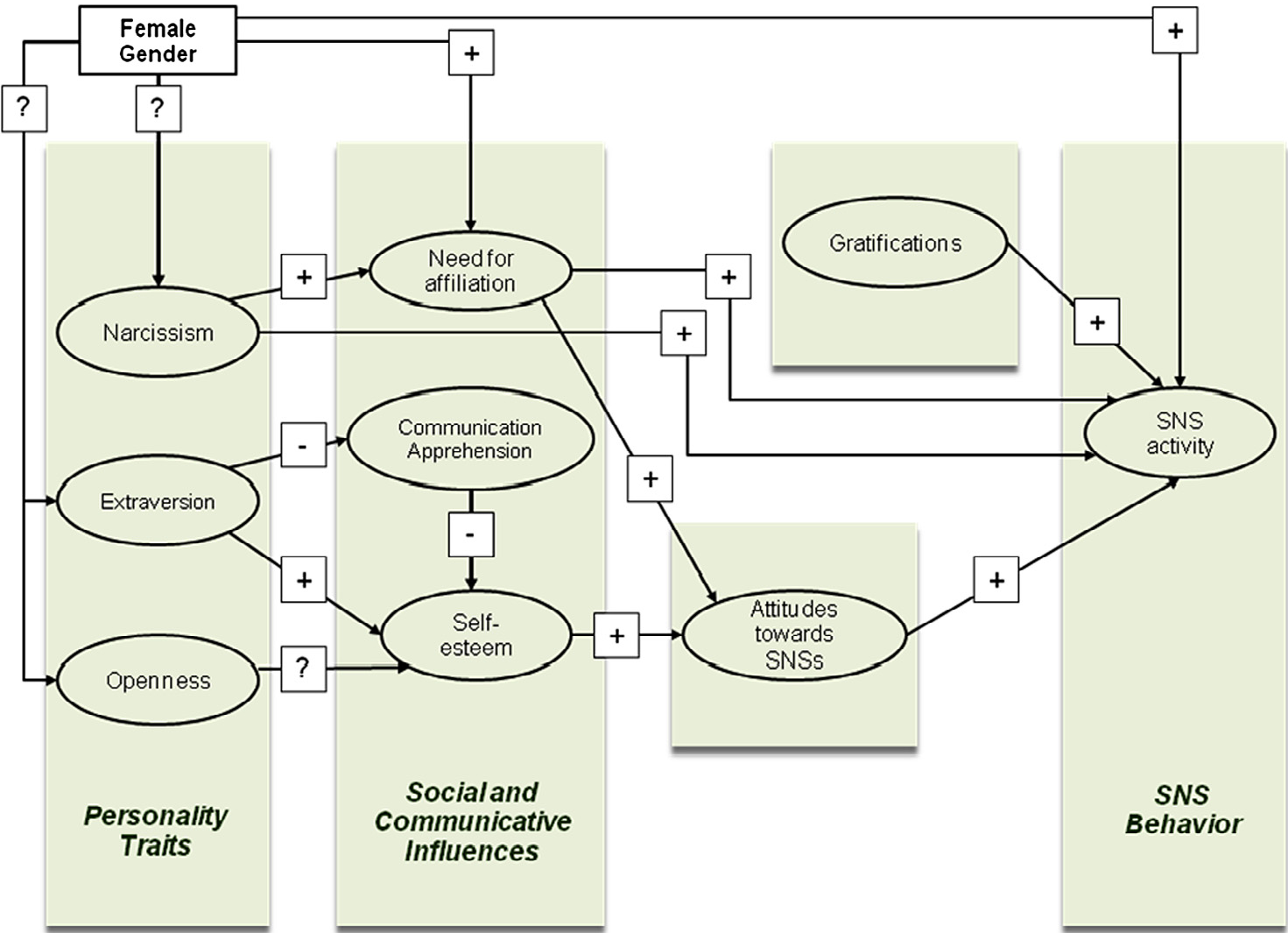
The study analyzed 674 participants through a rigorous Structural Equation Modeling (SEM) approach. The researchers organized variables into a logical flow of causality:
- Block 1: Personality Traits (The biological/stable base).
- Block 2: Social Influencers (How traits manifest, e.g., Self-esteem).
- Block 3: Attitudes (Perceived ease of use/social connection).
- Block 4: Motives (Infotainment, Social Tool, Passing Time).
- Block 5: Activity Level (The final output).
 Note: The model depicts how core personality traits filter through social anxiety and attitudes before resulting in actual SNS behavior.
Key Insights: Why "Rich-Get-Rich" Wins
The data revealed several profound psychological mechanics:
1. The Extraversion Multiplier
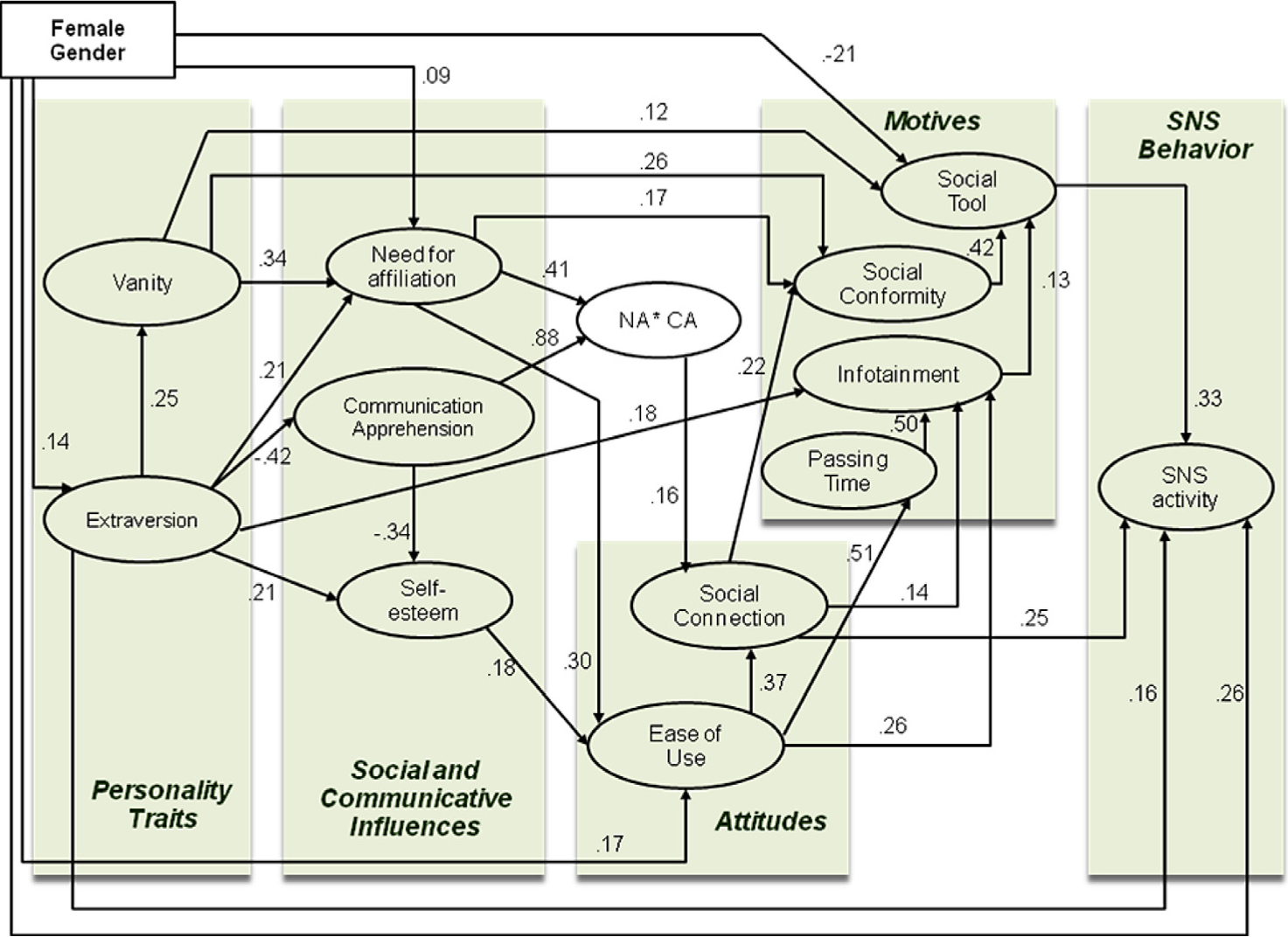
Extraversion wasn't just a predictor of activity; it was the engine. Extraverts are less apprehensive about communication, which boosts their self-esteem, leading to a more positive attitude toward using SNSs as a social connector.
2. The Vanity Link
The researchers found a specific link between Vanity (a sub-dimension of Narcissism) and the Need for Affiliation. Vain individuals use SNSs not just to be "seen," but to receive social validation through "likes" and "shares," effectively using the platform as a tool for social conformity.
3. The Mediating Role of the "Social Tool"
One of the most significant findings was that most motives (like "passing time" or "infotainment") did not directly lead to high activity. Instead, they were filtered through the Social Tool motive. If a user doesn't see the platform as a utility for maintaining relationships, their activity remains low, regardless of how "entertaining" the content is.
 The final re-specified model shows weight distribution across different motives.
Critical Analysis & Conclusion
Takeaway
The study concludes that Social Networking Sites are successfully fulfilling their naming convention—they are social first and multimedia second. The "rich-get-richer" because the multimodal format of modern SNSs (photos, links, immediate feedback) aligns perfectly with the skill sets of extroverted individuals.
Limitations
- The "Openness" Paradox: Interestingly, the "Openness to Experience" trait had no significant impact. The authors suggest this is because SNSs are no longer "new" or "innovative" technologies—they are mundane utilities.
- Sample Bias: The study focused on college students. While they are "digital natives," their social needs (high conformity, high peer pressure) might differ from older demographics.
Future Outlook
This work sets the stage for investigating "Social Fatigue." If the "rich" keep getting "richer," how do platforms prevent the "poor" (the socially anxious) from disengaging entirely? For product designers, the lesson is clear: Lowering the barrier for social connection is more important than simply adding more "infotainment."