
Virtual Reality: The Ultimate Frontier for Deep Emotional Elicitation
Induction and Profiling of Strong Multi-Componential Emotions in Virtual Reality
This study utilizes Virtual Reality (VR) to induce and profile strong, multi-componential emotions based on appraisal theory. By having participants engage with seven diverse VR games and measuring responses across cognitive, physiological, motivational, and experiential components, the researchers successfully identified distinct patterns for "Joy" and "Fear" that align with theoretical predictions.
TL;DR
Researchers Ben Meuleman and David Rudrauf have bridged the gap between complex psychological theory and experimental practice. By using VR games, they've proven that emotions are "multi-componential" episodes driven by cognitive appraisals. Their study shows that VR can trigger fear and joy so intense that they engage the body, mind, and motivational systems simultaneously—something traditional lab stimuli rarely achieve.
The "Weak Emotion" Problem in Affective Science
For decades, emotion research has relied on "passive" stimuli. Imagine sitting in a sterile lab, looking at a picture of a spider, or watching a short clip of a sad movie. While you might feel something, your body isn't preparing to run, and your mind knows there is no real threat.
Prior work often ignores Appraisal Theory, which suggests that emotions only happen when we evaluate a situation as personally relevant to our goals. Passive viewing lacks:
- Agency: You can't act on the stimulus.
- Immersion: The "screen" acts as a psychological barrier.
- Multi-componentiality: Because there is no "threat" or "reward" to interact with, the motivational and behavioral components of emotion remain dormant.
Methodology: Engaging the Whole Organism
The authors selected seven VR games (ranging from the peaceful Tilt Brush to the terrifying Zombies) to test their hypothesis. Unlike a movie, VR puts the participant inside the scenario.
The Componential Framework
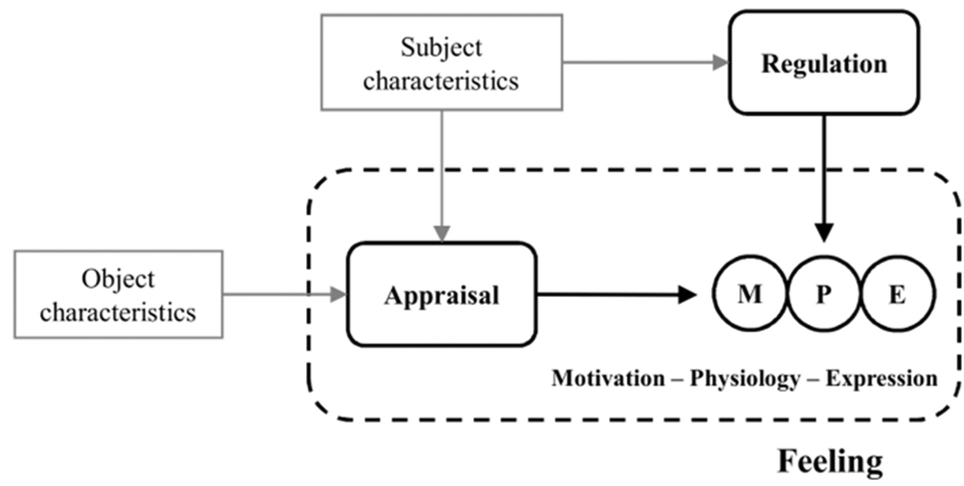
The study measured five key components:
- Appraisal: Cognitive evaluation (e.g., "Is this dangerous?")
- Physiology: Bodily responses (e.g., racing heart, sweaty palms).
- Motivation: Action tendencies (e.g., "I want to escape").
- Feeling: The subjective experience (e.g., "I feel terrified").
- Regulation: Efforts to control the emotion (e.g., "Reminding myself it's not real").
Core Insights: Why VR Works
The researchers used Hierarchical Clustering to see if these components actually "stuck together." They found that they did. Fear wasn't just a "feeling"; it was a synchronized package of danger appraisal, fast breathing, an urge to stop the game, and attempts to look away.
The Power of Appraisal
One of the study's most profound findings is that Appraisal is the engine of emotion. The cognitive evaluation of "Danger" was the single strongest predictor of fear intensity, explaining over 60% of the variance. This confirms that our brains don't just react to pixels; they react to the meaning those pixels project onto our safety and goals.
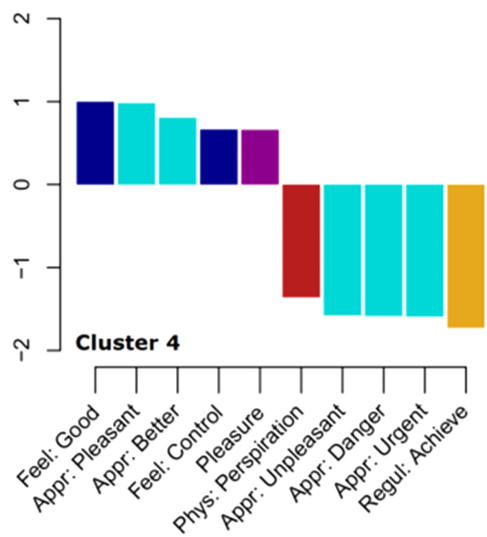 Fig 3 above shows how different "clusters" of responses emerged, mapping specific games to multi-componential profiles of Joy, Fear, and Gaming flow.
SOTA Comparison: Beyond the "Video Clip"
The study highlights that in VR, no participant reported "No Emotion." In many traditional studies, "boredom" or "neutrality" is a common problem. VR's ability to maintain high immersion (4.84/6) ensures that the "Ecological Validity" is much higher than standard lab setups.
| Feature | Traditional Labs (Images/Video) | VR Elicitation (Current Study) |
|---|---|---|
| Intensity | Low to Moderate | High |
| Body Engagement | Minimal | Significant (Heart rate, muscle tension) |
| Agency | None (Observer) | High (Participant/Player) |
| Theoretical Alignment | Often disconnected from Appraisal | Strictly grounded in Appraisal Theory |
Critical Analysis & Conclusion
Takeaway
This research validates that VR is not just a toy or a gaming peripheral; it is a precision instrument for psychology. By providing a "safe" way to simulate real-world threats and rewards, VR allows us to see the human emotional architecture in its full, synchronized glory.
Limitations
- Novelty Effect: As the authors admit, for some, the intensity might come from the "newness" of VR rather than the content itself.
- Self-Report Bias: The study relied on participants reporting their own physiological changes (e.g., "my heart raced") rather than using ECG sensors. Future work needs to integrate live biometric data with the VR environment.
Future Outlook
We are moving toward "Closed-Loop Affective VR," where the environment adjusts in real-time based on the user's physiological and appraisal data. This could revolutionize therapy for phobias and social anxiety by finding the perfect "stress threshold" for each individual.