
Deciphering Career Success: Mining Interest-Skill Association Rules for Occupational Adaptability
An Industrial Analysis Technology About Occupational Adaptability and Association Rules in Social Networks
This paper introduces an industrial analysis framework to evaluate occupational adaptability by mining multidimensional association rules between user interests and professional skills using LinkedIn data. The authors developed an occupational adaptive classifier that leverages these rules to predict career stability and professional fit.
TL;DR
Can your passion for basketball predict your leadership potential? According to a recent study published in IEEE Transactions on Industrial Informatics, the answer is a statistically significant "Yes." By analyzing thousands of LinkedIn profiles, researchers have uncovered multidimensional association rules between what we love (interests) and what we do (skills), creating a scalable "Occupational Adaptive Classifier" that predicts career stability without the need for manual psychological testing.
1. The Missing Link in User Profiling
While AI agents are becoming experts at guessing our gender, age, and next purchase, the industrial application of user profiling has overlooked a critical dimension: Occupational Adaptability.
The core challenge is that career suitability is traditionally measured via subjective surveys (like the Holland test). In the fast-paced world of industrial recruitment and career recommendation, we need a way to quantify "suitability" using the massive, unstructured data already present on platforms like LinkedIn. The authors argue that the mismatch between a person's intrinsic interests and their professional skills is a primary driver of "job-hopping" and low professional stability.
2. Methodology: From Raw Text to Association Rules
The researchers implemented a multi-stage pipeline to turn messy social media strings into a rigorous correlation model:
Data Preprocessing
LinkedIn interests are often non-standardized strings. The team processed over 64,000 profiles, identifying 19,430 unique interest sets after synonym aggregation and frequency filtering.
Association Rule Mining
Using the Apriori Algorithm, the study identified three types of relationships:
- S2S (Single-to-Single): e.g., Language → Strategy
- D2S (Double-to-Single): e.g., Basketball + Travel → Team Building
- D2D (Double-to-Double): e.g., Design + Sales → Training + Coaching
 Figure 1: The general framework for mining occupational characteristics from social networks.
The intensity of these relationships was measured using Confidence (how often the skill appears when the interest is present), Support (universality), and Lift (the strength of the influence).
3. The Core Discovery: Why Interests Matter
The results revealed high-confidence "anchors" for professional behavior. For example, the interest "Basketball" showed a 62.93% confidence for the "Leadership" skill.
| Antecedent (Interest) | Consequent (Skill) | Confidence | Lift |
|---|---|---|---|
| Building | Team Building | 68.42% | 432.60% |
| Basketball | Leadership | 62.93% | 184.05% |
| Communication | Strategic Planning | 52.99% | 183.02% |
These rules aren't just trivia; they form the basis of the Occupational Adaptive Classifier.
4. Validating Stability: Job-Hopping vs. Rule Match Rate
To prove that these association rules actually reflect professional reality, the authors tested two hypotheses:
- Hypothesis 1: Stable users (fewer job changes) should have interests/skills that align more closely with "strong" association rules.
- Hypothesis 2: Users with longer tenures at a single company should show higher rule match rates.
The data confirmed both. As shown in the performance charts, the match rate for these rules peaks for stable employees and steadily declines as the "job-hopping indicator" increases.
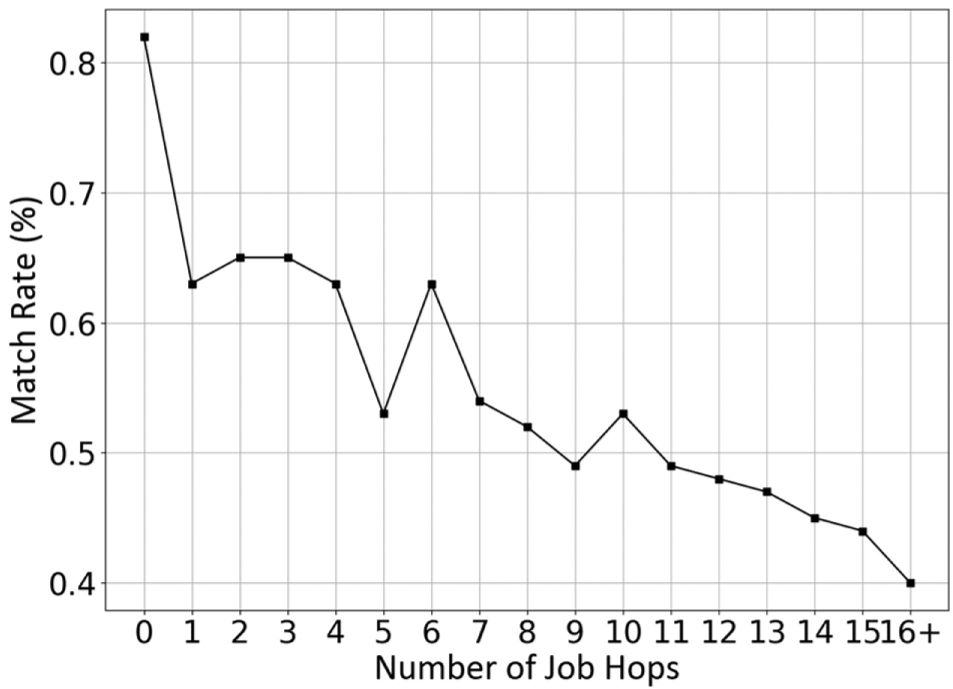 Figure 2: The negative correlation between job-hopping frequency and association rule match rates.
5. Industrial Application & Future Outlook
The "Occupational Adaptive Classifier" developed in this work offers three major upgrades for the industry:
- Precision Recommendation: LinkedIn and other platforms can recommend jobs not just based on what a user can do, but what their interests suggest they will stay doing.
- Talent Management: Employers can use big data to verify the "Inductive Bias" of a candidate's background against proven career success patterns.
- Personal Development: Individuals can identify "skill gaps" based on their intrinsic interests to optimize their career trajectory.
Limitations & Future Work
The authors acknowledge that occupational adaptability is subjective. Future iterations will explore negative association rules (interests that conflict with specific skills) and further refine the clustering of professional lifecycles.
Conclusion
This paper moves user profiling from simple "data mirroring" to "causal insight." By proving that our hobbies are a digital footprint of our professional potential, the authors have provided a new mathematical lens through which we can view the future of work.