
teleda: Transforming VOD into a Public Forum through Social TV
Industry Track: User Behavior in the "teleda" Social TV Service -Achieving a Public Forum on the Network
The paper introduces "teleda," an experimental Social TV platform by NHK that integrates Video on Demand (VOD) with Social Network Service (SNS) features. Through a three-month trial with 1,000 participants, it demonstrates how "horizontal links" between viewers can transform passive viewing into an active public forum, achieving a State-of-the-Art (SOTA) understanding of socialized media consumption.
TL;DR
NHK researchers have pioneered a platform called teleda, which merges Video on Demand with Social Networking. By analyzing a 3-month trial, they've proven that fostering "horizontal links" (viewer-to-viewer) significantly expands the variety of content users watch, effectively pushing beyond the "watching alone" culture of modern streaming.
Background: The Crisis of "Watching Alone"
In the age of Netflix and YouTube, viewing has become a solitary, highly personalized act. While VOD offers convenience, it often limits a viewer's horizon to their own previous tastes—a phenomenon known as the "Filter Bubble." As a public broadcaster, NHK (Japan Broadcasting Corporation) identified this as a threat to "social capital." Their goal was to recreate the "Public Forum"—a space where diverse values collide—by adding an SNS layer over high-quality broadcast content.
Methodology: The teleda Architecture
The teleda platform was designed to transition users from passive consumers to active participants.
1. The Core Interaction Model
The site provided standard VOD features but integrated "Community Functions" where users could post reviews, comment on others' thoughts, and link directly to specific scenes in a program.
2. Social Graph and Discovery
The platform visualized connections between users, programs, and communities. This allowed users to "follow" influential columnists or other viewers whose tastes they admired, creating a dynamic "MyPage" similar to a Facebook or Twitter feed but centered entirely around video content.
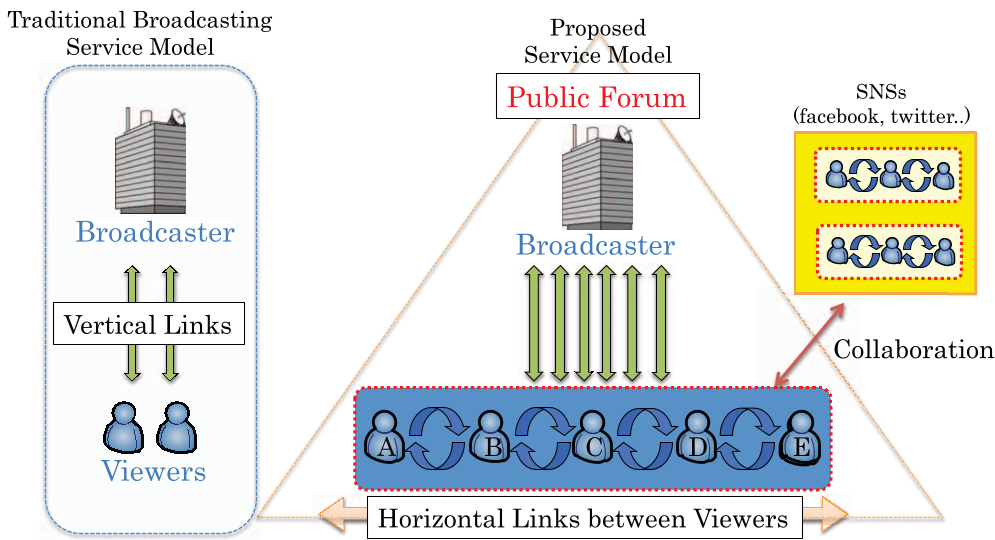 Figure 1: The conceptual shift from vertical broadcaster-viewer links to horizontal viewer-viewer links.
Trial Analysis: User Segments
The researchers categorized 1,032 participants into four distinct groups:
- Group A: Lurkers (Viewed programs, no posts).
- Group B: Reviewers (Wrote reviews, no comments).
- Group C: Influencers/Engagers (Made comments on others’ posts).
- Group D: Inactive participants.
The trial revealed that Group C was the "engine" of the platform. These users didn't just watch more; they watched a significantly wider variety of genres, particularly documentaries and news, which served as catalysts for discussion.
Performance & Results: Breaking the Long Tail
The most striking result from the trial was the correlation between social activity and content discovery.
- Genre Span: Group C users explored an average of 12.25 sub-genres, whereas passive Group A users only explored 3.8.
- The Power of Word-of-Mouth: For the top 100 programs, over 50% of the views originated from social paths (posts/recommendations) rather than direct searches.
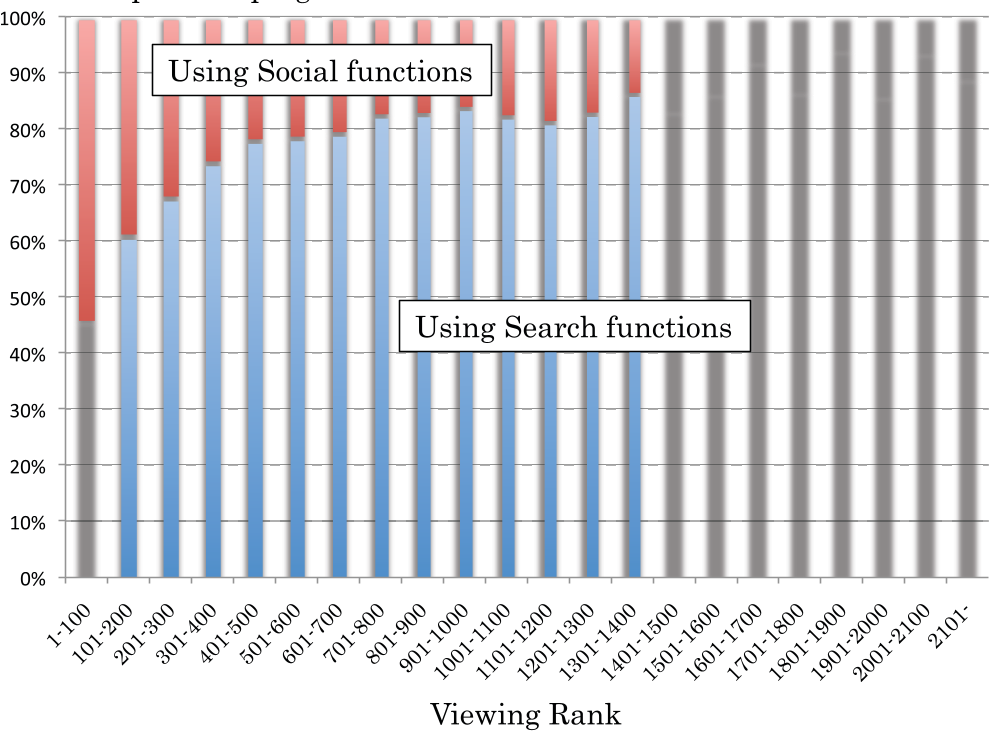 Figure 2: Ratio of discovery paths. Social functions become dominant as a program's rank increases.
Critical Insight: Social Capital in the Digital Age
The teleda experiment demonstrates that inter-viewer communication is a powerful tool for surfacing niche content. It suggests that the "Long Tail" of content—the thousands of high-quality documentaries that usually get buried—can be revitalized if we give "Power Users" (Group C) the tools to curate and discuss them.
Limitations and Future Outlook
While the trial was successful with the 40s–60s age groups, younger viewers (20s-30s) tended to be "lurkers" or found the interface less intuitive for their communication style. NHK's next step involves the Hybridcast platform, integrating these social functions directly into the TV set, turning the living room screen into a gateway for the global conversation.
Conclusion
The teleda project proves that Social TV is not just about "tweeting while watching"; it is a structural methodology to ensure that public broadcasting continues to foster a shared social reality in an increasingly fragmented digital world.