
Breaking the Nano-Glass Ceiling: Inequality in Canadian Pro-Poor Nanotechnology
Inequality and collaboration patterns in Canadian nanotechnology: implications for pro-poor and gender-inclusive policy
This study utilizes Social Network Analysis (SNA) to investigate gender inequality and collaboration patterns within Canadian nanotechnology R&D, specifically focusing on "pro-poor" applications (energy, water, and agri-food). The research reveals that while women are highly collaborative and often involved in more gender-balanced teams, they still face systemic "Matilda effect" biases in citation rates and professional recognition.
Executive Summary
TL;DR: This paper explores the intersection of gender disparity and "pro-poor" technology development in Canada. By analyzing 15 years of nanotechnology data, the authors find that while women are more collaborative and drive higher productivity in mixed-gender teams, they remain marginalized in high-impact citation networks and industrial patenting.
Background: Positioned at the crossroads of Scientometrics and Science Policy, this work is a critical assessment of whether emerging technologies like nanotechnology are living up to their "equitable" promise. It moves the conversation from "representation" to "structural network dynamics."
The "Nano-Divide" and the Motivation for Equity
Nanotechnology is often touted as a "silver bullet" for global challenges—clean water, renewable energy, and food security. However, there is a looming risk of a "nano-divide", where the benefits of these advancements are captured exclusively by affluent, male-dominated circles in the Global North.
The authors' intuition was simple: If we want to solve global poverty with technology, we must first fix the internal inequalities (gender and collaboration barriers) within the scientific systems producing that technology.
Methodology: Mapping the Invisible College
The study utilizes Social Network Analysis (SNA) to map the "co-innovation network." This includes:
- Co-authorship Networks: Who writes scientific papers together?
- Co-inventorship Networks: Who files patents together?
- Author-Inventors (A-Is): The rare "bridge" scientists who exist in both worlds.
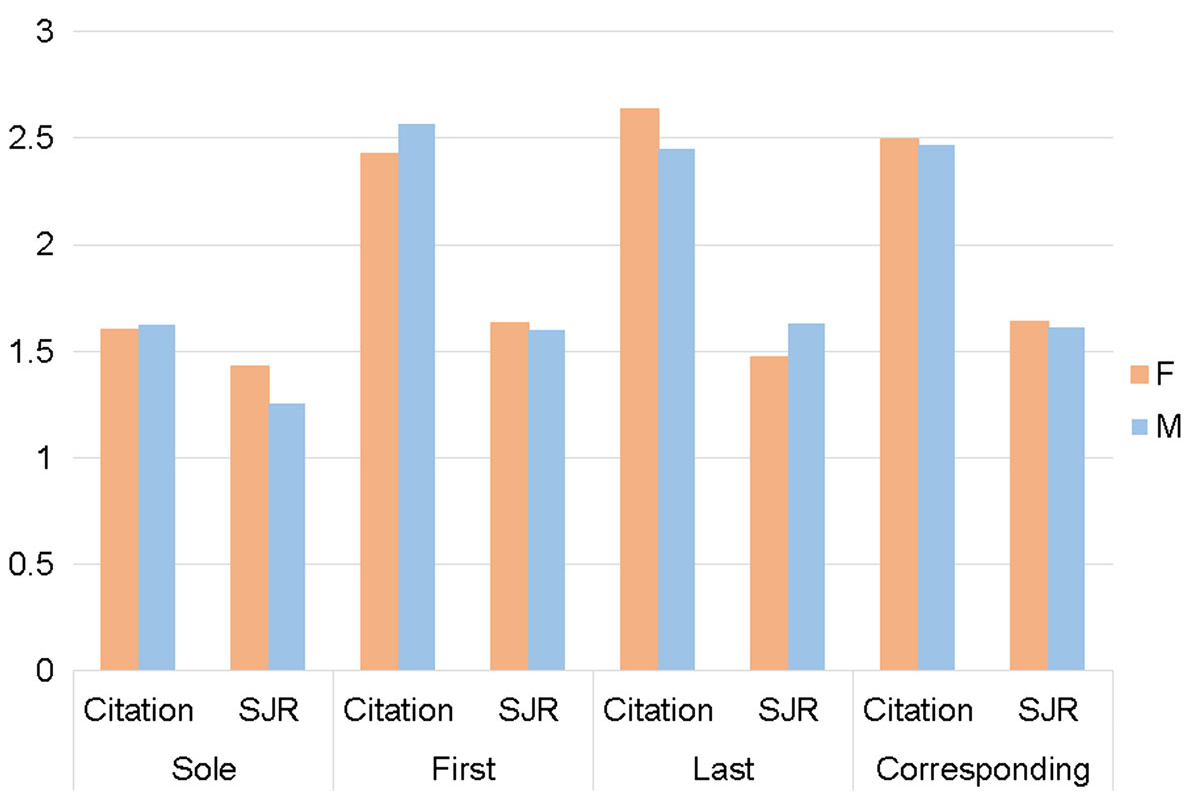 Figure 1: Comparison of citation and journal impact across gender and authorship order.
Key Insights: The Matilda Effect Lives On
One of the most striking methodology findings involves authorship order. In nanotechnology (as in chemistry/physics), the first author is often the junior researcher, while the last/corresponding author is the senior Principal Investigator (PI).
- The Paradox: Female first-authored papers occupy higher-ranked journals (High SJR) but receive fewer citations than their male counterparts. This is a classic manifestation of the Matilda Effect, where women's contributions are systematically undervalued by the community.
- The Survivor Bias: However, when women reach the "Last Author" position, their citation rates equal or exceed men's. The authors attribute this to a "strong selection effect"—the "Leaky Pipeline" ensures only the most exceptionally qualified women survive to reach senior ranks.
Collaboration Dynamics: Teams & Loyalty
The research utilized "Network Degree" to measure collaborativeness.
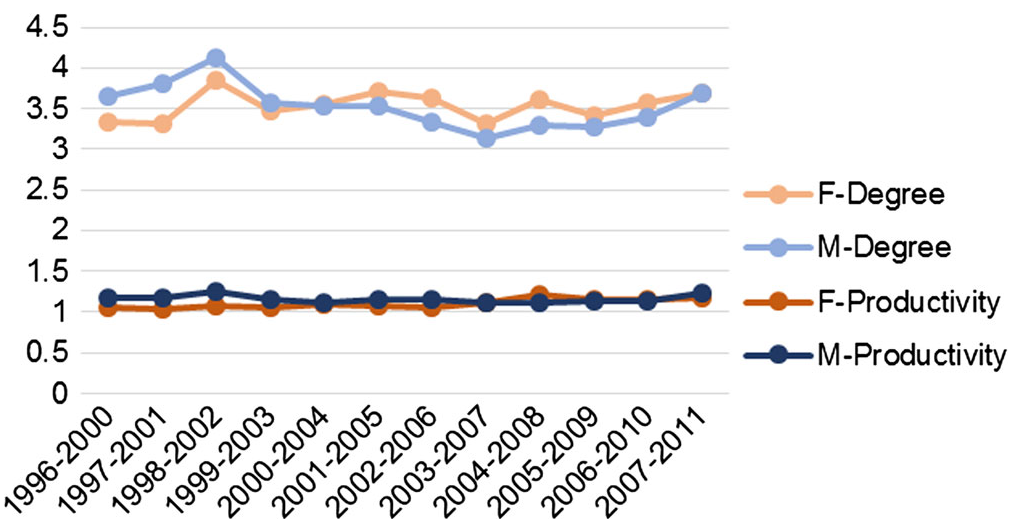 Figure 2: Gendered trends in degree centrality and productivity.
- Mixed-Gender Success: For both men and women, the most productive teams were mixed-gender. Diversity, in this case, correlates directly with scientific output.
- The Male Monoculture: Despite the benefits of diversity, 45% of male authors and 58% of male inventors collaborate exclusively with other men. This "loyalty" to same-gender networks acts as a barrier to women's entry into high-value industrial clusters.
Critical Analysis & Policy Implications
The study concludes that Canada's current policies, like the NSERC WISE program, are helpful but insufficient.
Limitations:
- The data is limited to national collaborations; international ties (which are often more prestigious) were not fully mapped.
- Women account for only 13% of inventors, making the sample size for FF (Female-Female) patenting collaborations small and susceptible to outliers (e.g., specific high-performing teams at Xerox Canada).
Future Outlook: To truly foster "pro-poor" technology, we must incentivize structural diversity. It is not enough to fund "women in science"; policy must actively bridge the gap between female-heavy academic clusters and male-dominated industrial "giant components" in the innovation network.
Conclusion
This paper serves as a data-driven wake-up call. If nanotechnology is to end poverty and reach the UN Sustainable Development Goals, the "invisible college" of science must first dismantle its own internal walls of exclusion.