
The Social Fabric of Algorithms: Inferring Trust in a Connected World
Inferring binary trust relationships in Web-based social networks
The paper introduces a framework for inferring binary trust relationships in Web-based social networks using the concepts of transitivity and personalization. It proposes two main algorithms—Rounding and Nonrounding—for calculating trust between unconnected users and demonstrates their utility through TrustMail, a prototype email client.
TL;DR
This seminal work by Golbeck and Hendler tackles the challenge of computing subjective trust in social networks. By leveraging "Small World" network properties and the transitivity of trust, they propose algorithms that allow a user to calculate how much to trust a stranger based on their friends' opinions. Their prototype, TrustMail, demonstrates how these social signals can solve the age-old problem of email filtering and spam.
Perspective over Popularity: The Motivation
In the early 2000s, as social networks like LinkedIn and Orkut emerged, most trust metrics were "global"—think of a Google PageRank for people. If everyone liked you, you were "trusted."
However, the authors argue that trust is inherently personal. A political leader might be trusted by 50% of the population and loathed by the other 50%. A global average of 0.5 is useless to everyone. The insight here is to compute trust from the source’s perspective. If you trust Alice, and Alice trusts Bob, you have a reason to trust Bob—regardless of what the rest of the world thinks.
Methodology: Spreading Trust through Small Worlds
The authors propose a system based on Transitivity, Asymmetry, and Personalization.
1. Network Topology
The paper utilizes the -model to simulate "Small World" networks, characterized by high clustering coefficients and short average path lengths. This structure is critical because it ensures that most users are only a few "hops" away from each other.
2. The Inference Algorithms
The authors present two variations of a modified Breadth-First Search (BFS):
- Rounding Algorithm: Each node in the path polls its neighbors, averages their ratings of the "sink" (the target), and rounds that value to 0 or 1 before passing it back. This "internal rounding" acts as a noise filter.
- Nonrounding Algorithm: Intermediate nodes pass continuous values (e.g., 0.75) back to the source, with rounding occurring only at the final step.
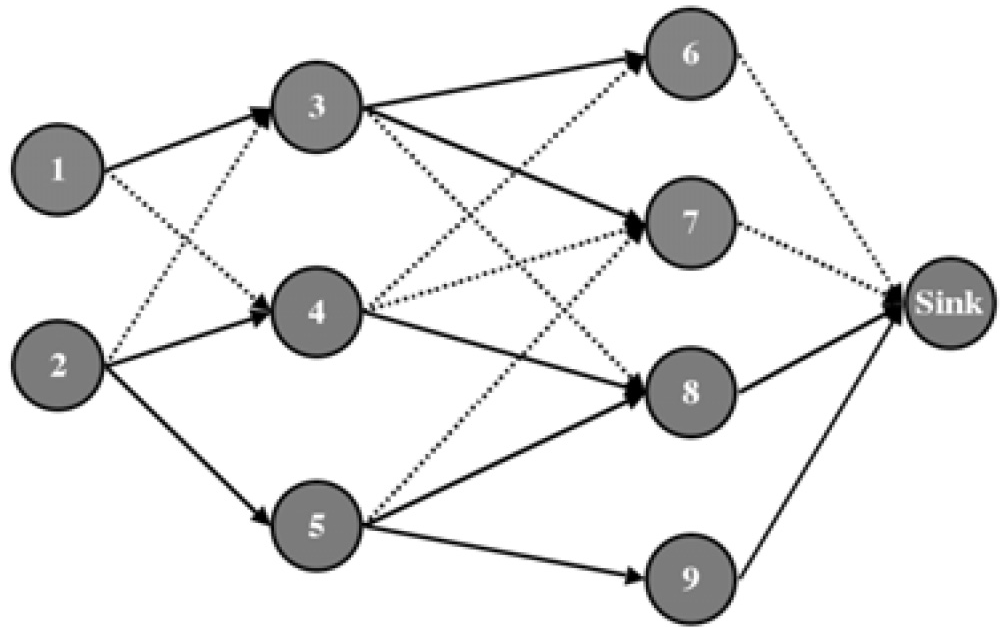 Figure 1: Trust propagation from source to sink. Even with contradictory data in the network, individual perspectives allow Node 1 and Node 2 to reach different, personalized conclusions.
Experiments: Performance Against Attackers
To test the algorithms, the authors simulated "bad nodes"—attackers who always give the opposite of the correct rating.
The mathematical "sweet spot" identified is (where is the product of node percentage and accuracy). If this condition is met, the probability of a correct inference approaches 1 as the network grows.
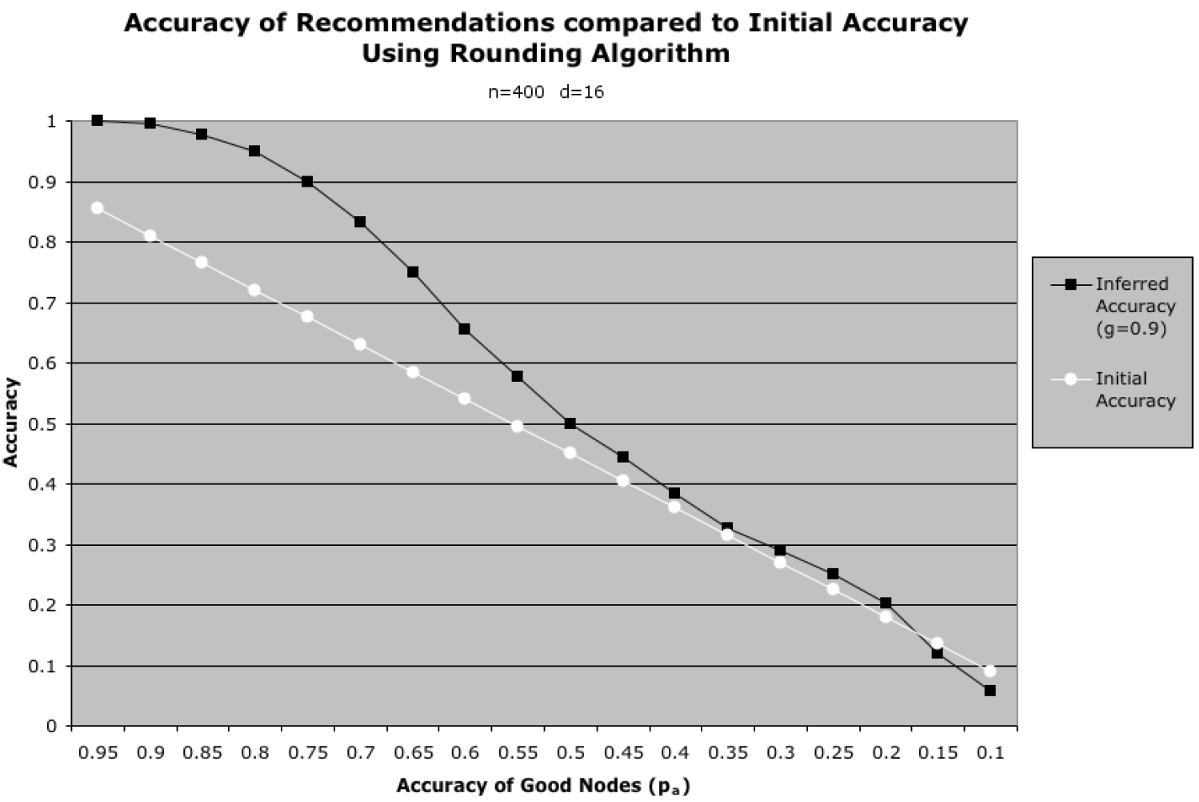 Figure 2: The Rounding Algorithm significantly outperforms the initial network accuracy, effectively "cleaning" the data as it propagates.
Real-world Application: TrustMail
The crowning achievement of the paper is TrustMail. Unlike standard whitelists that only allow known senders, TrustMail uses the social graph to "score" emails from strangers. If a stranger is trusted by your friends, their email gets a green light.
Analyzing the Enron Email Corpus, the authors found that 92% of all senders could have been assigned a trust rating using this method, proving that the social fabric is dense enough to support automated filtering.
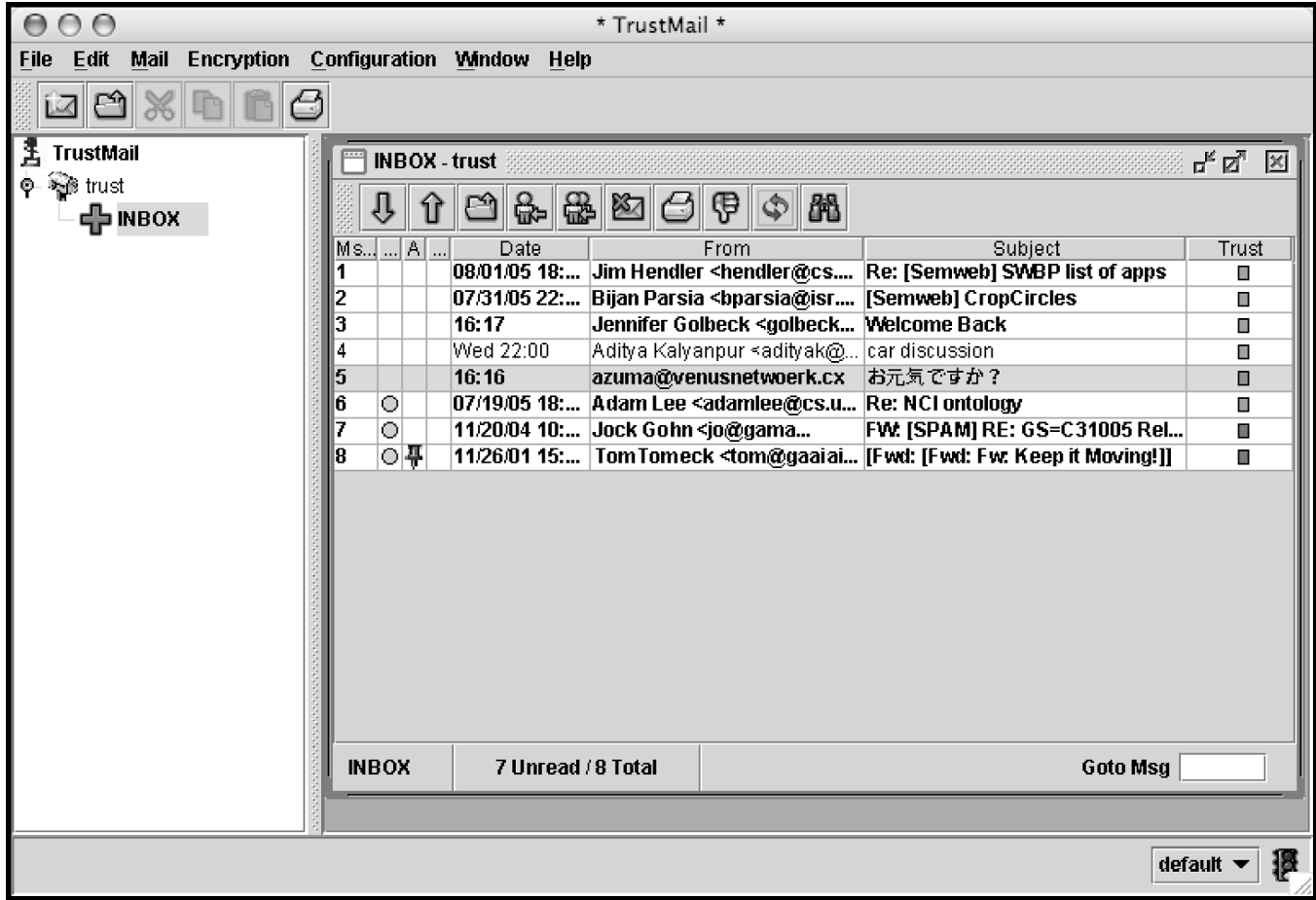 Figure 3: Semantic Web-based trust ratings integrated into an email client, providing immediate social context to the inbox.
Critical Insight & Vision
The beauty of this work lies in its simplicity. By ignoring complex histories or learning-based approaches, the authors created an efficient algorithm that works in the "momentary snapshot" of a network.
Limitations: The model assumes trust is a "bet on future actions" and works best in subjective domains (like movie recommendations). In domains where "absolute truth" exists (like scientific data), social trust alone is insufficient.
Future Outlook: This paper laid the groundwork for modern "Social Graphs" and decentralized identity systems. In an era where AI-generated spam threatens to overwhelm our digital lives, returning to these "Socially Intelligent" filters may be our best defense.