
Scaling Demographic Intelligence: High-Accuracy Twitter Profiling via Computer Vision APIs
Inferring Demographic Data of Marginalized Users in Twitter with Computer Vision APIs
This paper introduces a scalable framework for inferring demographic attributes (age and gender) of Twitter users by applying Computer Vision APIs to profile avatars. By leveraging Microsoft Azure Face API and Google Cloud Vision, the authors produced a large-scale corpus of 82,781 labeled users, achieving "very good" agreement with human-annotated gold standards.
TL;DR
Understanding who is talking on social media is often as important as what they are saying. However, obtaining demographic data (age, gender) at scale is notoriously difficult due to privacy constraints and the limitations of manual labeling. This paper presents a sophisticated pipeline that uses Computer Vision (Microsoft Azure & Google Cloud Vision) to turn public profile pictures into high-accuracy demographic labels, creating a massive corpus of over 80,000 annotated Twitter users.
Context: The Bottleneck of Demographic Inference
In social science research, researchers often struggle with the "marginalized user" problem. Traditional methods for identifying a user's age or gender rely on:
- Textual Heuristics: Searching for "I am 20 years old" (Rare and language-dependent).
- Name Lists: Comparing screen names to census data (Fails for nicknames or non-English names).
- Manual Crowdsourcing: Highly accurate but impossible to scale to millions of users.
The authors argue that the Avatar (Profile Picture) is a globally available, language-agnostic data source that remains underutilized due to the "noise" (pets, logos, celebrities) inherent in social media imagery.
Methodology: A Multi-Stage Filtering Pipeline
The core contribution is a robust pipeline that ensures the Computer Vision API only "sees" what it is designed to analyze.
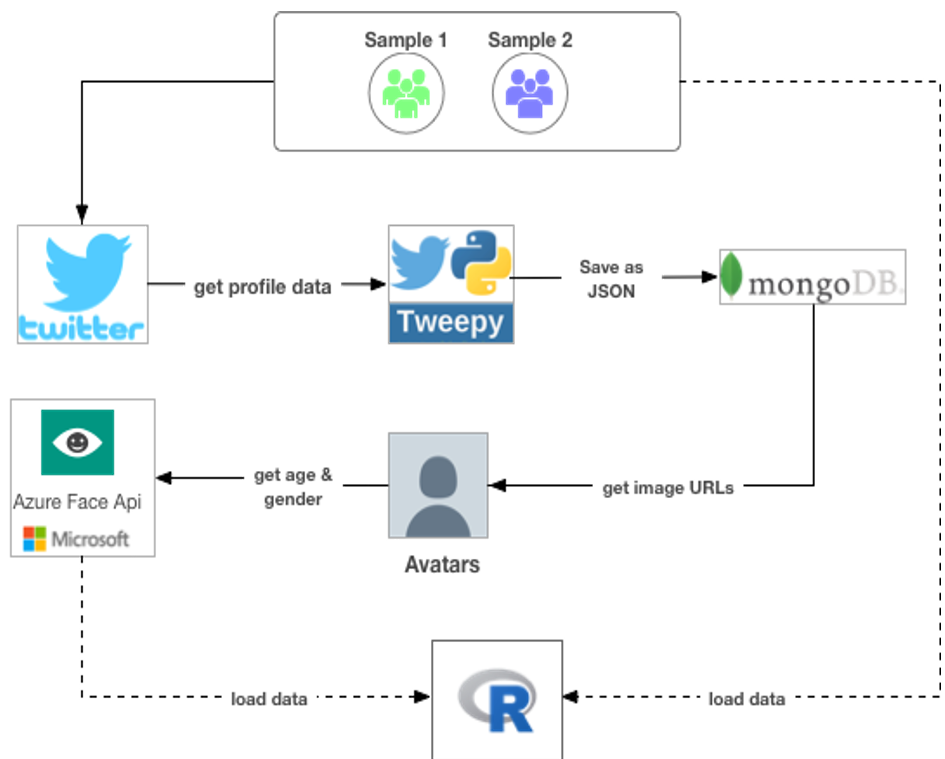
The process follows these critical steps:
- Anti-Bot/Anti-Default Filter: Excludes default Twitter avatars and GIFs.
- OpenCV Face Detection: Ensures at least one face is present in the image.
- Celebrity & Duplicate Removal: Uses Google Cloud Vision to check if an image appears more than 4 times on the web (identifying memes or famous people).
- Demographic Extraction: Feeds the "clean" human face to Microsoft Azure Face API to get floating-point age and gender estimates.
Proving Validity: Beyond Simple Accuracy
To prove that an API can replace a human, the authors compared the API's results against two "Gold Standard" datasets where humans had already manually labeled the users.
Rather than using standard accuracy or Cohen's Kappa—which can be misleading when certain age groups are more common than others—the researchers used Gwet’s AC1 and AC2. These statistics are more "resilient to chance agreements," providing a more honest look at how much the machine and the human actually agree.
Results at a Glance
| Dataset | Category Bins | Weighting | Gwet's Agreement (AC1/AC2) |
|---|---|---|---|
| Sample 1 (N=1163) | 3 | Linear | 0.969 |
| Sample 2 (N=659) | 3 | Linear | 0.993 |
The results show "Very Good" agreement (scores > 0.8) for 3-bin age categories (e.g., Young, Middle-aged, Senior) and "Good" agreement for more granular 10-year increments.
Deep Insight: Visualizing the Corpus
The study resulted in a massive dataset reflecting a wide variety of users. Interestingly, the authors validated their method on Dutch-speaking users to prove the language-agnostic nature of the tool.
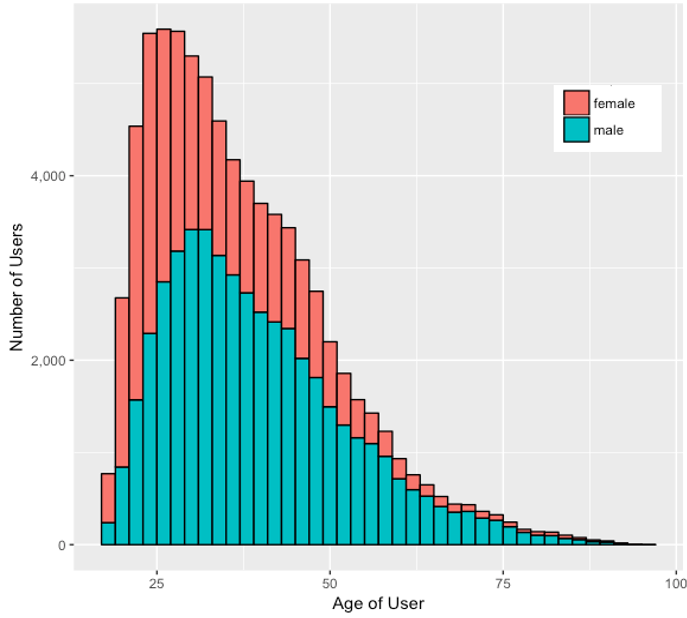
As seen in the distribution chart, while Twitter is dominated by users under 40, the CV-based approach successfully captured enough "marginalized" elderly users to allow for statistically significant social research on those demographics.
Critical Analysis & Conclusion
This work demonstrates that Computer Vision APIs have reached a commodity level where they can effectively replace or augment manual labor in the social sciences.
Strengths:
- Scalability: Processes thousands of users for the cost of an API call.
- Language Agnostic: Works just as well for Dutch, Arabic, or Chinese accounts as it does for English ones.
- Rigorous Filtering: The addition of celebrity detection is a vital "sanity check" often missing in earlier studies.
Limitations:
- Privacy: While the data is public, the ethical implications of automated demographic profiling remain a sensitive topic.
- Binary Constraints: The current API-based models often pivot on binary gender, which may not reflect the self-identification of all social media users.
Future Outlook: This framework paves the way for "real-time" demographic monitoring of public discourse, allowing organizations to see not just what the public thinks about a policy, but how that sentiment splits across different generations and genders in real-time.