
SeTRL: Decoding Expertise through Sentiment and Topic Synergy
Inferring Your Expertise from Twitter: Integrating Sentiment and Topic Relatedness
The paper introduces SeTRL (Sentiment-weighted and Topic Relation-regularized Learning), a novel supervised framework for inferring user expertise on Twitter. By integrating VADER-based sentiment intensity and structural topic correlations, the model achieves a significant F1-score improvement of up to 10.32% over standard sentiment-aware baselines.
TL;DR
Researchers from the ADAPT Centre have developed SeTRL, a machine learning model that predicts your professional expertise based on your tweets. Unlike previous systems that just count keywords, SeTRL looks at how strongly you express opinions and how your interests relate to each other (e.g., if you know Data Science, you likely know Machine Learning). By using Quora profiles to train the AI, they achieved a massive performance leap over traditional methods.
The "Frequency" Fallacy
In the world of Social Networking Sites (SNS), identifying experts is a billion-dollar problem for recruitment and information filtering. Most existing systems use a "Search Engine" logic: if you tweet the word "Blockchain" 100 times, you are an expert.
However, the authors point out a critical flaw: frequent mentions do not equal mastery. A bot or a fan might retweet a topic constantly without understanding it. The real signal of expertise lies in Subjective Expression and Cross-Domain Correlation.
The Core Insight: Sentiment as a Proxy for Knowledge
The researchers' first breakthrough is the Sentiment-Weighted Scheme. They argue that if a person can express a forceful, subjective opinion on a topic—whether positive or negative—they are perceived as more knowledgeable.
Using the VADER sentiment analysis tool, the model assigns higher weights to "high-intensity" tweets.
- Weak Signal: "I am reading about Python today." (Neutral)
- Strong Signal: "The memory management in Python's latest update is absolutely revolutionary for big data!" (Strong Sentiment)

Methodology: Connecting the Dots
The second pillar of the SeTRL (Sentiment-weighted and Topic Relation-regularized Learning) model is topic relatedness. Expertise isn't a silo; it’s a web. The authors used two sources to map this web:
- Internal (Co-occurrence): If many users list both "Java" and "C" as skills on Quora, the model learns they are related.
- External (WordNet): Using linguistic hierarchies to see how "Health" and "Nutrition" overlap.
These relations are baked into the math using a Tikhonov regularizer, which penalizes the model if it tries to treat related topics as completely different entities.
Experimental Results: Proving the Theory
The authors bypassed the "lack of data" problem by scraping Quora, where users explicitly list their expertise and link their Twitter handles.
| Method | F1-Score | Accuracy |
|---|---|---|
| Traditional SVM | 66.06% | 65.79% |
| SVM + Sentiment (SVM-Sen) | 69.76% | 69.75% |
| SeTRL-Co (Full Model) | 80.08% | 79.65% |
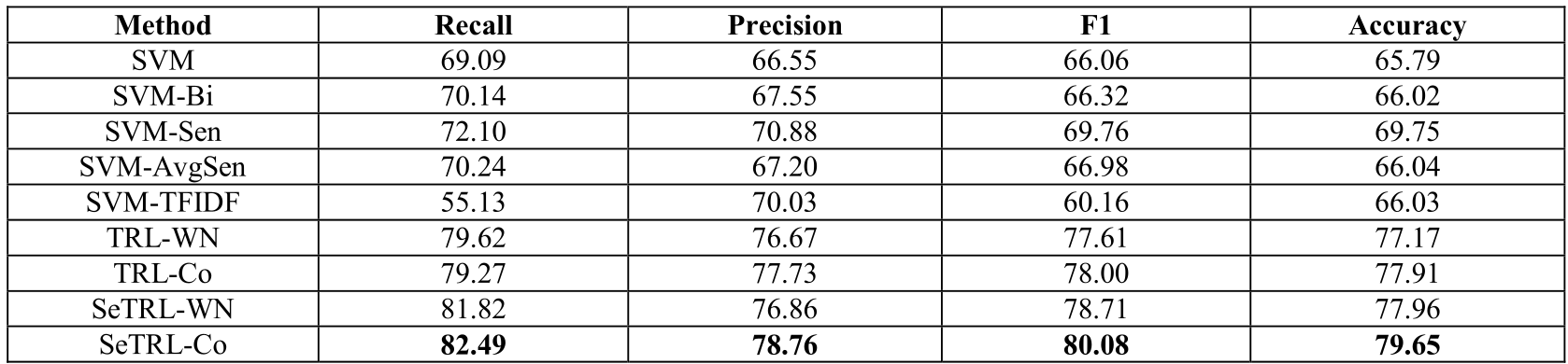
The results are clear: Adding sentiment weighting improves the model, but adding topic relations provides the biggest boost. Crucially, the model excels even when it has very little data for a specific topic, because it can "borrow" insights from related topics.
Critical Insight & Future Outlook
The most striking takeaway is that SeTRL doesn't suffer from the "Small Data" problem. While standard SVMs fail when a topic has fewer than 100 training samples, SeTRL maintains high accuracy by leveraging the topic graph.
Limitations: The current model uses a unigram (single-word) feature space. While efficient, it might miss complex technical phrases. Future Work: The authors aim to integrate "Social Capital" (who you follow and who follows you) to further refine the expertise score.
In an era of AI-generated noise, SeTRL provides a blueprint for finding the "Heated Experts" in a sea of lukewarm content.