
Inferring the Unseen: Advanced Similarity Learning for Social Network Profiling
Inferring Missing Attributes of Users in Large-Scale Social networks
This paper proposes a user attribute inference framework for large-scale social networks using Sina Weibo as a benchmark. The method integrates Collaborative Filtering (CF) with a Similarity Learning scheme to predict missing user data such as gender, age, and occupation, achieving a lower Root Mean Squared Error (RMSE) compared to traditional regression and decision tree models.
TL;DR
In the era of Big Data, missing user information is a silent killer for recommendation quality. This paper introduces a sophisticated Collaborative Filtering (CF) framework enhanced by Similarity Learning to predict missing attributes on Sina Weibo. By treating user profiles as multi-dimensional vectors and optimizing feature weights, the authors outperform traditional regression baselines in inferring sensitive data like gender and occupation.
Problem & Motivation: The Sparsity Trap
Social media platforms like Sina Weibo serve as gold mines for precision marketing, yet the profiles are notoriously incomplete. Users often leave fields like "Educational Experience" or "Occupation" blank.
Previous attempts at "filling in the gaps" encountered two major hurdles:
- Independent Inference: Treating attributes as isolated variables ignoring the correlation (e.g., VIP level correlation with follower count).
- Linear Limits: Classical models like Linear Regression fail to capture the nuances of social influence and behavioral similarity within large-scale networks.
The authors' insight is simple yet powerful: "Tell me who your neighbors are, and I'll tell you who you are." They leverage the intuitive behavioral clusters found in CF but refine it with a data-driven weight optimization strategy.
Methodology: Beyond Simple Cosine Similarity
The core of the framework is a three-step inference pipeline:
- Feature Vectorization: Converting 20 distinct user features (Table I) into a unified vector space.
- Weighted Similarity Mapping: Unlike standard CF that treats all features equally, this model introduces a weight parameter for each feature.
- Weighted Average Inference: The missing value is calculated as:
This formula ensures that the "most similar" users (determined by ) have a higher vote in determining the target user's missing attribute.
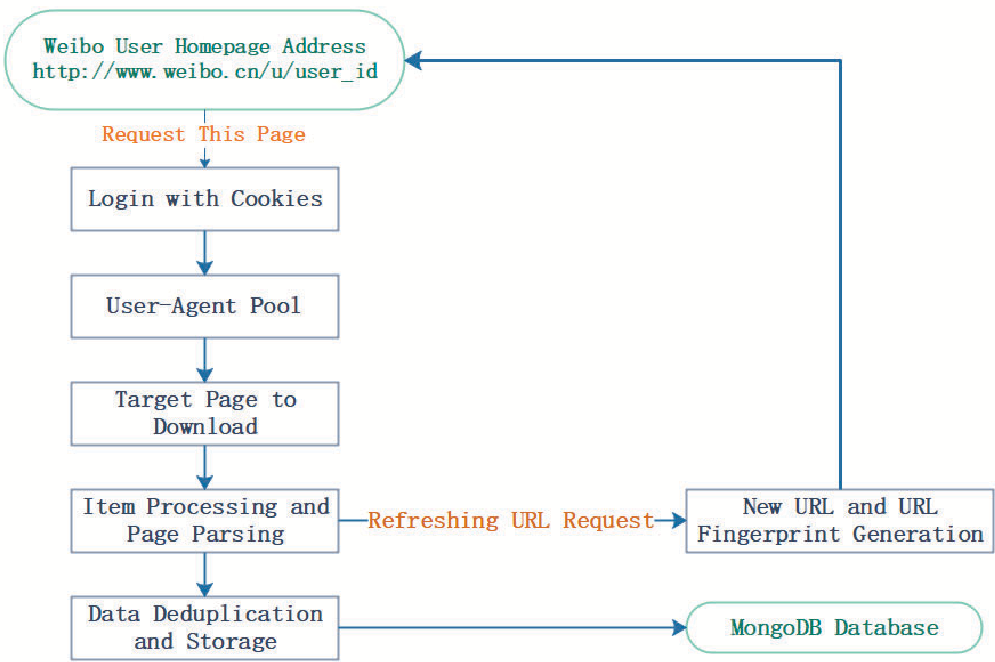 Figure 1: The distributed crawler architecture designed to collect high-quality Weibo data via Scrapy and Selenium.
Experiments & Results: Precision in Prediction
The team crawled approximately 60,000 user accounts from Sina Weibo. After NLP pre-processing and data cleaning, they tested the model primarily on gender inference (a binary classification challenge represented numerically).
SOTA Comparison
The results confirm that the "Similarity Learning" layer provides the edge. By minimizing the Root Mean Squared Error (RMSE), the proposed model proved more robust than standard decision trees or ridge regression.
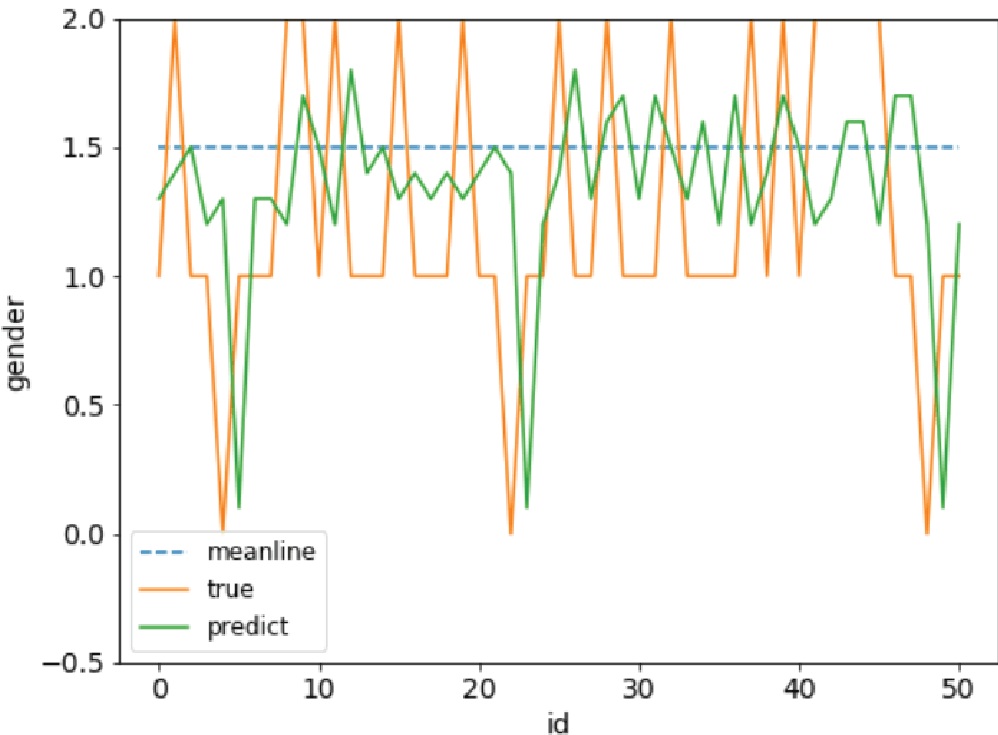 Figure 2: Visualization of gender prediction. The "Meanline" at 1.5 acts as the classification threshold for the CF model.
Key Feature Insights
A critical takeaway from the ablation and weight analysis (Table II) is that social clout (Follower/Fan count) and Gender are the most predictive indicators of other missing behaviors, accounting for over 50% of the total weight in the inference model.
Critical Analysis & Conclusion
This work demonstrates that even "shallow" features in a profile, when weighted correctly, can reconstruct a surprisingly accurate user identity.
Limitations:
- Scalability: As the authors admit, the user-to-user similarity matrix becomes a "dense monster" at scale. In a network of millions, O(N²) complexity is a death sentence for real-time applications.
- Static nature: The model treats attributes as static, whereas social media personas are dynamic.
Future Outlook: The shift toward Parallelized CF and Graph Convolutional Networks (GCNs) is the likely next step to resolve the latency issues mentioned in the paper. For now, this similarity learning scheme provides a solid mathematical baseline for anyone building precision marketing tools on top of unstructured social data.