
iBridge: Engineering Social Bridges to Break Information Echo Chambers
Inferring Social Bridges that Diffuse Information Across Communities
This paper introduces iBridge, a supervised learning framework specifically designed to infer "bridge links"—new connections that span different communities in social networks. By redefining weak ties through community structures, the authors achieve SOTA performance in predicting links that are critical for cross-community information diffusion.
TL;DR
While most social algorithms suggest friends you already almost know, iBridge focuses on the "weak ties" that connect entirely different worlds. By combining community detection with biased structural features, this framework identifies potential bridge links that facilitate information diffusion across isolated clusters, achieving an AUC of up to 0.98 on real-world social datasets.
The "Precision" Paradox in Social Networks
In the world of Link Prediction, we have become too good at predicting the obvious. Current SOTA models excel at identifying "strong ties"—people who share ten mutual friends and live in the same neighborhood. While accurate, these links have low utility. They provide redundant information.
The real value in a network lies in the Bridge Links. Based on Granovetter’s "Strength of Weak Ties," these are the paths that allow a viral idea to jump from a group of engineers to a group of artists. The problem? Bridge links are statistically rare and don't follow the "mutual friend" logic, making them "invisible" to standard supervised learning models.
Methodology: Biasing the Features for Bridging
The researchers introduced a framework called iBridge. The core intuition is that a bridge link isn't just a random weak connection; it's a strategic jump between communities.
1. Defining the Bridge
Unlike previous work that relied on interaction frequency (weights), this paper defines bridges via Community Structure. A link is a bridge if it connects nodes in different, perhaps overlapping, communities.
2. Biased Structural Metrics
The authors took standard metrics like Common Neighbors (CN) and Jaccard Coefficient (JC) and "biased" them using community sets. Instead of just counting common neighbors (), they add weight if those neighbors help bridge the gap between node 's community and node 's community.
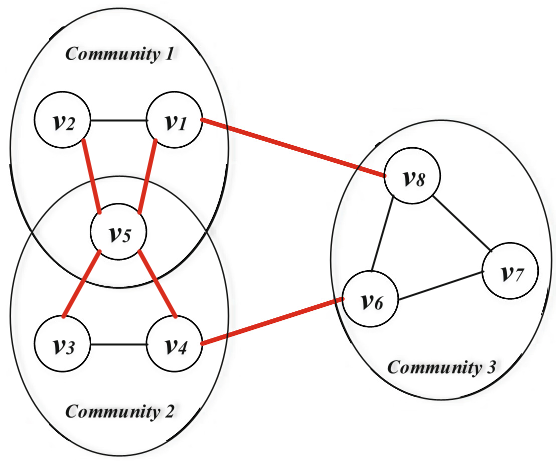 Figure 1: Illustration of bridge links in non-overlapping and overlapping community structures.
3. Influence-Based Centrality
The model also utilizes Sum of Betweenness Centrality (SBC). Since bridges often connect influential "brokers" of different communities, looking for nodes with high betweenness proves to be a powerful signal.
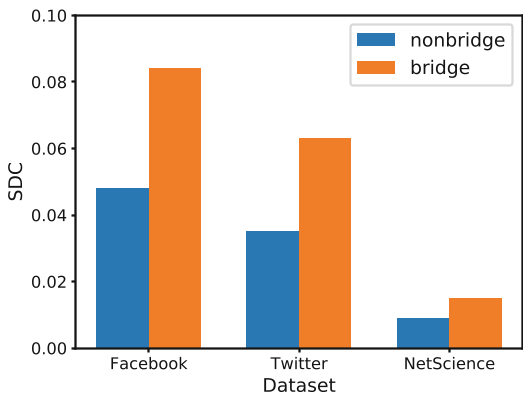 Figure 2: Statistical evidence showing that bridge links (orange) consistently involve nodes with higher Betweenness and Degree centrality compared to non-bridge links.
Experimental Battleground
The authors tested iBridge against a traditional supervised baseline (BLiP) across three distinct networks: Facebook (Social), Twitter (Information), and NetScience (Collaboration).
Key Findings:
- The Bridge Advantage: In Facebook, iBridge reached an AUC of 0.9883, a massive leap from the baseline's 0.8198.
- Robustness: Unlike many specialized models, iBridge doesn't trade off general accuracy. It remains competitive—and often superior—when predicting all types of links, not just bridges.
- The Science Exception: In NetScience, the improvement was smaller. The authors suggest this is because collaboration networks already value "interdisciplinary" ties, making the distinction between bridge and non-bridge links more fluid.
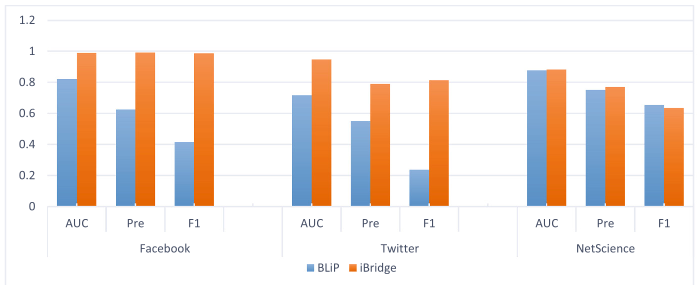 Figure 3: Performance metrics on the Facebook dataset highlighting the significant Precision and F1-score gains in non-overlapping communities.
Critical Analysis & Future Outlook
iBridge successfully moves the needle from "Will they connect?" to "Should they connect for maximum impact?" However, the reliance on manual community detection (Louvain/SLPA) remains a bottleneck.
The future of this work likely lies in Representation Learning. Instead of manually crafting "biased" versions of 20-year-old metrics like Jaccard, we could use Graph Neural Networks to learn "bridging embeddings" directly from the topology.
Summary Takeaway
If you are building a recommendation engine or a public health spread-prevention model, iBridge proves that overlooking the community context of a potential link is a missed opportunity. Predicting the bridge is the key to controlling the flow of information.