
Inferring Social Ties: Bridging Heterogeneous Networks via Social Theories
Inferring social ties across heterogenous networks
The paper introduces a Transfer-based Factor Graph (TranFG) model designed to infer social relationship types (e.g., advisor-advisee, trust, friendship) across heterogeneous networks. By bridging different domains using universal social theories—such as social balance, structural holes, and social status—the model achieves SOTA performance, specifically improving F1-scores by 8-28% on tasks like identifying manager-subordinate roles in email networks using academic data.
TL;DR
How do you identify a "manager-subordinate" relationship in an email network if you only have labeled data for "advisor-advisee" pairs in academia? This paper proposes TranFG (Transfer-based Factor Graph), a framework that uses universal social theories—like the fact that "the friend of my friend is my friend"—to transfer knowledge across seemingly unrelated networks. It achieves up to 28% improvement over standard classification models.
The Problem: The "Silent" Social Graph
Our online lives are messy and unlabeled. While we "follow" people on Twitter or "connect" on LinkedIn, we rarely categorize them as "family," "best friend," or "boss." For researchers, this lack of labels is a bottleneck. Furthermore, models built for one platform (like a co-author network) usually break when applied to another (like an email dump) because the features—number of papers vs. number of emails—simply don't match.
The Insight: Social Psychology as a Universal Language
The authors bridge this gap with a brilliant intuition: human social behavior is governed by universal rules, regardless of the medium. They focus on four pillars:
- Social Balance: In friendship networks, triads tend to reach equilibrium (e.g., if A and B trust C, they are likely to trust each other).
- Structural Holes: Individuals who bridge different communities (structural hole spanners) have unique interaction patterns.
- Social Status: In hierarchical relationships, triads follow an acyclic status ordering (A is higher than B, B is higher than C A is higher than C).
- Two-Step Flow: Opinion leaders (high PageRank) typically hold higher social status.
Methodology: The TranFG Model
The core of the paper is the Transfer-based Factor Graph (TranFG). Unlike a standard classifier, TranFG uses a joint objective function that balances:
- Local Features: Domain-specific data (e.g., h-index in academia).
- Transfer Features: Domain-independent social theories that act as "bridges."
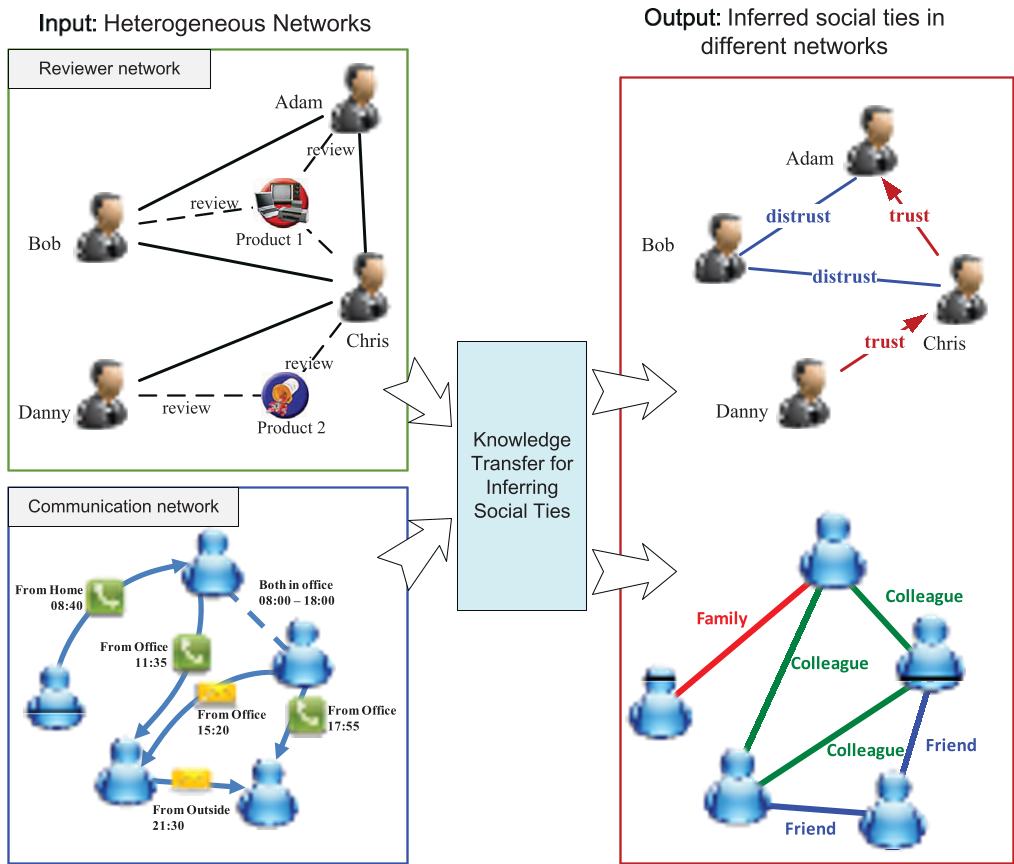 Figure 1: The model architecture uses social theories to bridge a Reviewer network and a Mobile network.
By using Loopy Belief Propagation (LBP), the model iteratively estimates the marginal distribution of relationship labels, effectively "smoothing" its predictions across the network structure based on these global social rules.
Experimental Results: Quantitative Dominance
The authors tested TranFG on five diverse datasets. The most impressive result came from transferring knowledge from the Coauthor network to the Enron email network:
- Baseline (SVM): F1-score ~70%
- TranFG (with Social Status & Opinion Leader): F1-score 86-90%
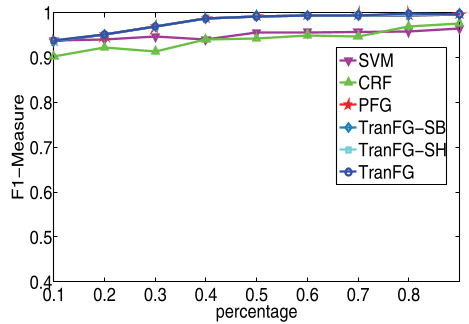 Figure 2: Factor contribution analysis. Removing social balance (SB) or social status (SS) significantly degrades performance, proving these theories are critical.
Case Study: Correcting the Bias
In a sub-graph of academic co-authors, standard models (PFG/SVM) often mistake colleagues for advisors because they only look at local publication counts. TranFG, however, recognizes that the triad structure "Azar-Amos-Leonardi" is statistically more likely to follow a specific status pattern found in other networks, successfully correcting these "mistakes" by leveraging global structural intuition.
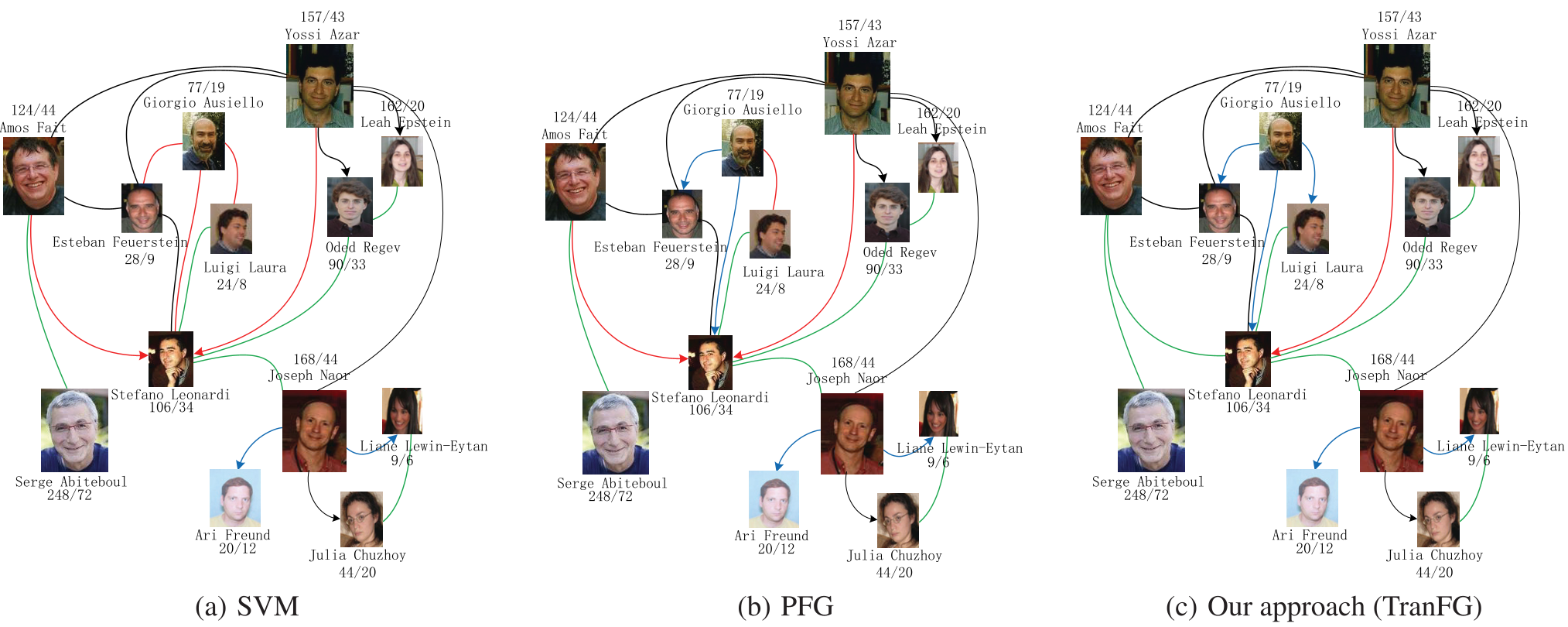 Figure 3: Case study highlighting how TranFG corrects advisor-advisee misclassifications (red = error).
Critical Analysis & Conclusion
The beauty of this work lies in its simplicity and grounding. Instead of chasing more complex neural architectures (which were less prevalent in 2012), it looks toward established sociology to find "invariant features."
Limitations:
- The model assumes a static network, whereas social ties are often dynamic.
- Enumerating all triads (cliques) can be computationally expensive as networks scale to billions of nodes, though the authors proposed a linear-time approximation.
Future Outlook: This work identifies a "social grammar" that remains relevant today. Modern GNNs often struggle with out-of-distribution (OOD) transfer; incorporating these explicit "social laws" as inductive biases could potentially make modern deep learning models much more robust across diverse social platforms.