
Inferring Social Trust: An Evidence Theory Approach to Navigating Digital Relationships
Inferring trust relationships in the social network: Evidence theory approach
This paper proposes a quantitative model to infer trust, distrust, and uncertainty in online social networks by leveraging user interactions and Dempster-Shafer Evidence Theory. By modeling social links as Friendship, Family, or Professional relationships, the authors establish a framework for calculating direct trust and propagating it to strangers through intermediate nodes.
TL;DR
In the digital age, how do we decide who to trust? This paper introduces a mathematical framework that calculates Trust, Distrust, and Uncertainty based on actual social interactions—likes, comments, and time spent chatting. By applying Dempster-Shafer Evidence Theory, the authors provide a way to "triangulate" trust for strangers by combining the opinions of mutual acquaintances, effectively reducing the "fog of uncertainty" in online social networks.
Background: Beyond Binary "Followers"
Most social platforms treat trust as a binary (Friend or Not Friend). However, human trust is subjective and nuanced. The authors argue that trust is derived from direct experience and is influenced by the context of the relationship (Family vs. Professional). The goal is to move from simple connectivity to a "weighted" social graph where we can predict trust even between users who have never met.
The "Why": Why Evidence Theory?
Traditional Bayesian methods struggle when information is missing or conflicting. Dempster-Shafer Theory (DST) is superior here because:
- Uncertainty Modeling: It explicitly represents "I don't know" rather than forcing a probability into "True" or "False".
- Evidence Fusion: It provides a formal rule (Dempster’s Rule of Combination) to merge opinions from three different friends who might have varying levels of confidence in a third party.
Methodology: The Trust Calculus
1. The Interaction Metrics
The model calculates trust using four behavioral rates:
- Sharing Rate (): Relevance of content.
- Commenting Rate (): Depth of engagement.
- Like Rate (): Positive affirmation.
- Communication Time (): The most critical indicator of intimacy.
These are weighted by relationship factors: .
2. Inferring Trust via Intermediaries
If User A trusts B, and B trusts E, how much should A trust E? The paper defines a transitivity rule:
3. Combining Opinions (Multi-Path Fusion)
When A has multiple neighbors (B, C, D) who all know E, the system uses the DST combination rule to aggregate these views.
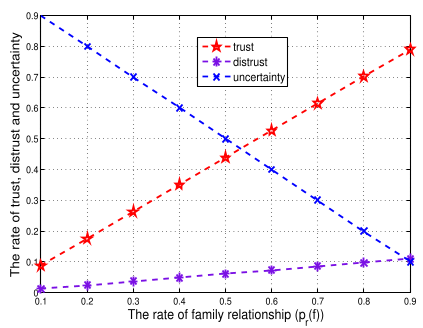 Figure 1: Scenario showing trust inference for a stranger (H) via multiple paths (B, C, D).
Experiments and Results
The authors simulated a network of 8 nodes with varying interaction levels.
Key Findings:
- Uncertainty Reduction: Using a single path (), uncertainty was roughly 0.21. However, after combining evidence from three paths, the combined uncertainty dropped to 0.024.
- Relationship Synergy: Family ties provide a faster "ramp-up" in trust levels compared to professional or casual friendship ties.
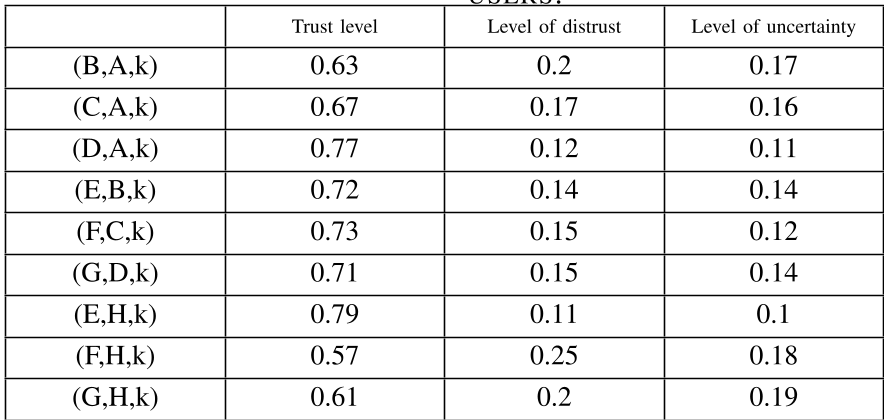 Table 1: Trust, Distrust, and Uncertainty values calculated across different node pairs.
Critical Insight: The Value of "I Don't Know"
The standout contribution here is the explicit tracking of the Uncertainty Level (). In high-stakes environments (like online marketplaces), knowing that you lack sufficient data (high uncertainty) is more valuable than receiving a "guessed" trust score. The model reveals that as social interaction strength crosses a specific threshold (~0.5), trust doesn't just grow—uncertainty collapses.
Conclusion and Future Work
While the current model is robust, it relies on manually tuned reward factors (). The authors suggest that future work should incorporate content similarity and user identity verification to protect against "Sybil attacks" or malicious actors who might fake interactions to build artificial trust.
Takeaway: In the future of decentralized social media, algorithms like this could provide the "reputation layer" needed to filter out bots and bad actors without relying on a central authority.