
Beyond Followers: Fusing Multi-Relational Evidence for Twitter Influence
Influence Assessment in Twitter Multi-relational Network
The paper introduces a novel influence assessment framework for Twitter using a Belief Diffusion Network to model multi-relational interactions. It employs a modified conjunctive combination rule from Belief Functions Theory to fuse multiple influence markers—retweets, mentions, and replies—into a unified global influence score.
TL;DR
Quantifying influence on Twitter is often reduced to simple counts like follower numbers, which fails to capture the complexity of real-world persuasion. This paper proposes a Belief Diffusion Network based on Belief Functions Theory to fuse different interaction markers (retweets, mentions, replies). By treating interactions as pieces of evidence under uncertainty, the authors provide a more robust way to rank political candidates during the 2014 European Elections.
Background Positioning
In the landscape of Social Network Analysis (SNA), we have moved from simple centrality measures (like PageRank) to topic-sensitive models (like TwitterRank). This paper positions itself as a theoretical advancement in information fusion, addressing the "Uncertainty" and "Multi-relational" nature of Twitter that standard algorithms often ignore.
Problem & Motivation: The Weighting Dilemma
Why is measuring influence so hard?
- Diversity of Markers: Is one retweet worth two mentions? Or three replies? Assigning fixed weights is arbitrary and fails across different contexts (e.g., a "reply" in a political debate vs. a "reply" in customer service).
- The Uncertainty Factor: Most models assume 100% certainty in the meaning of a link. In reality, our knowledge of a user's influence is often partial or "noisy."
The authors argue that we need a mathematical framework that can handle partial ignorance—knowing that we don't know the full story.
Methodology: The Belief Diffusion Network
The core innovation is the application of the Dempster-Shafer Theory (Evidence Theory) to a graph structure.
1. Frame of Discernment
The authors define a set of influence degrees ranging from Very Weak to Extremely Strong. Unlike traditional probability, belief functions allow mass to be assigned to the set itself, representing total ignorance.
2. Information Fusion
When a user retweets user , it provides "evidence" of 's influence. The paper uses a modified conjunctive combination rule to merge these pieces of evidence.
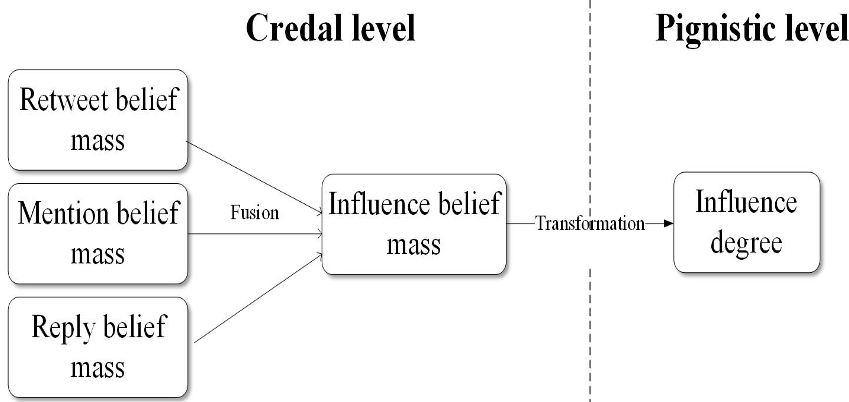 Figure 1: The workflow from raw Twitter data to Pignistic Probability (decision-making).
3. The Composition Rule
The authors define a specific operation to determine how two influence masses interact. Crucially, they prove that this operation is non-associative, meaning the order of evidence combination matters—a reflection of how influence builds over time in real social scenarios.
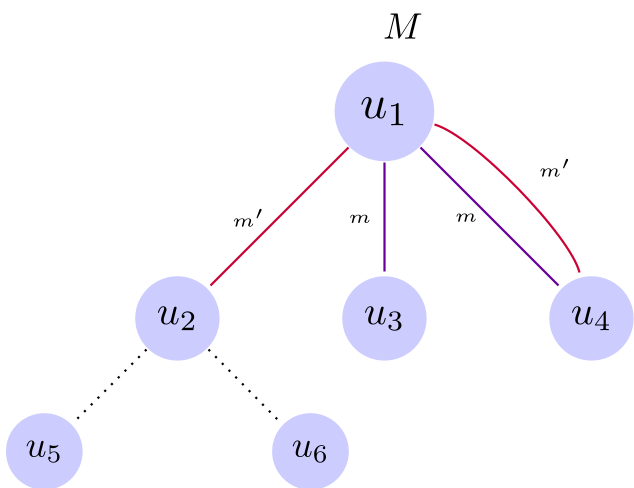 Figure 2: Multi-relational links (colors) contributing to the global belief mass of a central node.
Experiments & Results: The European Election 2014
The model was tested on a massive corpus of 37 million tweets.
SOTA Comparison: Beyond Single Metrics
The research compared candidates like Marine Le Pen and Nigel Farage. A key finding was that looking at retweets alone or mentions alone produces different rankings. By using the belief fusion approach, the authors generated a Global Influence Degree.
| Candidate | Influence Degree | Belief Mass |
|---|---|---|
| Marine Le Pen | E.Strong | 0.817 |
| Florian Philippot | V.Strong | 0.583 |
| Jean-Luc Mélenchon | V.Strong | 0.796 |
The study found that as the number of interactions increases, the belief mass "converges" toward stronger influence categories. However, to prevent all popular candidates from immediately hitting "Extremely Strong," the authors implemented a rescaling factor (), demonstrating the practical challenges of applying theoretical math to "Big Data" social scales.
Critical Analysis & Conclusion
The Takeaway
The shift from "Probability" to "Belief" is significant. It allows researchers to quantify not just how much influence a user has, but how certain we are about that estimation based on the available evidence.
Limitations
- Computational Complexity: Combining masses via the conjunctive rule can be expensive as the frame of discernment grows.
- Static Nature: While the paper mentions temporal data collection, the current model evaluates a "snapshot" of influence rather than a real-time flux.
- Indirect Influence: The authors acknowledge that the current model focuses on direct neighbors; "influence hops" (A influences B who then influences C) are yet to be fully integrated into the belief mass diffusion.
In conclusion, this paper provides a rigorous mathematical bridge between Evidence Theory and Social Network Analysis, offering a sophisticated tool for anyone needing to navigate the noisy waters of digital influence.