
Influential Team Formation: Balancing Viral Outreach and Team Connectivity
Influence Maximization-Based Event Organization on Social Networks
This paper introduces the Influential Team Formation (ITF) problem, which combines Team Formation (TF) and Influence Maximization (IM) to organize social events. It proposes the Influence-Cost Ratio (ICR) metric and develops efficient algorithms (M-Greedy and SimIS) to find a well-connected team of experts that maximizes information spread while minimizing communication overhead.
TL;DR
Organizing a successful social event requires more than just influential people; it requires a team that can work together. This paper proposes Influential Team Formation (ITF), a framework that selects a set of experts who not only cover the necessary topics and spread the word effectively but also remain closely connected in the social graph to facilitate low-cost communication.
The Conflict of Interest: Reach vs. Communication
Why is event organization different from typical Influence Maximization (IM)?
- Influence Maximization (IM): Tends to pick "isolated giants." To cover the most ground, IM algorithms select seeds that are far apart to avoid overlapping circles of influence. This is great for a viral marketing campaign but terrible for a team that needs to coordinate.
- Team Formation (TF): Focuses on "cliques." It looks for people with the right skills who are very close to each other. While communication is easy, their combined social reach is often redundant and limited.
The authors identify this fundamental tension and propose the Influence-Cost Ratio (ICR) to find the "sweet spot" between these two extremes.
Methodology: Optimizing for ICR
The core of the paper is the definition of ICR(S): Where:
- is the Influence Spread (expected number of nodes reached).
- is the Communication Cost (sum of all-pair shortest path lengths between team members).
High-Level Algorithms
Since the problem is NP-hard, the authors propose three primary solutions:
- ICR-Greedy: An iterative approach picking the best marginal gain in the ratio.
- M-Greedy (Mixed Influence-Cost): A hybrid that alternates between expanding the influence "frontier" and tightening the "core" connectivity of the team.
- SimIS (Similar Influence Search): A heuristic using Group-PageRank to guide a best-first search, prioritizing nodes that provide both reach and proximity.
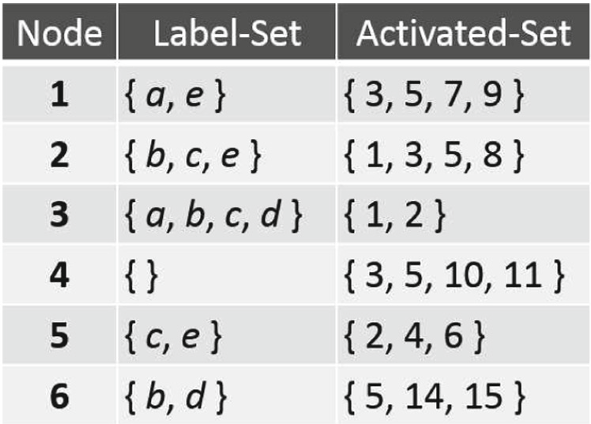 In the figure above, the authors illustrate how ITF finds a triangle structure that offers a superior balance compared to the scattered IM seeds or the hyper-local TF seeds.
Experiments and Real-World Validation
The authors didn't just stop at simulations on Facebook and Google+ data. They applied their ITF model to Meetup—a popular event-based social service.
- Effectiveness: M-Greedy and SimIS consistently outperformed baseline IM and TF methods in achieving a high ICR.
- Efficiency: The proposed heuristic methods maintained low computational overhead, making them viable for large-scale social graphs.
- Real-World Accuracy: When tested against history, the ITF framework was able to successfully predict the actual organizers of high-impact events on Meetup, proving that real-world organizers instinctively optimize for both influence and collaboration.
Critical Insight & Future Outlook
The brilliance of this work lies in its recognition that nodes in a social network are not just data points for diffusion, but human collaborators.
Limitations: The current model uses "shortest path" as a proxy for communication cost, which might oversimplify complex human interactions. Future work could integrate "relationship strength" or "historical collaboration success" into the cost function.
Future Work: As we move toward decentralized autonomous organizations (DAOs) and AI-assisted project management, the ability to algorithmically assemble "Influential Teams" will become a cornerstone of digital social engineering.