
CCIM: Redefining Influence Maximization through the Lens of Community Closeness
Influence Maximization Based on Community Closeness in Social Networks
This paper introduces CCIM (Community Closeness-based Influence Maximization), a novel heuristic algorithm designed to identify influential seed nodes in social networks. By integrating micro-level (point-to-point) and meso-level (point-to-community) influence metrics, the method achieves superior influence spread across both overlapping and non-overlapping community structures.
TL;DR
Influence Maximization (IM) is the art of finding a handful of users who can trigger a massive information cascade. Traditional methods often overlook the "meso-level" density of social groups. The CCIM (Community Closeness-based Influence Maximization) algorithm breaks this limitation by incorporating internal edge density and supporting overlapping communities, outperforming state-of-the-art methods in both synthetic and real-world collaboration networks.
The Missing Dimension: Why "Size" Isn't Everything
In the world of social network analysis, we often assume that larger communities are more influential. However, the authors of this paper identify a critical oversight: Density matters as much as volume.
Imagine two communities, C3 and C4, both with 100 members. If C3 is a loose collection of acquaintances and C4 is a tight-knit family, information will clearly spread faster and more reliably in C4. Prior SOTA methods like CoFIM and IMPC largely ignored this "Community Closeness," treating all nodes within a community as having equal activation potential regardless of the internal topology. Furthermore, they struggled with the reality that most people belong to multiple communities simultaneously (overlapping structures).
 Fig 1: Illustrating (a) why edge density differentiates influence even with equal node counts, and (b) the complexity of overlapping communities.
Methodology: Bridging Micro and Meso Influence
The CCIM framework operates on a dual-level influence measure:
- Micro-Level (Multi-neighbor Influence): It calculates the direct impact on 1-hop neighbors and the indirect impact on 2-hop neighbors. This captures the immediate viral potential of a node.
- Meso-Level (Community Influence): This is the paper's core innovation. It defines Community Closeness as the inverse of the average shortest path between nodes.
- Intra-community Influence: Measures how easily a node can activate its own dense groups.
- Inter-community Influence: Measures the bridge-building potential to neighboring communities.
The total influence is a weighted sum of these components, allowing the algorithm to pick "hub" nodes that are not just locally popular, but strategically positioned within tightly connected clusters.
Experimental Proof: Density Wins
The researchers tested CCIM against established algorithms like Single Discount (SD) and IMPC across diverse datasets.
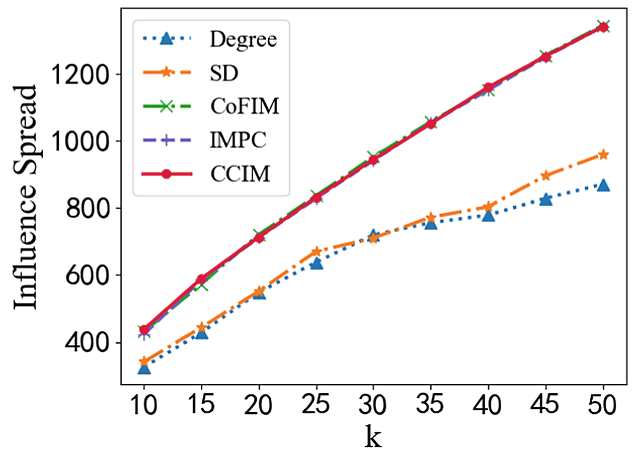 Fig 2: Influence spread comparison across different seed set sizes (k).
Key Findings:
- The "Strong Community" Advantage: On synthetic networks where community structures were strictly defined (low mixing parameter ), CCIM's performance gains were massive. This proves that when communities are distinct, "Closeness" is the most accurate predictor of spread.
- Weight Sensitivity: The ablation studies showed that Intra-community weight () generally plays a more significant role than inter-community weight (). It is more effective to fully saturate a dense local cluster than to spread influence thinly across many sparse groups.
- Overlapping Capability: Unlike many predecessors, CCIM maintained high accuracy in the Epinions dataset, which has a 45.1% community overlap ratio.
Critical Insights & Future Outlook
The CCIM algorithm moves the needle by proving that structural density (closeness) is a vital heuristic for information diffusion. By adopting a marginal gain strategy, it avoids the "influence overlap" problem where selected seeds cover the same ground.
Limitations: Currently, CCIM is designed for homogeneous networks (one type of node/link). As the authors suggest, the next frontier is applying these meso-level insights to heterogeneous networks—think LinkedIn, where relationships (colleague, classmate, follower) have different "closeness" weights.
The takeaway for practitioners is clear: when looking for influencers, don't just look for those with the most followers; look for those embedded in the most "reachable" communities.