
MIF & IMGA: Decoding Influence Through Heterogeneous Social Connections
An Influence Model Based on Heterogeneous Online Social Network for Influence Maximization
This paper introduces the Measuring Influence (MIF) model and the Influence Maximization Greedy Algorithm (IMGA) for identifying optimal seed sets in heterogeneous social networks. By integrating interactions, social friendships, tags, and topic interests, the method achieves superior influence spread compared to traditional IC and LT models.
TL;DR
Determining who the real "influencers" are in a sea of data is a complex task. This paper proposes the Measuring Influence (MIF) model, which looks beyond simple follower counts to analyze interactions, common interests (tags), social circles, and topic expertise. Combined with the IMGA greedy algorithm, it identifies seed nodes that trigger significantly larger information cascades than traditional models like IC or LT.
Problem & Motivation: The Heterogeneity Gap
Most prior work treats social networks as homogeneous graphs—just nodes and edges. In reality, a social network contains heterogeneous data: the tags a user chooses, the specific messages they interact with, and the time they take to respond (latency).
Existing models like Independent Cascade (IC) or Linear Threshold (LT) often fail because:
- They ignore the "why" behind an interaction (e.g., shared interests vs. accidental clicks).
- They don't account for the temporal dynamics of influence.
- They lack a mechanism to integrate varied data sources like user tags and message content.
The authors' insight is simple: influence is multi-dimensional. You are influenced by people who share your interests, have the same friends, and discuss topics you care about.
Methodology: The Four Pillars of Influence
The MIF model calculates a Comprehensive Influence score by fusing four specific sub-models:
- Interaction-Based (): Measures how often and how quickly user v responds to user u. It utilizes an exponential decay function to reward low-latency interactions.
- Friendship-Based: Uses TF-IDF on neighbor sets to see if users "move in the same circles."
- Tag-Based: Analyzes user tags to find personality/interest overlaps.
- Topic-Based: The most complex pillar, it builds a bridge from User Message Message Similarity User to see if influencer u talks about things that follower v actually finds relevant.
Model Architecture
The integration of these factors allows for a more holistic view of the network's influence pathways.
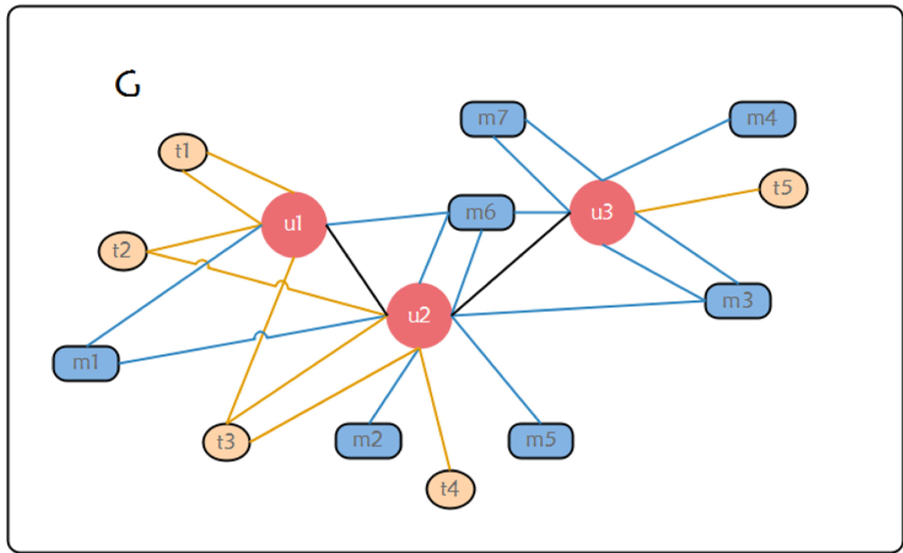 (Note: Fig 1. represents the complex correlation between heterogeneous nodes: users, tags, and messages.)
The IMGA Algorithm
Since finding the absolute best seed set is NP-hard, the authors propose the Influence Maximization Greedy Algorithm (IMGA). It works by recursively selecting the node that offers the maximum marginal gain in influence, essentially conducting a local simulation of the info-spread to see who brings the most "new" people to the table.
Experiments & Results: Proving the Superiority
The researchers tested MIF against the heavyweights of the field (IC, LT, MIA, CDNF, BBA) using the Flickr dataset and an internal Ego Network of a company.
Key Findings:
- Influence Spread: On the Flickr dataset, with 50 seed nodes, the "Sum of Influence" for MIF was 1002.6, compared to only 346.6 for the standard IC model.
- Real-world Impact: The "Sum of Interactions" (actual comments/likes received by the seed set) was nearly 3x higher than traditional heuristic models, proving that MIF seeds are genuinely more "viral."
- Threshold Trade-offs: To handle the complexity, the authors introduced a threshold () to prune weak connections. This reduced computation time from minutes to seconds with only a minor dip in ranking accuracy.
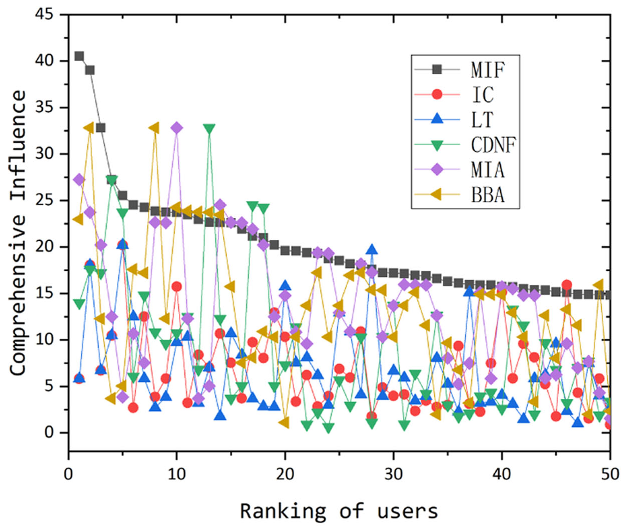 (Note: Results show MIF consistently identifying nodes with higher cumulative influence than competitive baselines.)
Critical Analysis & Conclusion
The MIF model is a milestone in moving from "structural" influence to "contextual" influence. By incorporating interaction latency and topic similarity, it mimics the human psychology of social interaction more closely than a simple directed graph.
Limitations: The model currently doesn't account for sentiment. A user might interact with a message frequently but negatively (e.g., arguing in the comments).
Future Outlook: The next logical step is integrating Natural Language Processing (NLP) to distinguish between positive influence and negative controversy. For marketers and public opinion monitors, MIF provides a sophisticated framework to identify the true hubs of a digital ecosystem.
Takeaway: Influence isn't just about how many people you know; it's about what you say, who shares your tags, and how fast they listen when you speak.