
Analysis of Influence Maximization: Leveraging Series-Parallel Graphs for Scalability
Analysis of influence maximization in large-scale social networks
This paper introduces a novel Influence Maximization (IM) approach for large-scale social networks using the Independent Cascade (IC) model. The core contribution is the utilization of Series-Parallel Graphs (SPG) to approximate influence computation, achieving nearly linear time complexity while maintaining high accuracy.
TL;DR
Influence Maximization (IM) is the art of picking the most "infectious" nodes in a network to trigger a massive information cascade. While the problem is NP-hard, this paper proposes a breakthrough: by approximating complex social structures with Series-Parallel Graphs (SPGs), we can calculate influence in linear time without the massive accuracy loss seen in typical heuristics.
Background & Motivation: The Computational Wall
In the Independent Cascade (IC) model, information spreads like a virus. However, predicting how many people will eventually be "infected" by a seed set is notoriously difficult.
- The Greedy Approach: Provides a approximation but relies on Monte-Carlo simulations, making it painfully slow for millions of users.
- The Heuristic Approach: Methods like PMIA or Degree Discount are fast but often "blind" to the complex intersection of paths, leading to poor influence estimation.
The authors identify a specific graph class—Series-Parallel Graphs—where the "reliability" (or reachability) can be calculated exactly and efficiently.
Methodology: The Power of Series-Parallel Decomposition
The core insight is that if a graph can be reduced to series and parallel compositions, the probability of influence propagates according to simple algebraic rules.
1. The SPG Influence Algorithm
For an edge with probability , influence follows:
- Series ():
- Parallel ():
By representing the graph as a Decomposition Tree, the algorithm recursively computes influence in time.
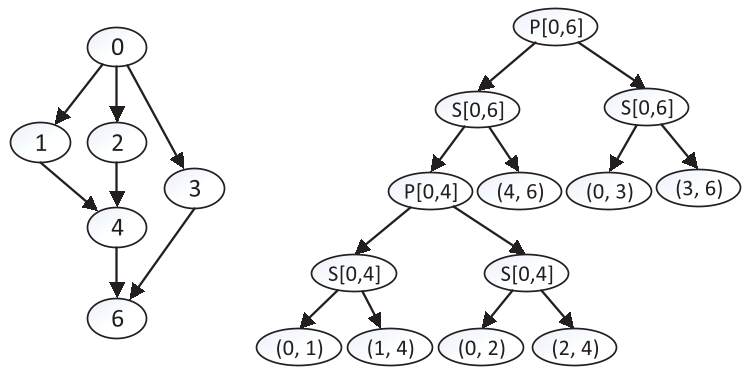
2. Handling General Graphs (MSPG)
Since real social networks aren't perfect SPGs, the authors propose Algorithm 3 (FindMSPG). This heuristic extracts the "Maximum Influence Series-Parallel Subgraph." It starts with the strongest path and iteratively adds "augmenting paths" that maintain the SPG property, ensuring that the most critical influence routes are captured and efficiently calculated.
Experiments: Performance in Community Networks
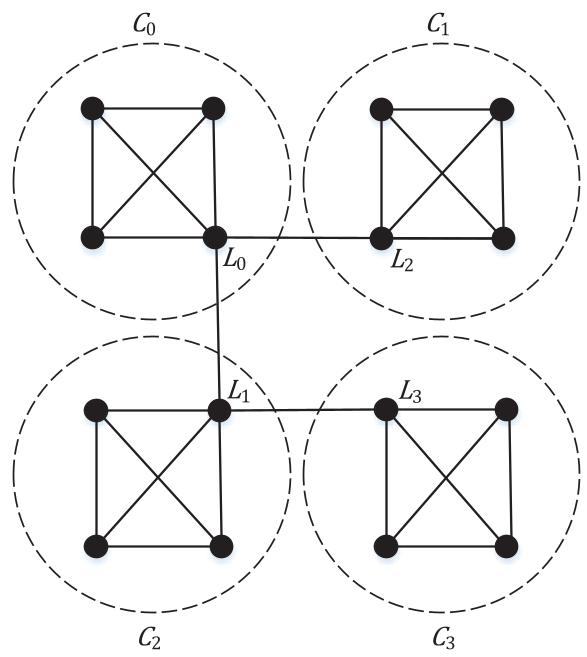
The authors tested their approach on a network of four communities (C0-C3) connected via "leaders." This structure mimics real-world scenarios where information must jump between tightly-knit clusters.
Key Results Comparison
The results highlight a massive gap between MSPG and standard heuristics:
| Method | Total Influence Spread | Accuracy vs. Bound |
|---|---|---|
| MSPG (Ours) | 142 | > 98.6% |
| PMIA / SPM | 30 | ~21% |
| SP1M | 222 (Overestimation) | Fail |
| Theoretical Bound | 144 | 100% |
While PMIA and SPM significantly underestimated the spread by ignoring multi-path effects, and SP1M over-counted, the MSPG method stayed remarkably close to the ground truth.
Deep Insight & Conclusion
The genius of this work lies in recognizing that topology matters more than raw connectivity. By forcing a general graph into a series-parallel structure, we retain the "physical" logic of information flow—where paths either reinforce each other (parallel) or depend on each other (series)—while discarding the computational noise that makes General Graph analysis NP-hard.
Limitations & Future Work
- Constructing MSPGs: The current heuristic for finding the MSPG can still be optimized for even larger datasets.
- Real-world Dynamics: Future iterations intend to incorporate time-decay factors and content relevance into the probabilities, moving from a static topology to a dynamic behavior model.
This research paves the way for real-time viral marketing engines capable of processing global-scale social graphs without needing a supercomputing cluster for Monte-Carlo simulations.